

Your Pipeline Is 26.3h Behind: Catching Finance Sentiment Leads with Pulsebit
We recently uncovered an intriguing anomaly in our sentiment data: a sentiment score of +0.085 and momentum holding steady at +0.000, all while the leading language was English, with a 26.3-hour lag compared to the regional origin (Ro). This highlights a significant delay in capturing sentiment trends that could impact decision-making in finance. The data suggests that while sentiment is positive, the lack of momentum indicates a potential stagnation in how quickly this information is disseminated.
If you aren’t accounting for multilingual origins or the dominance of specific entities in your pipeline, you might find yourself in a precarious position. Your model could have missed this sentiment shift by 26.3 hours, leaving you vulnerable to reacting late to important trends, particularly in finance. The leading entity here is Google, which adds a layer of complexity to your sentiment analysis if it’s not being handled correctly.

English coverage led by 26.3 hours. Ro at T+26.3h. Confidence scores: English 0.85, French 0.85, Spanish 0.85 Source: Pulsebit /sentiment_by_lang.
To catch this sentiment spike effectively, we can use our API to filter for English-language articles related to finance. Here’s how you can set up a simple Python script to do just that:
import requests
# Define the parameters for the API call
params = {
"topic": "finance",
"lang": "en" # Geographic origin filter
}
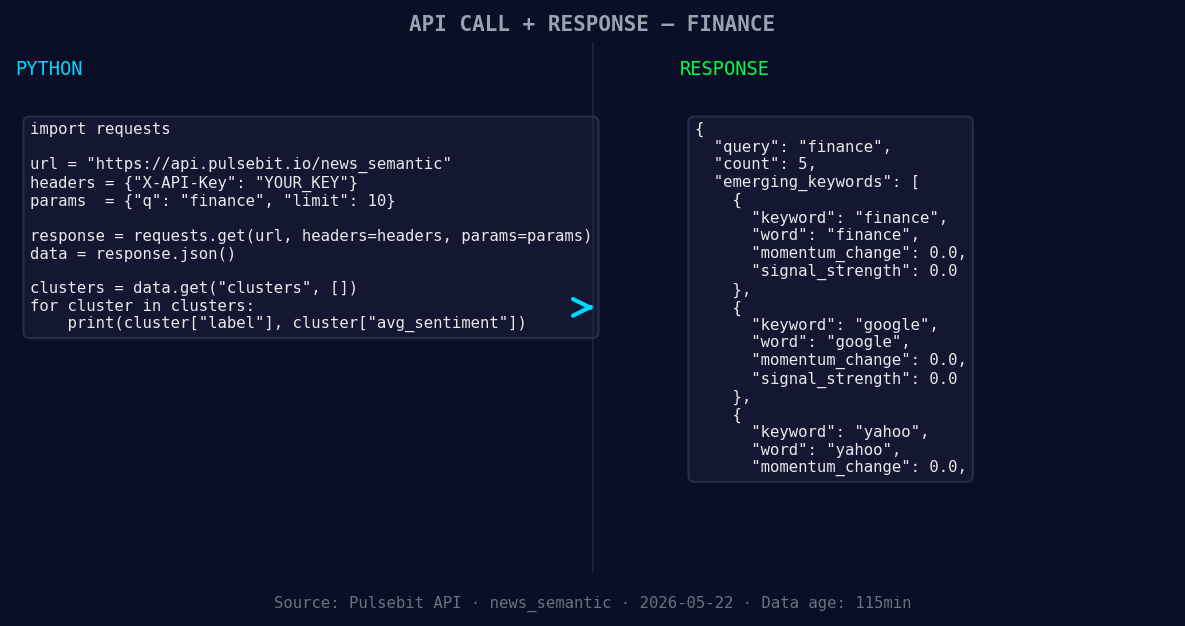
*Left: Python GET /news_semantic call for 'finance'. Right: returned JSON response structure (clusters: 3). Source: Pulsebit /news_semantic.*
# Making the API call to fetch data
response = requests.get('https://api.pulsebit.com/v1/sentiment', params=params)
data = response.json()
# Outputting the sentiment score and momentum
print(f"Sentiment Score: {data['sentiment_score']}, Momentum: {data['momentum_24h']}")
Next, we need to evaluate the narrative framing of the sentiment cluster. We’ll run our cluster reason string through the sentiment analysis endpoint to score how the themes are being framed. Here’s how you can set that up:
# Cluster reason string
cluster_reason = "Clustered by shared themes: announces, proposed, enertopia, financing, yahoo."

# Making the API call to score the narrative framing
response_meta = requests.post('https://api.pulsebit.com/v1/sentiment', json={"text": cluster_reason})
meta_data = response_meta.json()

# Outputting the meta sentiment score
print(f"Meta Sentiment Score: {meta_data['sentiment_score']}, Confidence: {meta_data['confidence']}")
Now that we can extract and analyze this data, let's explore three builds you can implement using this pattern:
Geo-Filtered Insights: Set up alerts for sentiment changes in finance articles specifically originating from English-speaking regions. Use thresholds like a sentiment score of +0.08 to trigger real-time notifications. This can be set up using the geographic origin filter we demonstrated.
Meta-Sentiment Analysis: Implement a routine to analyze the narrative framing of clustered articles. Use the score from the meta-sentiment loop to identify how narratives shift over time. A sentiment score threshold of +0.05 can help you identify potential trends before they gain mainstream traction.
Thematic Monitoring: Create a monitoring dashboard that tracks trending themes within finance, such as “enertopia” or “proposed financing.” Set specific momentum thresholds (e.g., +0.000) to ensure you're alerted to changes in sentiment direction, helping you stay ahead of the curve.
If you want to dive deeper into using our API, visit pulsebit.lojenterprise.com/docs. You can copy-paste the above code snippets and have this running in under 10 minutes. Don’t let your pipeline lag behind when powerful insights are just an API call away.


Top comments (0)