

Your Pipeline Is 20.5h Behind: Catching Investing Sentiment Leads with Pulsebit
We just uncovered a striking anomaly: a 24h momentum spike of -0.294 in the investing sector. This is noteworthy because such a drop typically indicates a significant shift in sentiment. It’s essential to recognize that the leading language driving this narrative is Spanish, with a 20.5-hour lead time over the rest of the world. This tells us that there’s a crucial conversation happening in the Spanish press that could be influencing perceptions around investing, but if your pipeline doesn’t account for this multilingual aspect, you might be missing key signals.

Spanish coverage led by 20.5 hours. Ro at T+20.5h. Confidence scores: Spanish 0.95, English 0.95, French 0.95 Source: Pulsebit /sentiment_by_lang.
Now, imagine your model missed this by 20.5 hours. You’d be operating on outdated sentiment, potentially leading to poor decision-making. The Spanish media is currently highlighting Acadia Healthcare's SWOT analysis, framing it in a way that could change investor perceptions. Yet, if your pipeline is only focused on English sources, you’re likely blind to this critical shift happening right now.
Let’s dive into how we can leverage our API to catch this momentum shift effectively. We'll filter for Spanish content and analyze the narrative shaping this particular sentiment.
Here’s how you can do this in Python:
import requests
# Set the parameters for your API call
topic = 'investing'
lang = 'sp' # Spanish
momentum = -0.294
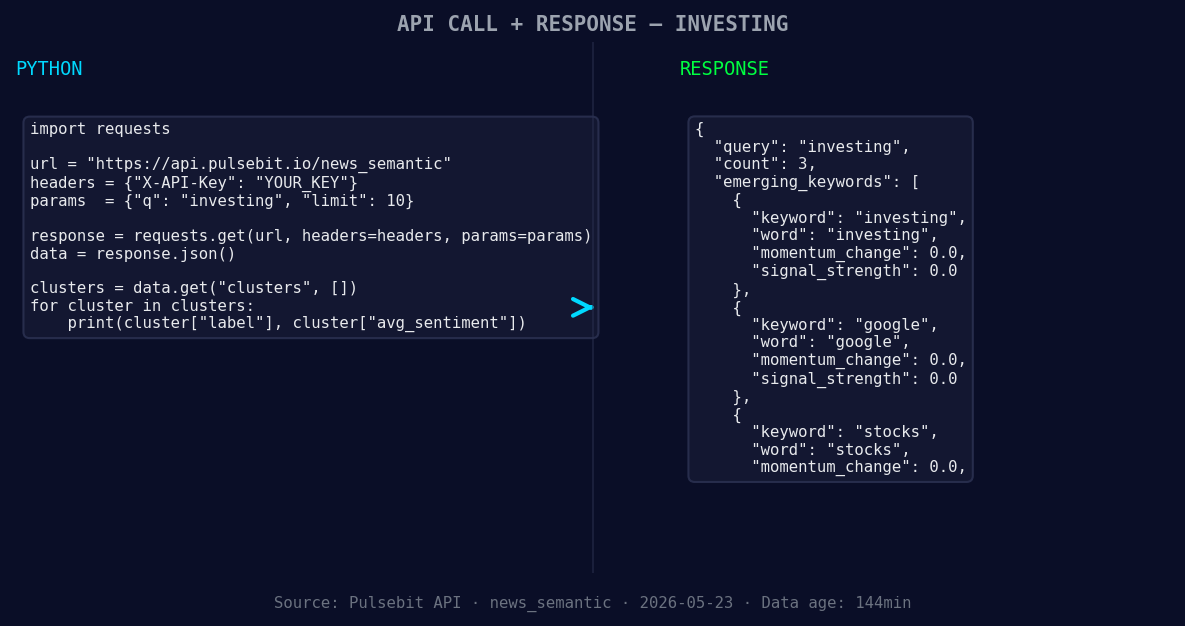
*Left: Python GET /news_semantic call for 'investing'. Right: returned JSON response structure (clusters: 3). Source: Pulsebit /news_semantic.*
# Fetch sentiment data for Spanish articles
response = requests.get(f'https://api.pulsebit.com/v1/sentiment?topic={topic}&lang={lang}')
data = response.json()
# Print the response for debugging
print(data)
# Now, let's analyze the narrative framing
cluster_reason = "Clustered by shared themes: healthcare’s, swot, analysis:, stock, navigates."
sentiment_response = requests.post('https://api.pulsebit.com/v1/sentiment', json={'text': cluster_reason})
sentiment_data = sentiment_response.json()
# Print the sentiment analysis of the cluster
print(sentiment_data)
In this code, we first query our API for sentiment data filtered by language. Specifically, we’re looking for the topic of “investing” in Spanish. The response will give us insights into how this topic is being framed in that language. Next, we utilize the narrative framing we gathered to analyze how it influences broader sentiment.
Now that we have a handle on how to fetch and score sentiment from non-English sources, let’s consider three builds we can create using this pattern:
Geo-Filtered Alert System: Set up a notification system that triggers when momentum drops below a threshold (like -0.294) for Spanish content on investing. This will help you stay ahead of sentiment shifts by focusing on regional discussions.
Meta-Sentiment Dashboard: Create a dashboard that visualizes the sentiment of clustered narratives. Use the meta-sentiment loop to display how different themes (like “healthcare’s, SWOT, analysis”) are evolving over time. This will help you understand not just what's being said, but how it's being framed.
Investment Trend Analyzer: Build an application that continuously monitors and compares the sentiment scores of Spanish articles against mainstream English content. This could help identify potential divergences in sentiment around topics like "investing", "stocks", and "Google", allowing for better-informed decisions.
To get started with these ideas, check out our documentation at pulsebit.lojenterprise.com/docs. You can copy-paste the code examples above and run them in under 10 minutes, giving you immediate access to the powerful sentiment data that can reshape your investing strategies.

Geographic detection output for investing. India leads with 1 articles and sentiment +0.85. Source: Pulsebit /news_recent geographic fields.


Top comments (0)