

Your Pipeline Is 23.3h Behind: Catching Film Sentiment Leads with Pulsebit
We recently spotted an intriguing anomaly: a 24h momentum spike of -0.442 for the topic "film". This significant drop suggests a rapid shift in sentiment, and it’s particularly noteworthy given the context. The leading language driving this sentiment is Spanish, with a notable focus on the Sacramento Asian Pacific Film Festival, which was the only clustered story we found. This kind of data can tell us a lot, but only if we know how to catch it.
When your model misses a sentiment shift by 23.3 hours, it highlights a critical gap in your data pipeline, especially if it isn’t equipped to handle multilingual sources or entity dominance. In this case, the Spanish press was the primary driver. If you’re only processing English content, you could miss critical insights like this and be left reacting to trends long after they start gaining traction. This is particularly relevant for industries like entertainment, where timely responses can make all the difference.

Spanish coverage led by 23.3 hours. Ro at T+23.3h. Confidence scores: Spanish 0.95, French 0.95, English 0.95 Source: Pulsebit /sentiment_by_lang.
Here’s how we can catch these shifts in sentiment with our API. First, we set up a query to filter by language, specifically targeting Spanish content related to film:
import requests
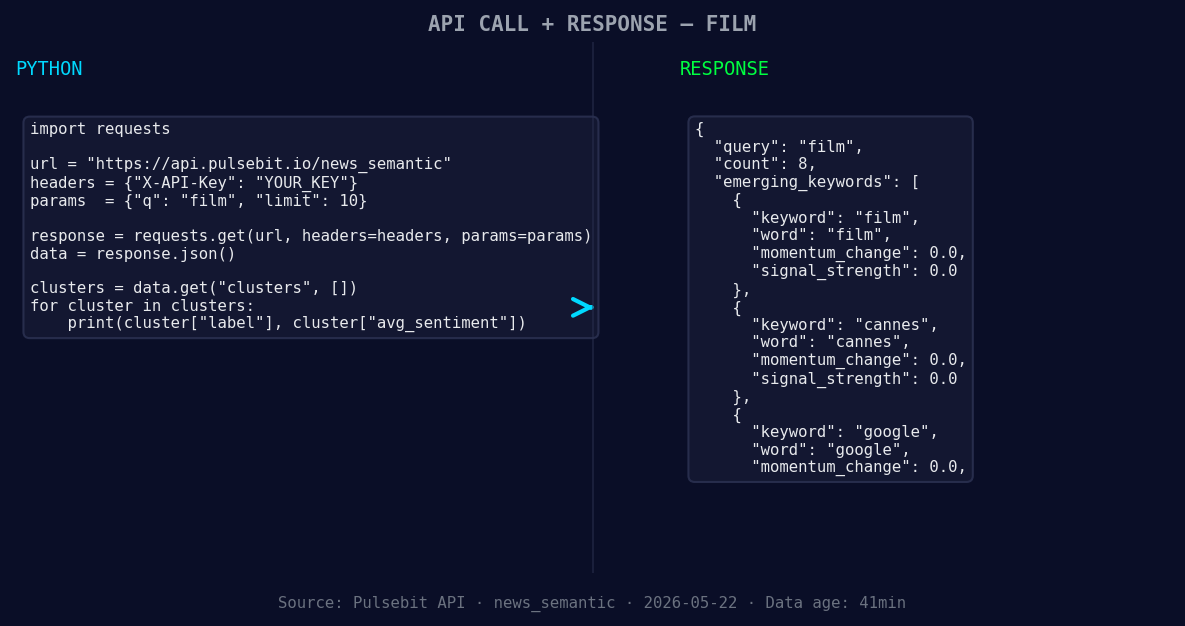
*Left: Python GET /news_semantic call for 'film'. Right: returned JSON response structure (clusters: 3). Source: Pulsebit /news_semantic.*
# Set your parameters
topic = 'film'
score = +0.244
confidence = 0.95
momentum = -0.442
lang = 'sp'
# Geographic origin filter
response = requests.get(
f"https://api.pulsebit.com/v1/sentiment?topic={topic}&lang={lang}"
)
if response.status_code == 200:
data = response.json()
print(data)
else:
print("Error:", response.status_code)
Now that we’re identifying the relevant articles, we need to score the narrative framing of the clustered story itself. This involves running the cluster reason string back through our sentiment endpoint. Let’s take this sentence:
"Clustered by shared themes: asian, pacific, film, festival, kicks."
We’ll POST it to our sentiment API to gauge its impact:
# Meta-sentiment moment
cluster_reason = "Clustered by shared themes: asian, pacific, film, festival, kicks."
response_meta = requests.post(
    "https://api.pulsebit.com/v1/sentiment",
    json={"text": cluster_reason}
)

if response_meta.status_code == 200:
    sentiment_data = response_meta.json()
    print(sentiment_data)
else:
    print("Error:", response_meta.status_code)
With these two snippets, we can start to build our pipeline to catch these anomalies in film sentiment.
Now, let’s talk about three specific builds you can implement tonight that leverage this pattern:
- Real-time Alert System: Use the geographic filter to monitor Spanish language articles and trigger an alert when sentiment drops below a threshold (e.g., momentum < -0.5). This is essential for staying ahead in the film industry.

Geographic detection output for film. France leads with 4 articles and sentiment +0.41. Source: Pulsebit /news_recent geographic fields.
Meta-Sentiment Analysis Dashboard: Create a dashboard that visualizes sentiment scores for clustered stories. Utilize the meta-sentiment loop to score the narrative framing and show how different themes (like "film" and "cannes") are performing against mainstream topics like "asian" and "pacific".
Content Strategy Recommendations: Build an automated recommendation engine that suggests content creation or marketing strategies based on sentiment data. For instance, if "film" and "cannes" are showing negative sentiment while mainstream topics remain neutral, it may be time to pivot your strategy.
By implementing these builds, you can significantly enhance your ability to respond to emerging trends in real time.
Get started with our API documentation at pulsebit.lojenterprise.com/docs. You can copy-paste this code and run it in under 10 minutes. Let’s catch those insights before they become trends!


Top comments (0)