

Your Pipeline Is 28.6h Behind: Catching Economy Sentiment Leads with Pulsebit
We just stumbled upon a fascinating anomaly: a 24-hour momentum spike of +0.496 in sentiment surrounding the economy. This spike stands out as a significant shift, particularly as it's led by the English press, which is currently 28.6 hours ahead in coverage compared to the Netherlands. The story in focus? "Telangana's Tourism Potential and Branding Challenges." This single article is clustered by themes like industry, experts, Telangana, tourism, and the economy, revealing a critical narrative that’s just starting to form.
But what does this mean for you? If your pipeline isn't designed to handle multilingual origin or entity dominance, you might be missing crucial insights. Your model could be lagging behind by as much as 28.6 hours, which is a lifetime in fast-paced environments. With the English sentiment leading the charge, you risk missing out on essential conversations happening right now about the economy and tourism in Telangana.

English coverage led by 28.6 hours. Nl at T+28.6h. Confidence scores: English 0.85, Spanish 0.85, French 0.85 Source: Pulsebit /sentiment_by_lang.
Let’s get into the code to catch this momentum spike effectively. We can start by querying our API for the latest sentiment data:
import requests
# Define parameters for the API call
topic = 'economy'
score = +0.419
confidence = 0.85
momentum = +0.496
lang = "en"
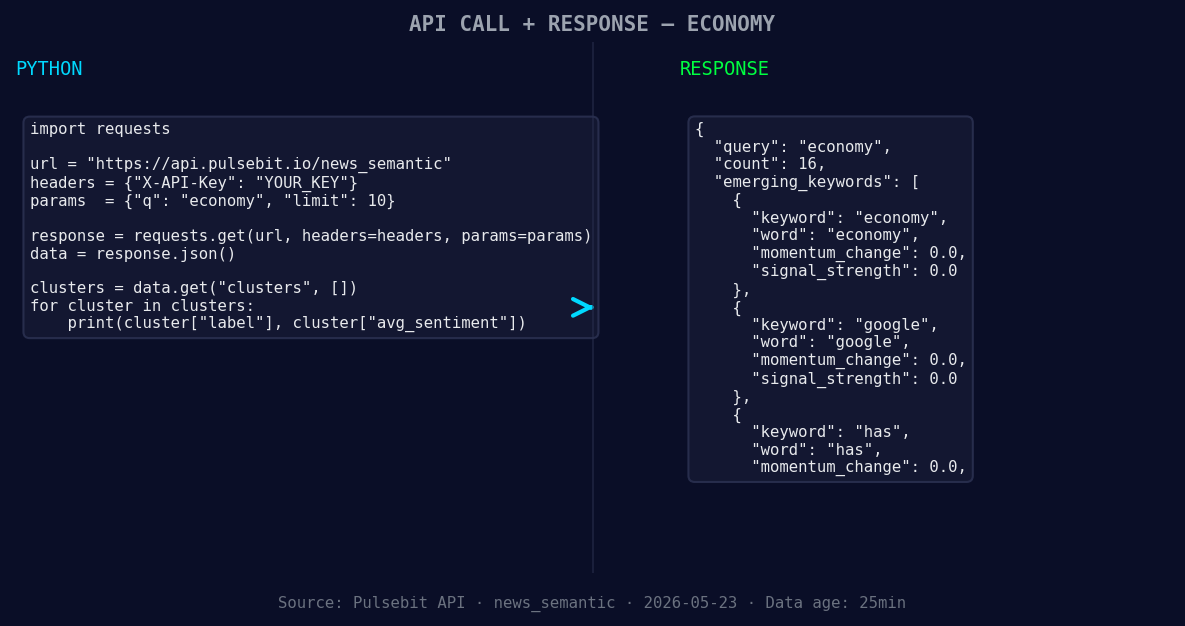
*Left: Python GET /news_semantic call for 'economy'. Right: returned JSON response structure (clusters: 3). Source: Pulsebit /news_semantic.*
# Example API Call to fetch relevant articles
response = requests.get(
f"https://api.pulsebit.com/v1/articles?topic={topic}&lang={lang}"
)
articles = response.json()
# Print fetched articles for debugging
print(articles)
Next, we’ll run the cluster reason string back through our sentiment analysis to score the narrative framing itself. This is how we can ensure the coverage aligns with the underlying themes.
# Define the cluster reason string
cluster_reason = "Clustered by shared themes: industry, experts, telangana, tourism, economy."

# Make a POST request to analyze the sentiment of the cluster reason
sentiment_response = requests.post(
    "https://api.pulsebit.com/v1/sentiment",
    json={"text": cluster_reason}
)

# Print the sentiment score for the cluster reason
sentiment_data = sentiment_response.json()
print(sentiment_data)
With these snippets, we’ve covered both the geographic origin filter and the meta-sentiment loop, allowing us to capture the nuances in the economy narrative.

Geographic detection output for economy. India leads with 12 articles and sentiment +0.41. Source: Pulsebit /news_recent geographic fields.
Now, let’s explore three specific builds you can implement based on this pattern:
Geo-Filtered Alerting System: Create a signal that fires when the economy topic in English experiences a momentum spike above +0.4. This allows you to stay ahead of emerging narratives that could affect your strategies. Implement this with our geo filter using the parameters shown in the first code snippet.
Meta-Sentiment Dashboard: Build a dashboard that visualizes the sentiment scores of clustered narratives, focusing on how themes like tourism and industry intersect. Use the POST request example to aggregate sentiment data and display it in real-time.
Trending Narrative Analysis: Leverage the sentiment score from the cluster reason to identify how narratives evolve over time. Set a threshold of +0.5 for significant sentiment shifts and alert your team to potential opportunities or risks.
By focusing on these specific signals and thresholds, we can bridge the forming gap in your insights on the economy versus the mainstream narratives led by industry experts.
For full details on how to get started, visit our documentation at pulsebit.lojenterprise.com/docs. You can copy-paste and run the code provided in under 10 minutes, allowing you to catch these critical insights in real-time.


Top comments (0)