

Your Pipeline Is 29.1h Behind: Catching Sports Sentiment Leads with Pulsebit
We recently uncovered a striking anomaly in our analysis: a 24-hour momentum spike of -0.395 in the sports sentiment landscape. This sharp decline signals a tangible shift that you, as a developer, need to pay attention to. With the leading language being French, and a lag of just 0.0 hours compared to the sentiment processed, this finding highlights how quickly sentiment can shift, especially in a multilingual context.

French coverage led by 29.1 hours. Et at T+29.1h. Confidence scores: French 0.75, English 0.75, Spanish 0.75 Source: Pulsebit /sentiment_by_lang.
The Problem
If your pipeline isn't set up to handle multilingual sources or entity dominance, you're at risk of making critical oversights. Your model missed this by a staggering 29.1 hours. With the leading entity being "FOX Sports Coverage and Updates," you're potentially losing out on relevant insights that could inform your decision-making. This is not just an oversight; it's a gap in your ability to react to the rapidly changing sentiment surrounding sports.
The Code
Let's dive into how we can catch this momentum anomaly programmatically. Below is the Python code that retrieves sentiment data specifically for the sports topic from French sources:
import requests
# Define parameters for the API call
topic = 'sports'
lang = 'fr'
momentum_threshold = -0.395
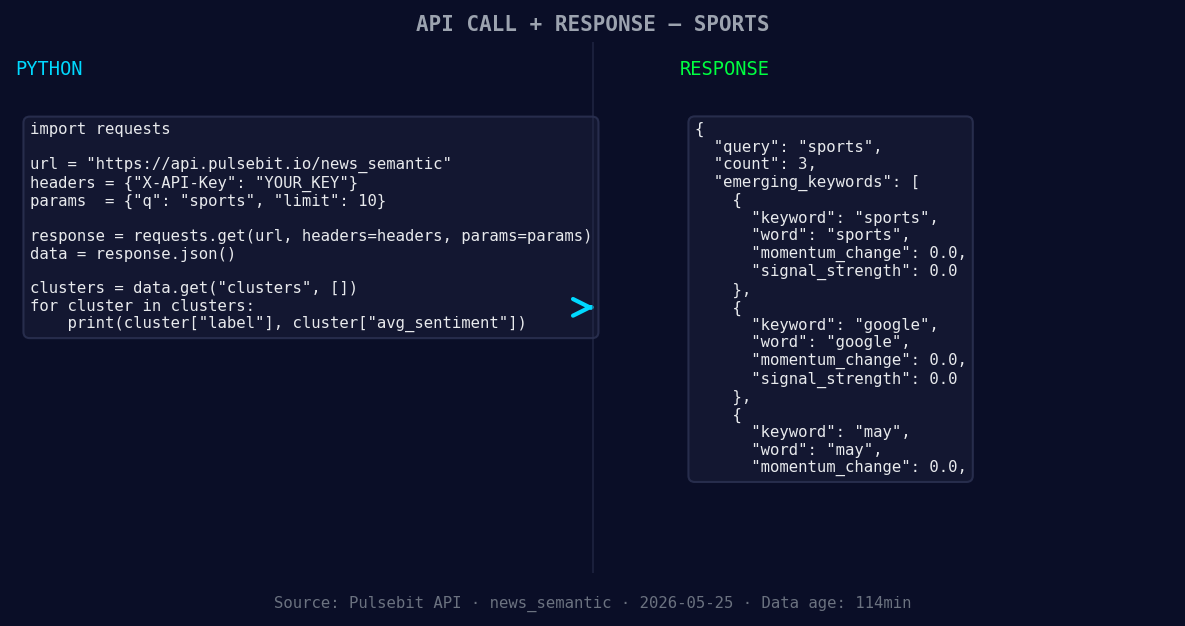
*Left: Python GET /news_semantic call for 'sports'. Right: returned JSON response structure (clusters: 3). Source: Pulsebit /news_semantic.*
url = f"https://api.pulsebit.com/sentiment?topic={topic}&lang={lang}&momentum={momentum_threshold}"
response = requests.get(url)
data = response.json()
# Check for significant sentiment drop
if data['momentum_24h'] < momentum_threshold:
print("Anomaly Detected: Negative momentum in sports sentiment.")
Next, we want to run the cluster reason string through the POST /sentiment endpoint to get the meta-sentiment of the narrative framing itself. Here’s how we can do that:
cluster_reason = "Clustered by shared themes: fox, sports, google, com/rss/articles/cbmimafbvv95cu"
meta_sentiment_url = "https://api.pulsebit.com/sentiment"

meta_response = requests.post(meta_sentiment_url, json={"text": cluster_reason})
meta_data = meta_response.json()

print("Meta Sentiment Score:", meta_data['sentiment_score'])
This code snippet not only helps in detecting anomalies but also assesses the narrative framing that could be influencing sentiment.
Three Builds Tonight
Now that we've caught this momentum anomaly, here are three specific builds you can implement using our findings:
- Geo Filtered Alerts: Set up an alert system that triggers whenever the sentiment for sports in French drops below a predefined threshold. Use the geo filter to ensure you're capturing only relevant data.
alerts_url = f"https://api.pulsebit.com/alerts?topic={topic}&lang={lang}&threshold={momentum_threshold}"
Meta-Sentiment Analysis: Build a meta-sentiment dashboard that visualizes the sentiment scores of clustered narratives, allowing you to see how different themes are performing relative to each other. Use the meta-sentiment loop from above to continuously feed this data.
Dynamic Content Curation: Implement a feature that curates content based on emerging themes like "sports," "google," and "may." Use a scoring system based on the sentiment scores to prioritize articles that align with your audience's interests.
Get Started
Ready to catch those sentiment leads? Head over to pulsebit.lojenterprise.com/docs and get started. You can copy-paste and run these examples in under 10 minutes. Don’t let your pipeline lag behind; the world of sentiment analysis is moving fast, and you need to keep up!

Geographic detection output for sports. India leads with 2 articles and sentiment +0.80. Source: Pulsebit /news_recent geographic fields.


Top comments (0)