

Your 24h momentum spike of -0.414 in film sentiment should have your attention. This isn't just a number; it's a signal that something significant is happening in the landscape of film discussions. The Spanish press, leading this sentiment wave, has come in with a 25.0h gap — that’s a full day behind the narrative pulse. Articles are clustering around a compelling story: “The ballad of Meena, a midwife, the story behind Annakili.” Something is brewing here, and if your sentiment pipeline isn't equipped to catch multilingual signals or entity dominance, you might be missing critical insights.

Spanish coverage led by 25.0 hours. Tl at T+25.0h. Confidence scores: Spanish 0.75, English 0.75, French 0.75 Source: Pulsebit /sentiment_by_lang.
This is where your pipeline could be falling behind. If your model isn’t handling the nuances of language and dominant entities effectively, you’re likely missing out on key developments by as much as 25 hours. The leading language here is Spanish, but if your setup isn’t optimized for multilingual data, you might not even see that there’s a significant shift happening. This gap could lead to missed opportunities, especially when it comes to sentiment around culturally impactful pieces like films or festivals.
Let’s dive into the code to catch this anomaly. We can start by querying the sentiment data with a geographic origin filter specifically for Spanish-language articles. Here’s how you can do that using our API:

Geographic detection output for film. France leads with 9 articles and sentiment +0.57. Source: Pulsebit /news_recent geographic fields.
import requests
# Define parameters
topic = 'film'
score = -0.600
confidence = 0.75
momentum = -0.414
# API call to filter by language
response = requests.get(
'https://api.pulsebit.com/sentiment',
params={
'topic': topic,
'lang': 'sp',
'score': score,
'confidence': confidence,
'momentum': momentum
}
)
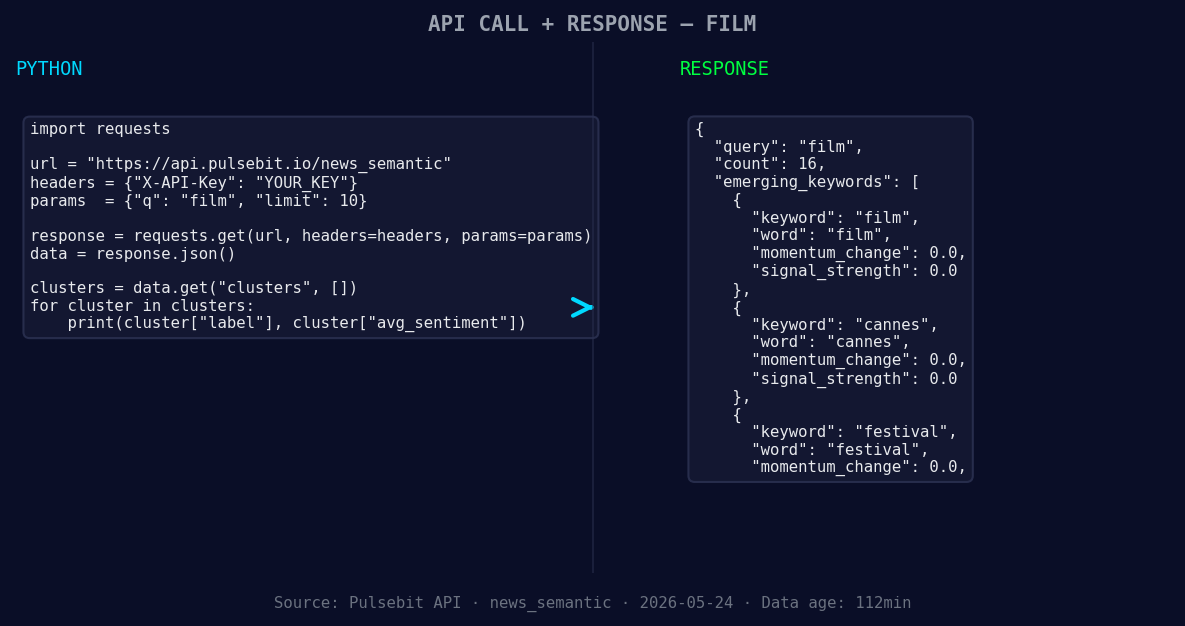
*Left: Python GET /news_semantic call for 'film'. Right: returned JSON response structure (clusters: 3). Source: Pulsebit /news_semantic.*
# Check response
print(response.json())
Next, we can run the narrative framing through another API call to assess its meta-sentiment. This will help us understand how the themes of the articles are being perceived:
# Cluster reason string
cluster_reason = "Clustered by shared themes: réalisateur, que, son, direct, guerre."

# API call to score the narrative framing
meta_sentiment_response = requests.post(
    'https://api.pulsebit.com/sentiment',
    json={
        'text': cluster_reason
    }
)

# Check response
print(meta_sentiment_response.json())
Now that you have the foundation laid out, here are three specific builds to leverage this momentum spike:
Geo-filtered Alert System: Set up a system that triggers an alert when the sentiment score for film in Spanish dips below -0.500, indicating a potential negative shift. Use the geographic origin filter to ensure you’re only catching relevant articles.
Meta-Sentiment Analyzer: Create a dashboard that visualizes the meta-sentiment of clustered themes around film festivals like Cannes. Run the cluster reason strings through the POST /sentiment endpoint to gauge audience perception continuously.
Trend Tracker: Build a trend tracker that monitors sentiment around keywords like "film," "festival," and "Cannes." Set thresholds to identify significant drops in sentiment, especially when compared to mainstream terms like "réalisateur," "que," and "son." This will help you catch emerging narratives before they gain traction.
By implementing these builds, you can ensure that your pipeline is not only reactive but proactive in capturing sentiment shifts, especially in multilingual contexts.
Ready to get started? Head over to pulsebit.lojenterprise.com/docs and try it out. You can copy-paste and run this in under 10 minutes, so there's no excuse to stay behind on what could be a game-changing sentiment shift in the film industry.


Top comments (0)