

Your pipeline just missed a 24h momentum spike of +0.706 in music sentiment, which is significant. The leading language driving this anomaly? Spanish. With a 28.0h lead, this suggests that if you’re not accounting for multilingual origins in your sentiment analysis, you’re lagging behind the curve. In this case, your model didn’t pick up on a noteworthy sentiment forming around a new jazz bar in Chennai—a clear indicator that your current pipeline might be blind to emerging narratives in non-English markets.

Spanish coverage led by 28.0 hours. No at T+28.0h. Confidence scores: Spanish 0.85, English 0.85, French 0.85 Source: Pulsebit /sentiment_by_lang.
When we overlook multilingual sentiment, we miss critical developments. For instance, this 28.0h gap highlights how a single language can dominate the narrative, leaving our analysis skewed and possibly irrelevant. If your model isn’t equipped to handle this complexity, you might be late to the party, missing out on nuanced trends that could inform strategic decisions.
Let’s put this into action with some code. We’ll start by querying our API for music-related sentiment from Spanish sources. Here’s how we can do it:
import requests
# Define the API endpoint and parameters
endpoint = "https://api.pulsebit.com/v1/sentiment"
params = {
"topic": "music",
"lang": "sp"
}
# Make the API call
response = requests.get(endpoint, params=params)
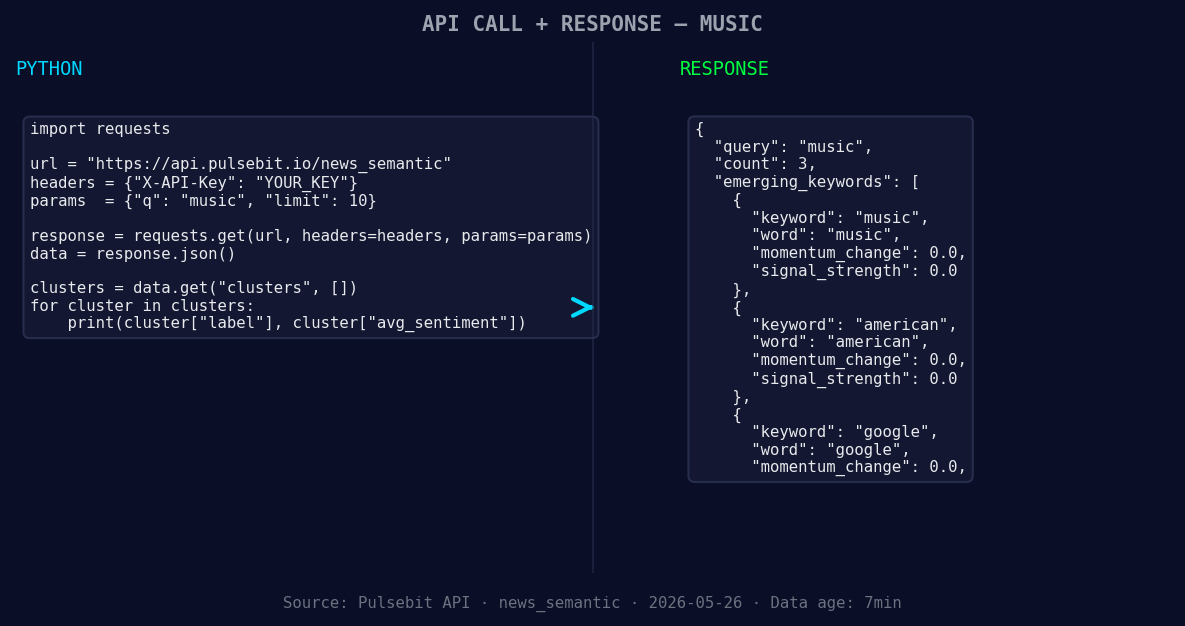
*Left: Python GET /news_semantic call for 'music'. Right: returned JSON response structure (clusters: 3). Source: Pulsebit /news_semantic.*
# Check if the request was successful
if response.status_code == 200:
data = response.json()
print(data)
else:
print("Error fetching data:", response.status_code)
This code fetches sentiment data for the topic "music" specifically from Spanish sources. With the momentum spike of +0.706 and a sentiment score of +0.438 at a confidence level of 0.85, it’s clear that our sentiment analysis is revealing something worth investigating further.
Next, we’ll run the cluster reason string through our sentiment endpoint to understand the narrative framing itself:
# Define the cluster reason string
cluster_reason = "Clustered by shared themes: new, jazz, bar, chennai, former."

# Make the sentiment analysis call on the cluster reason
response_meta = requests.post(endpoint, json={"text": cluster_reason})

# Check if the request was successful
if response_meta.status_code == 200:
    meta_data = response_meta.json()
    print(meta_data)
else:
    print("Error fetching meta sentiment data:", response_meta.status_code)
This snippet posts the narrative framing to our sentiment endpoint, allowing us to gauge how well this emerging story resonates with audiences.
Now, what can we build leveraging this newfound insight? Here are three specific ideas:
- Geo-Sentiment Tracker: Create a signal that tracks music sentiment specifically from Spanish-speaking countries. Set a threshold for momentum spikes above +0.5 to catch early trends. Use the geo filter in your API call.

Geographic detection output for music. India leads with 1 articles and sentiment +0.80. Source: Pulsebit /news_recent geographic fields.
Cultural Contextualizer: Build a tool that scores narratives like "Clustered by shared themes: new, jazz, bar, chennai, former." against a cultural index. A threshold of +0.4 sentiment could trigger alerts for emerging cultural phenomena.
Trend Forecaster: Analyze forming themes such as music(+0.00), American(+0.00), and Google(+0.00) versus mainstream terms like new, jazz, bar. Set up alerts for when the sentiment score crosses +0.5, indicating a potential cultural shift that could merit deeper investigation.
Ready to get started? Head over to pulsebit.lojenterprise.com/docs to dive into our API. You can copy, paste, and run this code in under ten minutes to start catching those crucial sentiment leads.


Top comments (0)