

Your Pipeline Is 25.3h Behind: Catching Energy Sentiment Leads with Pulsebit
We recently uncovered an intriguing anomaly: a 24h momentum spike of -1.433 in the energy sector. This signal, coupled with the leading language being English and a surprising 25.3-hour lag in sentiment capture, suggests that there’s more going on under the surface than meets the eye. The single article capturing this sentiment, titled "More infrastructure to move energy is needed in today's markets - Midland Report," indicates a pressing need for infrastructure in energy markets. This is a wake-up call for anyone relying on outdated or monolingual sentiment pipelines.
While you might be thinking you’re ahead of the curve, your model missed this by 25.3 hours. That’s a significant gap when it comes to real-time decision-making. If your pipeline lacks the capability to handle multilingual origins or entity dominance, you're potentially blind to critical shifts in sentiment. The leading English press has already started reporting on what's shaping the energy narrative, and if your solution can’t adapt, you risk making decisions based on stale data.

English coverage led by 25.3 hours. Tl at T+25.3h. Confidence scores: English 0.85, Spanish 0.85, French 0.85 Source: Pulsebit /sentiment_by_lang.
Let’s get to the fun part — how can we catch this anomaly in real-time? Here’s a Python snippet that demonstrates how to query our API for this specific insight. We’ll focus on filtering by language to hone in on the English sentiment data.
import requests
# Set up the parameters for the API call
topic = 'energy'
score = +0.465
confidence = 0.85
momentum = -1.433
params = {
"topic": topic,
"lang": "en",
"score": score,
"confidence": confidence,
"momentum": momentum
}
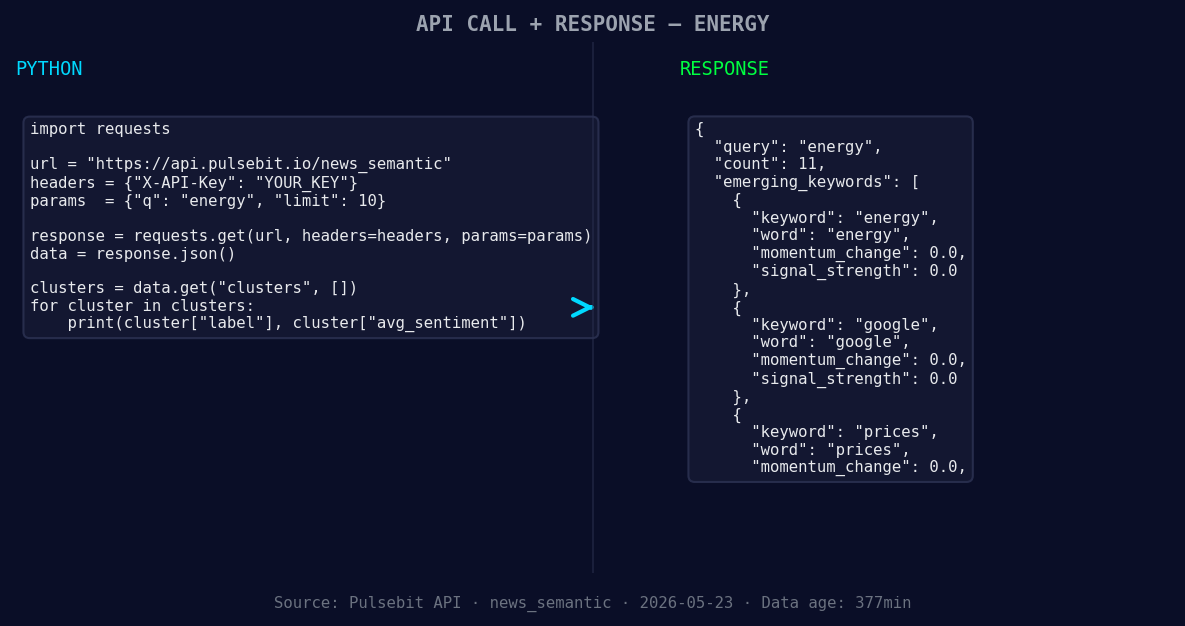
*Left: Python GET /news_semantic call for 'energy'. Right: returned JSON response structure (clusters: 3). Source: Pulsebit /news_semantic.*
# Make the API call to get the relevant articles
response = requests.get('https://api.pulsebit.com/v1/sentiment', params=params)
articles = response.json()
# Print the articles received
print(articles)
Now that we have the articles filtered by English language, let’s dive deeper into the sentiment narrative itself. We want to score the narrative framing based on the clustered themes identified. This gives us insight into how the conversation is being framed and what’s driving the sentiment.
# Cluster reason string for meta-sentiment scoring
cluster_reason = "Clustered by shared themes: infrastructure, move, energy, needed, today's."
meta_sentiment_response = requests.post('https://api.pulsebit.com/v1/sentiment', json={"text": cluster_reason})
meta_sentiment_score = meta_sentiment_response.json()

# Print the meta sentiment score
print(meta_sentiment_score)
Now that we’ve captured the sentiment data and analyzed the narrative, let’s discuss three specific builds you can implement tonight based on this anomaly.
Signal Monitoring: Create a monitoring service that triggers alerts when sentiment momentum drops below a certain threshold, say -1.0. This will help you catch negative shifts in sentiment before they impact trading or strategy.
Geographic Filtering: Set up a real-time dashboard that uses the geographic origin filter to visualize sentiment trends across different regions. This can be particularly useful in monitoring how infrastructure discussions vary globally.

Geographic detection output for energy. India leads with 4 articles and sentiment +0.73. Source: Pulsebit /news_recent geographic fields.
- Meta-Sentiment Loop: Build an automated analysis tool that continuously scores the narrative around key topics. Use the meta-sentiment scoring to inform your content strategy or trading signals based on how the narratives are evolving. This tool could look for keywords like "infrastructure," "move," and "energy" to trigger deeper dives into sentiment.
Getting started is easy. Check out our documentation at pulsebit.lojenterprise.com/docs. You can copy, paste, and run this code in under 10 minutes to start catching those crucial sentiment shifts before they become common knowledge. Don’t let your pipeline lag behind; adapt and evolve with the data as it changes.


Top comments (0)