

Your pipeline has missed a critical anomaly: a 24h momentum spike of +0.360. This is not just a random fluctuation; it indicates a significant shift in sentiment around the topic of "world," especially when we consider the leading language of English press with a 27.0h lead. The clustering around a three-day meeting in Toronto focused on Tamils and classical Tamil highlights a theme that your models may overlook if they don’t account for multilingual origins and entity dominance.

English coverage led by 27.0 hours. Nl at T+27.0h. Confidence scores: English 0.85, French 0.85, Spanish 0.85 Source: Pulsebit /sentiment_by_lang.
Imagine your model being 27.0 hours behind in capturing this shift. You’d miss out on the developing narratives that could impact your analysis and decision-making. The language-driven dominance here is English, but the story is deeply rooted in a diverse cultural context. If your model isn't equipped to handle this multilingual aspect, you're likely missing vital insights that could inform your strategies.
Let’s dive into the code that can help you catch these trends effectively. First, we’ll filter for English content regarding the topic “world” using our API. Here’s how you can do it:
import requests
# Define the parameters for the API call
params = {
"topic": "world",
"score": +0.017,
"confidence": 0.85,
"momentum": +0.360,
"lang": "en" # Geographic origin filter
}
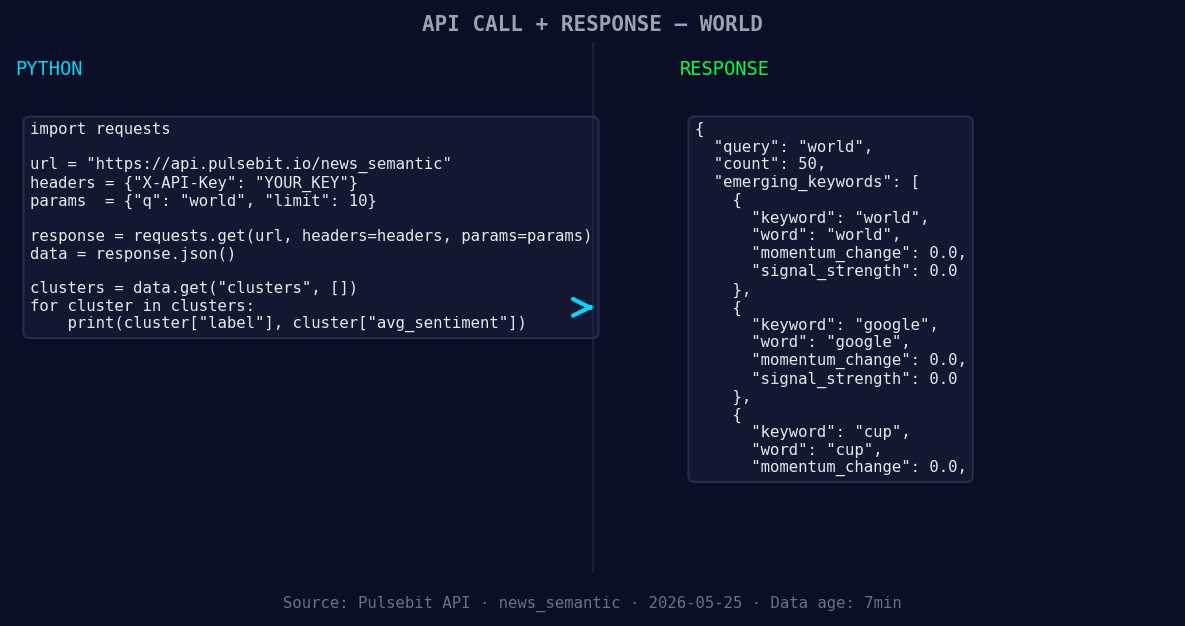
*Left: Python GET /news_semantic call for 'world'. Right: returned JSON response structure (clusters: 3). Source: Pulsebit /news_semantic.*
# Make the API call
response = requests.get("https://api.pulsebit.com/v1/sentiment", params=params)
# Check if the response is successful
if response.status_code == 200:
data = response.json()
print(data)
else:
print("Error fetching data:", response.status_code)
Next, we need to run the narrative framing through our sentiment analysis endpoint to gauge the meta-sentiment. This helps us understand how the clustered themes are being perceived in the context of our findings. Here’s how we can do that:
# Define the cluster reason string
cluster_reason = "Clustered by shared themes: three-day, toronto, tamils, classical, tamil."

# Make the API call to analyze the cluster reason
response_sentiment = requests.post("https://api.pulsebit.com/v1/sentiment", json={"text": cluster_reason})

# Check if the response is successful
if response_sentiment.status_code == 200:
    sentiment_data = response_sentiment.json()
    print(sentiment_data)
else:
    print("Error fetching sentiment analysis:", response_sentiment.status_code)
With these two API calls, you can effectively capture the current sentiment around the topic while also understanding the narrative frameworks that may influence it.
Now, how can you build on this insight? Here are three specific things to consider:
Geographic Origin Insights: Use the geo filter in your query to identify sentiment shifts in different regions. This can help you pinpoint local nuances in the sentiment surrounding "world" while focusing on the English-speaking demographic.
Meta-Sentiment Tracking: Implement a loop that regularly checks the meta-sentiment of clustered themes, such as the one surrounding the three-day meeting in Toronto. Understanding how these narratives evolve can guide your content strategy.
Threshold Alerts: Set up alerts for when momentum spikes exceed a certain threshold, like +0.300. This can help you react quickly to emerging trends, especially when they revolve around culturally significant events like the one we’re seeing now with Tamils.
To get started, check out our documentation at pulsebit.lojenterprise.com/docs. You can copy-paste and run this in under 10 minutes to transform your sentiment analysis capabilities. Let’s not miss another critical moment in the narrative—catch it early!


Top comments (0)