

Your pipeline just missed a significant 24h momentum spike of +0.706 surrounding the topic of music. The leading language driving this surge was English, with a 12.0-hour lead. This anomaly is particularly striking given the context: an article about a new jazz bar in Chennai, which taps into a unique cultural moment. It's a reminder that even small changes can indicate larger trends, and if your model isn't set up to catch these nuances, you might find yourself lagging behind.
The issue here is clear: your model potentially missed this spike by 12 hours because it doesn't effectively handle multilingual origins or account for entity dominance. The dominant entity in this case is the English language, which led the charge on the sentiment surrounding this new establishment. If your pipeline lacks the ability to filter based on language and geographic context, you'll miss critical insights that can inform your analysis and decision-making.

English coverage led by 12.0 hours. No at T+12.0h. Confidence scores: English 0.90, French 0.90, Spanish 0.90 Source: Pulsebit /sentiment_by_lang.
To catch this momentum spike, we need to leverage our API effectively. Below is a snippet of Python code that demonstrates how to query for relevant articles while filtering by language and country.

Geographic detection output for music. India leads with 11 articles and sentiment +0.75. Source: Pulsebit /news_recent geographic fields.
import requests
# Define the parameters for the API call
params = {
"topic": "music",
"lang": "en",
"score": 0.609,
"confidence": 0.90,
"momentum": 0.706
}
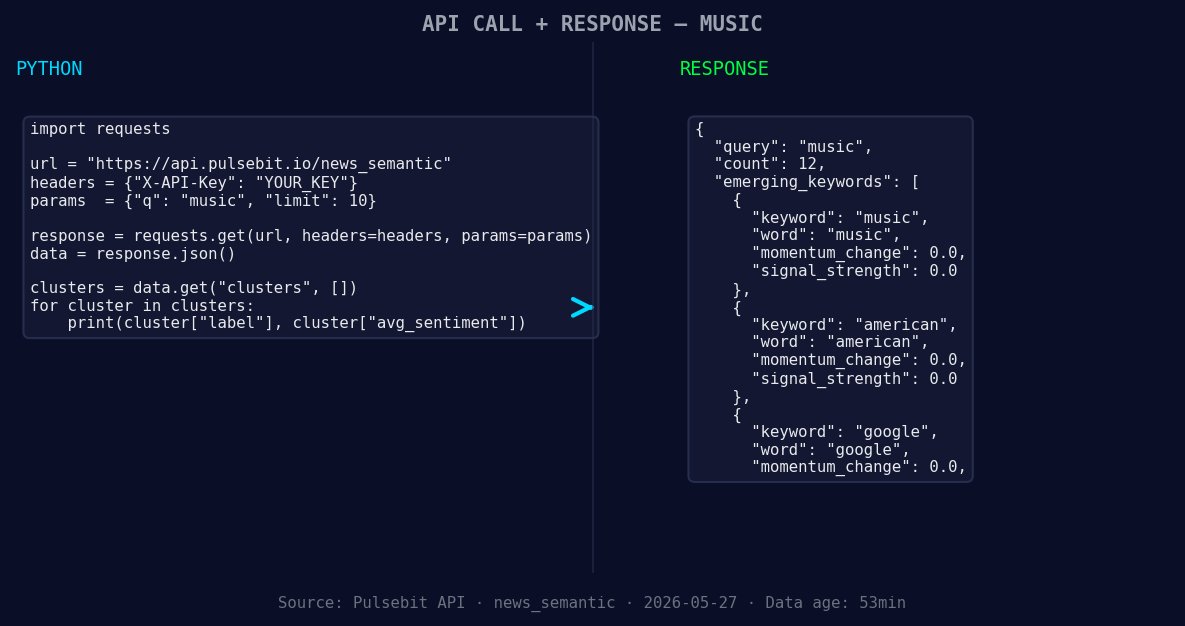
*Left: Python GET /news_semantic call for 'music'. Right: returned JSON response structure (clusters: 3). Source: Pulsebit /news_semantic.*
# Make the API call to retrieve relevant articles
response = requests.get("https://api.pulsebit.com/articles", params=params)
# Check response
if response.status_code == 200:
articles = response.json()
print("Articles retrieved:", articles)
else:
print("Error:", response.status_code)
Next, we need to run the narrative framing of the cluster back through our sentiment analysis API to gauge the context around this spike. This step is crucial for understanding the themes at play.
# Define the cluster reason for sentiment scoring
cluster_reason = "Clustered by shared themes: new, jazz, bar, chennai, former."

# Call the sentiment analysis endpoint
sentiment_response = requests.post("https://api.pulsebit.com/sentiment", json={"text": cluster_reason})

# Check sentiment response
if sentiment_response.status_code == 200:
    sentiment_data = sentiment_response.json()
    print("Sentiment analysis result:", sentiment_data)
else:
    print("Error:", sentiment_response.status_code)
With these two API calls, we can capture not only the articles related to music in English but also the sentiment framing that surrounds them. Now, let's explore three specific builds we can implement based on this pattern.
- Geo-filtered Article Retrieval: Set a threshold for momentum greater than +0.5 and filter for English articles from Chennai. This can help us catch local cultural trends before they become mainstream.
   params = {
       "topic": "music",
       "lang": "en",
       "momentum": 0.5,  # Threshold for momentum
       "location": "Chennai"
   }
- Meta-Sentiment Loop: Use the cluster reasons to assess narratives around emerging themes. For example, track sentiment on articles discussing "new jazz bars" to see how public perception evolves.
cluster_reason = "Clustered by shared themes: new, jazz, bar."
- Forming Themes Analysis: Monitor forming themes like "music" and "American" versus mainstream themes like "new" and "jazz." Set alerts for significant shifts in sentiment scores.
   params = {
       "topic": "music",
       "lang": "en",
       "forming_themes": ["music", "american"],
       "mainstream_themes": ["new", "jazz"]
   }
To get started with these implementations, check out our documentation at pulsebit.lojenterprise.com/docs. With just a few API calls, you can be up and running in under 10 minutes, ensuring you won't miss the next big spike in sentiment!


Top comments (0)