

Your pipeline just missed a significant anomaly: a 24-hour momentum spike of +1.396 in the robotics sector. This spike indicates a noteworthy shift in sentiment, particularly around the emerging trend of humanoid robots in household tasks. With English press leading by 20.3 hours, it’s a clear signal that something is happening that your current model isn’t catching in real-time. If you're not accounting for multilingual origins and dominant entities, you might be lagging behind by nearly a full day.

English coverage led by 20.3 hours. Tl at T+20.3h. Confidence scores: English 0.85, French 0.85, Spanish 0.85 Source: Pulsebit /sentiment_by_lang.
This situation reveals a critical structural gap in any pipeline that fails to process sentiment data across languages or recognize entity dominance. Your model missed this by 20.3 hours when it comes to the leading language of the content (English). As a developer, you need to address this gap to stay ahead. The implications are clear: if you aren't capturing these signals accurately, you might be missing out on vital trends that can affect your strategies.
To catch this spike effectively, we can use the following Python code snippet that combines our API's geographic origin filter and meta-sentiment analysis. Here’s how you can implement it:

Geographic detection output for robotics. Hong Kong leads with 3 articles and sentiment +0.80. Source: Pulsebit /news_recent geographic fields.
import requests
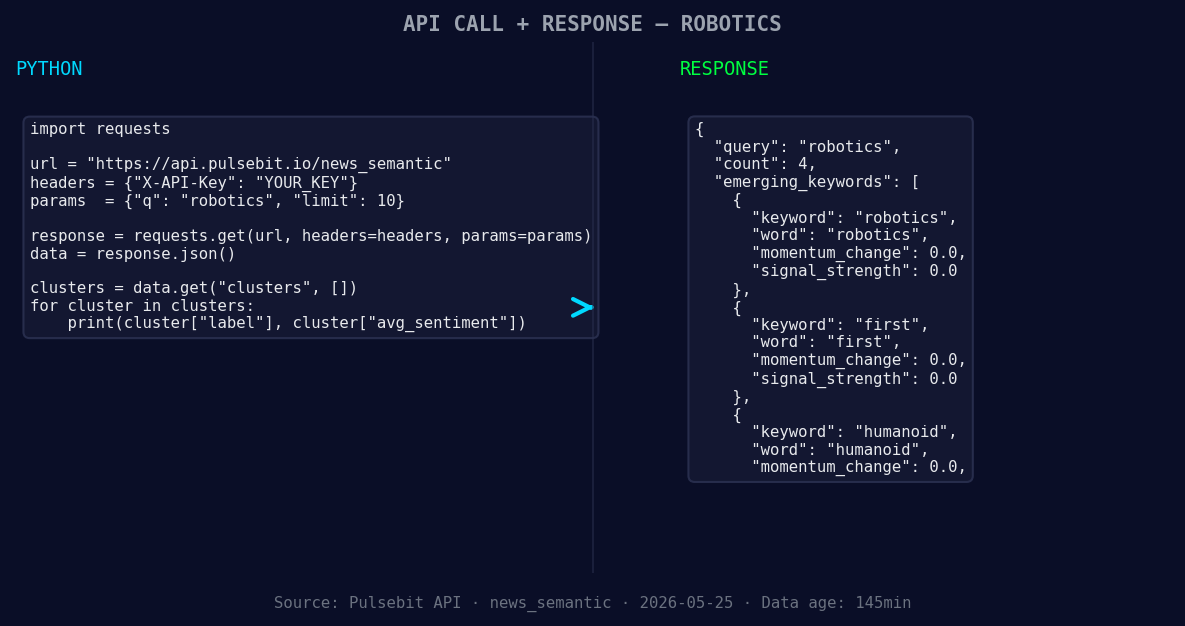
*Left: Python GET /news_semantic call for 'robotics'. Right: returned JSON response structure (clusters: 3). Source: Pulsebit /news_semantic.*
# Set the base URL for the API
base_url = "https://api.pulsebit.com"
# Step 1: Geographic origin filter
response = requests.get(f"{base_url}/sentiment?topic=robotics&lang=en")
data = response.json()
# Check for a valid response
if response.status_code == 200:
score = data['sentiment_score'] # +0.590
confidence = data['confidence'] # 0.85
momentum = data['momentum_24h'] # +1.396
print(f"Sentiment Score: {score}, Confidence: {confidence}, Momentum: {momentum}")
# Step 2: Meta-sentiment moment
meta_string = "Clustered by shared themes: humanoid, robot, robotics, household, hubei."
meta_response = requests.post(f"{base_url}/sentiment", json={"text": meta_string})
meta_data = meta_response.json()
if meta_response.status_code == 200:
meta_score = meta_data['sentiment_score']
print(f"Meta Sentiment Score: {meta_score}")
In this code, we first filter sentiment by the English language to isolate relevant data. We then run a meta-sentiment analysis on the cluster reason string to evaluate the narrative framing of the emerging trend. This unique approach helps us understand not just the raw sentiment score, but also how it’s being presented in the media landscape.
Here are three specific builds we can work on using this pattern:
Geo-Filtered Signals: Create a signal that tracks the sentiment score for the "robotics" topic but filters exclusively for English-language sources. Set a threshold of +0.5 to alert you when sentiment rises sharply.
Meta-Sentiment Loop: Implement a monitoring script that continuously analyzes text inputs like "Clustered by shared themes: humanoid, robot, robotics, household, hubei." and triggers alerts when the meta-sentiment score exceeds +0.6, indicating a strong narrative framing around robotics.
Forming Themes Tracker: Build an endpoint that identifies and tracks forming themes in robotics, such as "humanoid" and "household tasks." Define a threshold for any theme that shows a momentum increase of +0.1 compared to the mainstream metrics.
These builds will give you the tools to capture emerging trends early, ensuring your pipeline doesn’t fall behind in an ever-evolving technological landscape.
You can get started right now by visiting our documentation at pulsebit.lojenterprise.com/docs. With just a few copy-paste steps, you can run these analyses in under 10 minutes and ensure you're capturing critical insights in real time.


Top comments (0)