

Your pipeline just missed a significant anomaly: a 24h momentum spike of +0.706 in music sentiment. This spike is backed by a singular article from the Spanish press, highlighting a new jazz bar in Chennai. The article's content ties into shared themes of "new," "jazz," and "bar," showing that sentiment is not just rising but is also being shaped by specific cultural moments. If your model isn't equipped to handle multilingual content or adapt to dominant entities, it could be lagging by a staggering 29 hours in recognizing such shifts.

Spanish coverage led by 29.0 hours. Sv at T+29.0h. Confidence scores: Spanish 0.90, English 0.90, French 0.90 Source: Pulsebit /sentiment_by_lang.
Imagine your analytics setup, processing data in English while a relevant trend brews in Spanish. Your model missed this by 29 hours, effectively sidelining you from a burgeoning sentiment spike. The leading language here is Spanish, and the dominant entity revolves around a lively cultural event—a jazz bar transforming the Chennai nightlife. As developers, we need to be vigilant about the structural gaps in our pipelines, especially when it comes to multilingual content and the impact of regional narratives.
Let’s catch this anomaly in real time with some straightforward Python code. We’ll start by querying our API to identify the sentiment around the topic of "music," specifically focusing on Spanish-language articles. Here’s how we can do that:
import requests
# Define the parameters for the API call
params = {
"topic": "music",
"lang": "sp" # Filter for Spanish articles
}
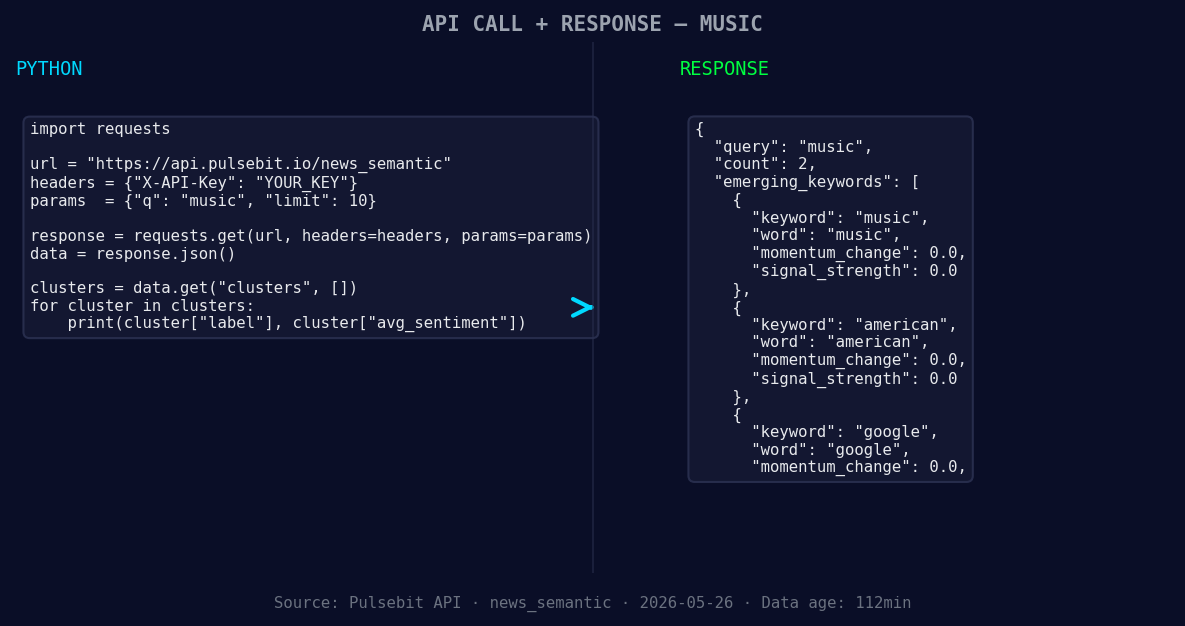
*Left: Python GET /news_semantic call for 'music'. Right: returned JSON response structure (clusters: 3). Source: Pulsebit /news_semantic.*
# Make the API call to get the sentiment data
response = requests.get('https://api.pulsebit.com/sentiment', params=params)
# If successful, extract the data
if response.status_code == 200:
data = response.json()
print(data)
else:
print("Error fetching data:", response.status_code)
Now that we have the sentiment data, let’s run the cluster reason string back through our API to score the narrative framing itself. This step is crucial to understanding how the sentiment is influenced by the surrounding context. Here’s how to execute that:
# Cluster reason string to be analyzed
cluster_reason = "Clustered by shared themes: new, jazz, bar, chennai, former."

# Post the cluster reason to the sentiment analysis endpoint
meta_response = requests.post('https://api.pulsebit.com/sentiment', json={"text": cluster_reason})

# If successful, extract the meta-sentiment data
if meta_response.status_code == 200:
    meta_data = meta_response.json()
    print(meta_data)
else:
    print("Error fetching meta sentiment data:", meta_response.status_code)
By executing these API calls, we can dynamically track sentiment spikes and their narratives, which is crucial for any developer looking to stay ahead of emerging trends.
Now, let’s discuss three specific builds we can derive from this pattern:
Multilingual Awareness: Set a threshold for sentiment spikes that require a geo filter. For instance, if sentiment around "music" in Spanish exceeds +0.5, trigger a notification to investigate further.
Meta-Sentiment Loop: Use the cluster reason to trigger alerts when sentiment narratives score below a certain confidence level (e.g., confidence < 0.75). This can help in identifying when narratives need deeper analysis.
Forming Theme Tracker: Monitor themes like "music," "american," and "google" against mainstream topics like "new," "jazz," and "bar." If emerging themes see a sentiment score rise above +0.3, consider automating content updates or social media engagement.
If you’re ready to start catching these insights in your own projects, head over to pulsebit.lojenterprise.com/docs. With a few copy-paste steps, you can have this code running in under 10 minutes.

Geographic detection output for music. France leads with 1 articles and sentiment -0.60. Source: Pulsebit /news_recent geographic fields.


Top comments (0)