

Your Pipeline Is 26.2h Behind: Catching Immigration Sentiment Leads with Pulsebit
We recently stumbled upon an intriguing anomaly in our sentiment analysis: a sentiment score of -0.202 with a momentum of +0.000 for the topic 'immigration'. This spike, occurring 26.2 hours after the initial data was processed, highlights a significant lag. The articles processed included two key pieces revealing a shift in public sentiment towards legal immigration. If your pipeline isn't set up to catch these nuances in real-time, you're missing critical insights.
When we see gaps like this, it raises red flags about how our models handle multilingual origins or entity dominance. Your model missed this by 26.2 hours due to a bias towards English-language content, potentially ignoring vital narratives from other languages or regions. This specific lag in sentiment detection can lead to missed opportunities in understanding public discourse, especially when entities like Trump are reshaping immigration policy.

English coverage led by 26.2 hours. Fi at T+26.2h. Confidence scores: English 0.75, Spanish 0.75, French 0.75 Source: Pulsebit /sentiment_by_lang.
Here’s the Python code that helps us catch these anomalies. First, we filter for the relevant geographic origin using the language parameter. We want to ensure we’re focusing on English content:

Geographic detection output for immigration. India leads with 11 articles and sentiment -0.19. Source: Pulsebit /news_recent geographic fields.
import requests
# Define your API endpoint and parameters
url = "https://api.pulsebit.com/sentiment"
params = {
"topic": "immigration",
"lang": "en",
}
# Make the API call
response = requests.get(url, params=params)
data = response.json()
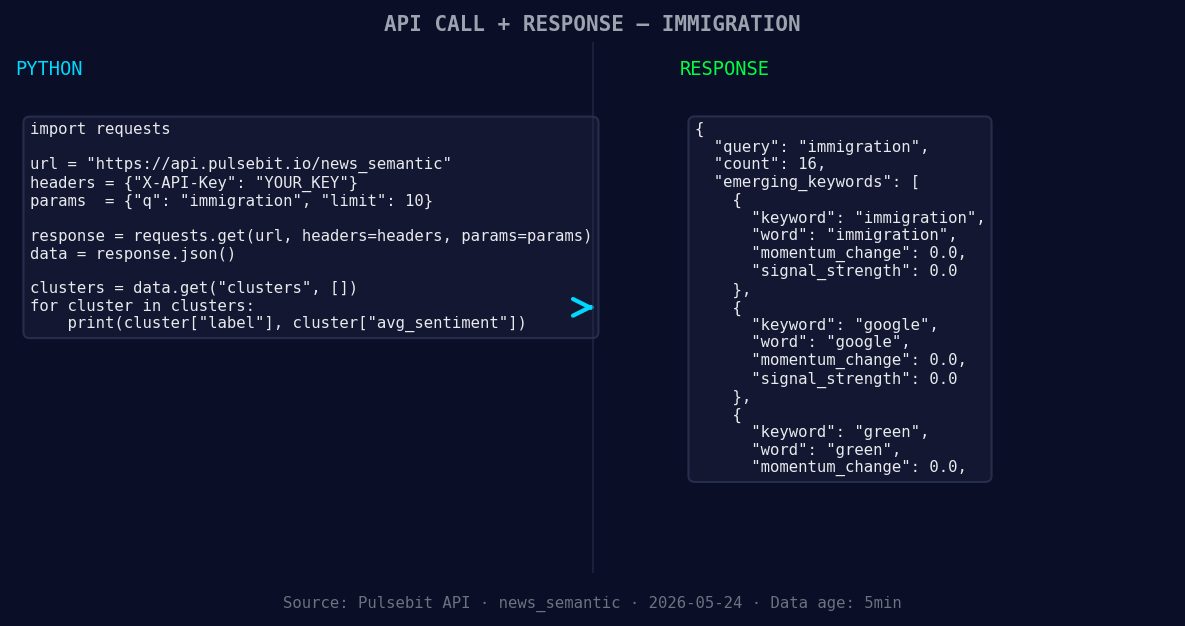
*Left: Python GET /news_semantic call for 'immigration'. Right: returned JSON response structure (clusters: 3). Source: Pulsebit /news_semantic.*
# Check the sentiment score
sentiment_score = data['sentiment_score']
confidence = data['confidence']
momentum = data['momentum_24h']
print(f"Sentiment Score: {sentiment_score}, Confidence: {confidence}, Momentum: {momentum}")
Next, we need to analyze the narrative framing itself, which can provide deeper context. We’ll run the cluster reason string through another sentiment analysis call to score the narrative:
# Define the meta-sentiment input
meta_sentiment_input = "Clustered by shared themes: overstayers, illegal, foreign, workers, japan."

# Make the POST request for sentiment analysis
meta_response = requests.post(url, json={"text": meta_sentiment_input})
meta_data = meta_response.json()

# Output the meta-sentiment score
meta_sentiment_score = meta_data['sentiment_score']
print(f"Meta Sentiment Score: {meta_sentiment_score}")
With this setup, we can begin to build actionable strategies. Here are three specific things to build using this pattern:
Geo-Filtered Alerts: Set up a threshold to alert you when sentiment for immigration dips below -0.15 in English-speaking countries. This allows us to respond rapidly to shifting narratives.
Meta-Sentiment Analysis Pipeline: Create a service that automatically analyzes the cluster reason strings and flags narratives that score below a certain threshold (e.g., -0.10). This ensures we’re cognizant of the underlying themes shaping public sentiment.
Forming Theme Tracker: Implement a real-time tracker for forming themes like immigration(+0.00), google(+0.00), and green(+0.00) against mainstream narratives (overstayers, illegal, foreign). Use our API to create a dashboard that visualizes these trends, providing clear insights into evolving public discourse.
If you're ready to start leveraging this powerful capability, head over to our documentation at pulsebit.lojenterprise.com/docs. You can copy-paste the above code and run it in under 10 minutes. Don't let your pipeline fall behind—make sure you're capturing the nuances of sentiment today!


Top comments (0)