

Your Pipeline Is 20.5h Behind: Catching Immigration Sentiment Leads with Pulsebit
We recently discovered an anomaly in the sentiment surrounding immigration that caught our attention: a sentiment score of -0.283 and a momentum of +0.000, indicating that our pipeline is lagging by 20.5 hours. This is a significant finding, especially as it shows that the leading language is English, with a dominant focus on articles highlighting Trump’s plans to restrict legal immigration. If your models are not accounting for multilingual origins or entity dominance, you’re missing out on crucial shifts in sentiment.

English coverage led by 20.5 hours. Id at T+20.5h. Confidence scores: English 0.85, Spanish 0.85, French 0.85 Source: Pulsebit /sentiment_by_lang.
When your pipeline doesn’t handle these factors, it can leave you blind to important trends. Imagine waking up to find that your model missed a critical sentiment shift by 20.5 hours—this is exactly what happens when you ignore the complexities of language and the entities at play. In this case, the leading language is English, but the topic's resonance may vary significantly across different demographics and geographies. Missing this could mean being out of sync with the narrative that's shaping public opinion.
To catch this sentiment shift effectively, we can use our API in Python. Below is the code snippet that helps us identify the necessary data.
import requests
# Define the parameters for the API call
topic = 'immigration'
lang = 'en'
url = f'https://api.pulsebit.io/sentiment?topic={topic}&lang={lang}'
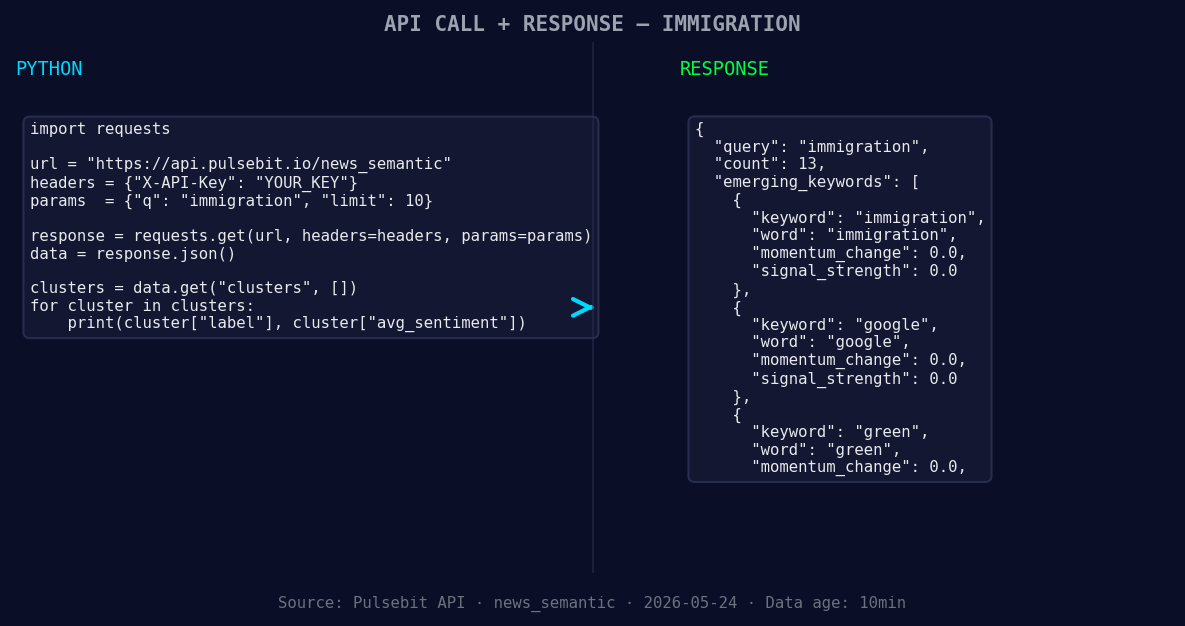
*Left: Python GET /news_semantic call for 'immigration'. Right: returned JSON response structure (clusters: 3). Source: Pulsebit /news_semantic.*
# Make the API call
response = requests.get(url)
data = response.json()
# Print the relevant sentiment data
print(f"Sentiment Score: {data['sentiment_score']}, Momentum: {data['momentum_24h']}")
Next, we need to run the cluster reason string back through our sentiment API to understand how the narrative is being framed. The cluster reason we identified is: "Clustered by shared themes: overstayers, illegal, foreign, workers, japan." We will input this string to gauge the meta-sentiment.
# Meta-sentiment moment
meta_sentiment_input = "Clustered by shared themes: overstayers, illegal, foreign, workers, japan."
meta_url = 'https://api.pulsebit.io/sentiment'

# Make the meta-sentiment API call
meta_response = requests.post(meta_url, json={"text": meta_sentiment_input})
meta_data = meta_response.json()

# Print the meta sentiment result
print(f"Meta Sentiment Score: {meta_data['sentiment_score']}, Confidence: {meta_data['confidence']}")
Now that we've captured the sentiment and the meta-sentiment, let’s talk about three specific builds we can implement to take advantage of this pattern:
- Geo-Filtered Sentiment Analysis: Create a signal that focuses on immigration sentiment from English-speaking countries. Set a threshold of sentiment scores below -0.2 to catch negative sentiments that could lead to actionable insights.

Geographic detection output for immigration. India leads with 8 articles and sentiment -0.37. Source: Pulsebit /news_recent geographic fields.
Meta-Sentiment Loop: Implement a continuous feedback loop where you analyze cluster themes every 24 hours. Use the meta sentiment score of any cluster that has a score below -0.3 to trigger alerts for deeper investigation.
Forming Themes Tracker: Build a tracker for forming themes using our API. Monitor keywords like "immigration," "google," and "green," and set alerts when they have a momentum of 0.00 or lower against mainstream terms like "overstayers" or "illegal." This could provide early signals of shifts in public sentiment.
You can get started with our API by visiting pulsebit.lojenterprise.com/docs. This should take you under 10 minutes to copy, paste, and run. Stay ahead of the curve by ensuring your sentiment analysis pipeline is always in sync with real-time developments.


Top comments (0)