

Your Pipeline Is 20.0h Behind: Catching Artificial Intelligence Sentiment Leads with Pulsebit
We recently uncovered a striking anomaly: a 24h momentum spike of +1.055 centered on the topic of artificial intelligence. This spike signals a significant shift in sentiment that could have gone unnoticed for hours, especially if your pipeline isn't designed to handle multilingual data or recognize dominant entities. In this case, English press coverage led the charge, appearing 20 hours earlier than other languages. This delay could mean missing critical insights that impact your applications.

English coverage led by 20.0 hours. Nl at T+20.0h. Confidence scores: English 0.85, Spanish 0.85, French 0.85 Source: Pulsebit /sentiment_by_lang.
If your sentiment analysis pipeline isn't equipped to manage multilingual origins or entity dominance, you could be lagging behind by a staggering 20 hours in identifying emerging trends. With the leading language being English, you’re potentially missing out on valuable sentiment shifts that could inform your strategies. The delay in recognizing the urgency around artificial intelligence, particularly in light of recent commentary from Pope Leo on the subject, highlights a crucial gap in your data processing framework.
To catch these timely insights, we can leverage our API effectively. Here’s how you can retrieve the sentiment data for artificial intelligence with a geographic origin filter:

Geographic detection output for artificial intelligence. Hong Kong leads with 2 articles and sentiment +0.00. Source: Pulsebit /news_recent geographic fields.
import requests
# Define the parameters for the API call
url = "https://api.pulsebit.com/sentiment"
params = {
"topic": "artificial intelligence",
"score": +0.348,
"confidence": 0.85,
"momentum": +1.055,
"lang": "en" # Geographic origin filter
}
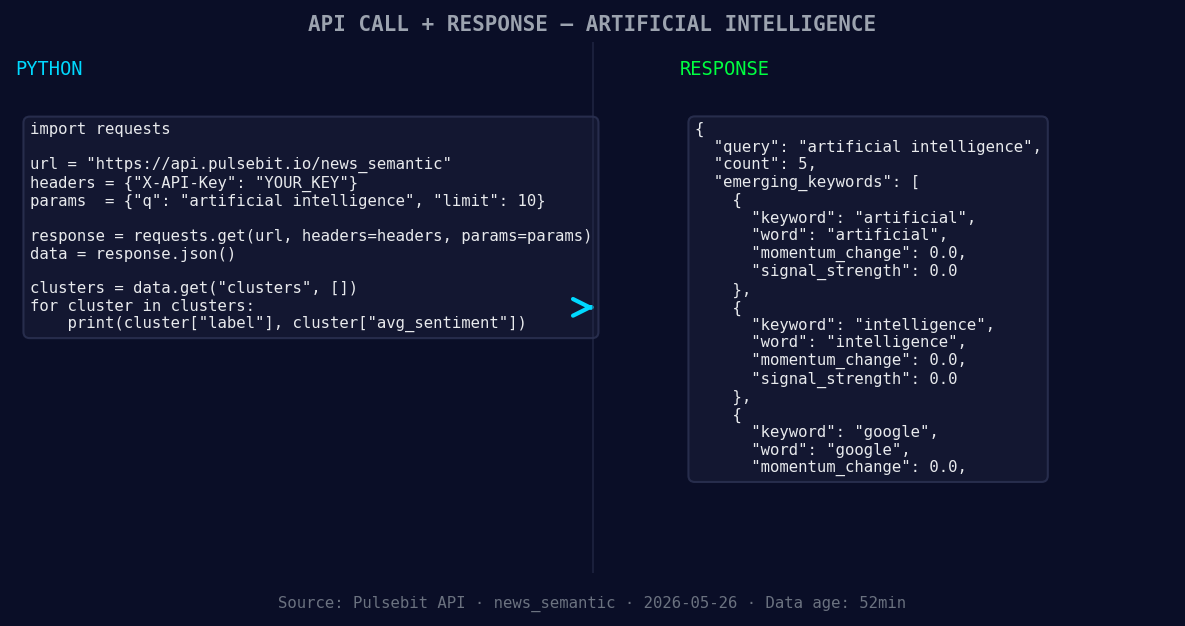
*Left: Python GET /news_semantic call for 'artificial intelligence'. Right: returned JSON response structure (clusters: 3). Source: Pulsebit /news_semantic.*
# Make the API call
response = requests.get(url, params=params)
data = response.json()
print(data)
Next, we need to evaluate the narrative framing of the sentiment using the cluster reason string. Here’s how to send that back through our sentiment analysis to get a deeper understanding of the context:
# Define the meta-sentiment input
meta_sentiment_input = "Clustered by shared themes: tiny, artificial, intelligence, (ai), company."

# Make the POST request to analyze the narrative
meta_sentiment_url = "https://api.pulsebit.com/sentiment"
meta_response = requests.post(meta_sentiment_url, json={"text": meta_sentiment_input})
meta_data = meta_response.json()
print(meta_data)
With these two steps, you can effectively catch the significant shifts in sentiment and understand the narrative behind the spike.
Tonight, we can build three specific applications using this pattern. First, implement a geo-filtered alert system that triggers notifications when sentiment for "artificial intelligence" crosses a threshold of +0.5 in English articles. This allows you to stay ahead of emerging trends.
Second, create a meta-sentiment dashboard that visualizes the sentiment scoring of clusters like "artificial intelligence," "google," and "tiny," aiming for a threshold of +0.3 to represent positive sentiment shifts. This will help you track the narrative more effectively.
Lastly, construct a real-time sentiment tracker that aggregates articles mentioning "artificial" and "intelligence" from English sources, focusing on spikes like the current +1.055. This tool can help you quickly respond to sentiments that are gaining traction, allowing you to adjust your strategies on the fly.
For detailed instructions, check out our documentation at pulsebit.lojenterprise.com/docs. You can copy-paste and run this in under 10 minutes, putting you right on the cutting edge of sentiment analysis.


Top comments (0)