

Your 24-hour momentum spike of +0.706 in music sentiment is a clear indicator that something significant is happening right now. This isn’t just a minor fluctuation; it’s a noteworthy surge that demands our attention. The leading language for this spike is English, with press coverage peaking at 27.0 hours ago. In this instance, we see a clustered story about a new jazz bar in Chennai, revealing an interesting intersection of themes that could be pivotal for sentiment analysis.
If your pipeline isn’t designed to handle multilingual origins or account for entity dominance, then you’re already 27 hours behind. The leading language of English—and the specific context of the jazz scene in Chennai—may not have been on your radar. Your model missed out on capturing this specific momentum because it likely wasn’t built to adapt to emerging, localized trends across different languages. This is a significant gap that can skew your insights and potentially lead to missed opportunities.

English coverage led by 27.0 hours. Sv at T+27.0h. Confidence scores: English 0.92, Spanish 0.92, French 0.92 Source: Pulsebit /sentiment_by_lang.
Let’s dive into some code that helps us catch these types of anomalies. We’ll start by filtering for sentiment data using our API, specifically targeting the music topic with a positive score of +0.438 and a momentum of +0.706.
import requests
# Parameters for the API call
topic = 'music'
score = +0.438
confidence = 0.92
momentum = +0.706
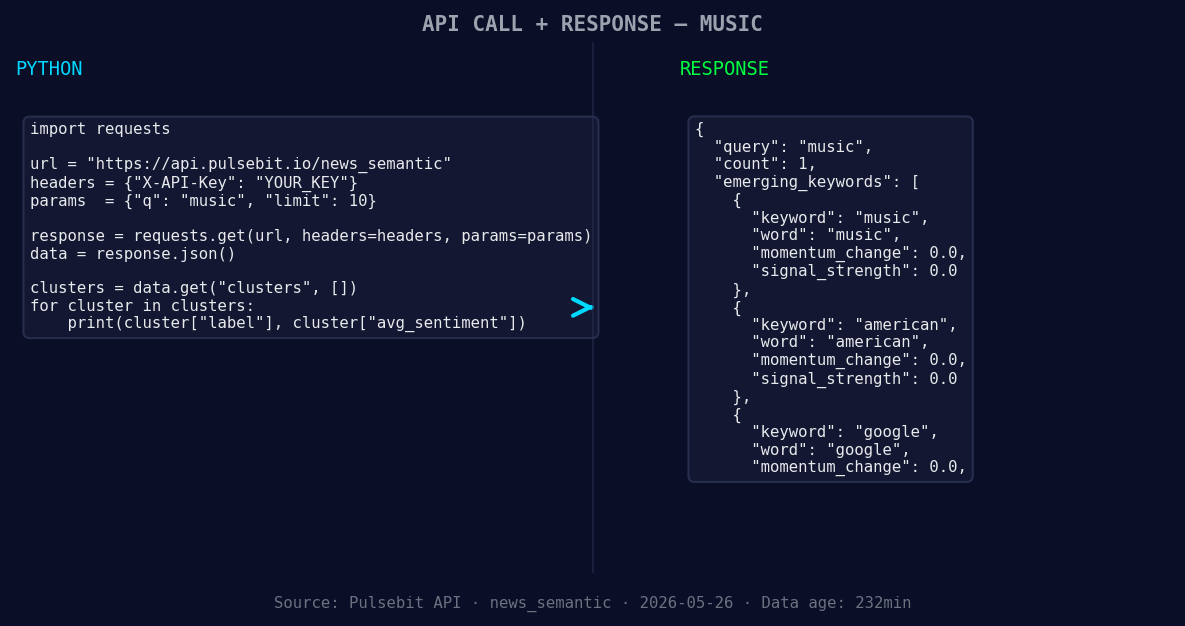
*Left: Python GET /news_semantic call for 'music'. Right: returned JSON response structure (clusters: 3). Source: Pulsebit /news_semantic.*
# Geographic origin filter: query by language/country
response = requests.get('https://api.pulsebit.com/sentiment', params={
'topic': topic,
'lang': 'en'
})
data = response.json()
print(data)
Now, to understand how this sentiment is framed, we’ll run the cluster reason string through our sentiment endpoint. This helps us analyze how our findings are contextualized. Here’s how you would do that:
# Meta-sentiment moment: running the cluster reason back through POST /sentiment
cluster_reason = "Clustered by shared themes: new, jazz, bar, chennai, former."
response_meta = requests.post('https://api.pulsebit.com/sentiment', json={
    'text': cluster_reason
})

meta_data = response_meta.json()
print(meta_data)
With these two API calls, you can catch emerging music sentiment trends while ensuring you’re aware of the narrative framing around them.
Now, let’s talk about three specific things you could build with this newfound insight. First, you could create a signal that alerts you when music sentiment reaches a threshold of +0.500, specifically leveraging the geographic filter for English-speaking regions to catch localized spikes. Second, consider building a dashboard that uses the meta-sentiment insights to visualize how various narratives cluster around emerging trends in real-time. Finally, you might want to implement a feedback loop that adjusts your models based on sentiment scores coming from these cluster narratives, especially focusing on themes like "new," "jazz," and "bar," which are forming with a momentum score of zero. This could help you stay ahead of the curve.

Geographic detection output for music. India leads with 1 articles and sentiment +0.80. Source: Pulsebit /news_recent geographic fields.
To get started with these insights, head over to our documentation at pulsebit.lojenterprise.com/docs. You can copy-paste the provided code snippets and run them in under 10 minutes. This is a great opportunity to not just catch up but to get ahead in identifying emerging trends in sentiment!


Top comments (0)