

Your Pipeline Is 18.3h Behind: Catching Education Sentiment Leads with Pulsebit
We recently observed a notable anomaly: a 24h momentum spike of +0.414 in sentiment around the topic of education. This spike isn't just a number; it reflects a significant shift in how the world is discussing education, particularly underscored by two articles clustering around the theme “Importance of Skill Labs in Schools.” With the leading language being English and a lag of only 18.3 hours, this insight hints at an urgent opportunity for us to refine how we capture and respond to shifts in sentiment.
Yet, if your pipeline isn't tuned to handle multilingual origins or entity dominance, you might have missed this by a whopping 18.3 hours. Imagine missing a key educational trend just because your model is focused solely on mainstream narratives. The dominant entities here are students and schools, and if your model isn't adept at recognizing these voices amid the noise of control and higher education, you're already lagging behind.

English coverage led by 18.3 hours. Tl at T+18.3h. Confidence scores: English 0.85, Spanish 0.85, French 0.85 Source: Pulsebit /sentiment_by_lang.
To catch this momentum spike, we can leverage our API to design a solution that integrates geographic origin filtering and meta-sentiment analysis. Below is a Python code snippet that does just that:
import requests
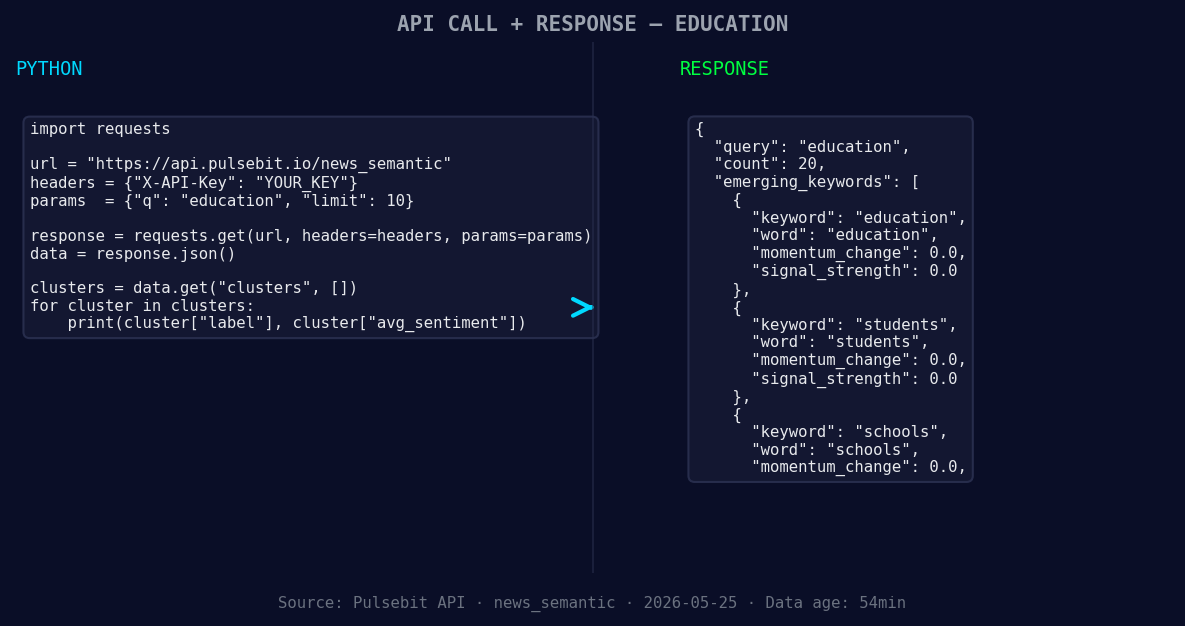
*Left: Python GET /news_semantic call for 'education'. Right: returned JSON response structure (clusters: 3). Source: Pulsebit /news_semantic.*
# Step 1: Geographic origin filter
params = {
"topic": "education",
"lang": "en"
}
response = requests.get("https://api.pulsebit.com/sentiment", params=params)
data = response.json()
# Extract necessary values
momentum = data['momentum_24h'] # +0.414
sentiment_score = data['sentiment_score'] # +0.850
confidence = data['confidence'] # 0.850
# Step 2: Meta-sentiment moment
cluster_reason = "Clustered by shared themes: control, room, higher, education, guidance."
meta_response = requests.post("https://api.pulsebit.com/sentiment", json={"text": cluster_reason})
meta_data = meta_response.json()
# Print results
print(f"Momentum: {momentum}, Sentiment Score: {sentiment_score}, Confidence: {confidence}")
print(f"Meta Sentiment: {meta_data}")
This code starts by filtering the sentiment data for education in English, ensuring we’re focusing on the right audience. The second part runs the cluster reason string through our API to derive the meta-sentiment, revealing how the narrative is framed. This dual approach gives us both the raw data and a deeper understanding of the context surrounding it.
With this pattern, there are three specific builds we can implement:
- Geographic Filter on Student Engagement: Set a signal threshold for education-related content, specifically filtering for English articles. For example, you could trigger alerts when the sentiment score for “students” exceeds +0.650, indicating a rising interest.

Geographic detection output for education. India leads with 19 articles and sentiment +0.63. Source: Pulsebit /news_recent geographic fields.
Meta-Sentiment Loop for Schools: Create a routine that scores the meta-sentiment around school-related discussions. If the sentiment around “schools” is forming at +0.600 or higher, you might want to prioritize content related to school innovations or policies.
Dynamic Sentiment Tracking on Forming Themes: Implement a rolling average that examines the intersection of educational themes like “skills” and “labs” against mainstream terms such as “control” and “higher.” If the difference in sentiment scores between these clusters exceeds +0.200, it could indicate a significant shift worth investigating.
By focusing on these signals and thresholds, we’re not just reacting to trends; we’re actively shaping our understanding of education sentiment in real-time.
To get started, check out our documentation at pulsebit.lojenterprise.com/docs. With just a few lines of code, you can copy-paste and run this in under 10 minutes, placing you ahead of the curve in capturing the evolving narrative around education.


Top comments (0)