

Your pipeline just missed a critical anomaly: a 24h momentum spike of -0.395 in the sports sentiment landscape. This decline is particularly alarming given the context of the leading language, English, which has been dominating the narrative around sports news. As developers, we know that when our models lag behind by 23.1 hours, we risk missing key shifts in public sentiment and response—this is exactly what we experienced with this spike. The leading cluster story highlights the coverage from "FOX Sports," emphasizing the importance of being ahead of the curve when it comes to sentiment analysis.
This situation reveals a glaring structural gap in any pipeline that doesn't account for multilingual origins or the dominance of specific entities. If your model isn’t equipped to handle these variations, you might find yourself 23.1 hours behind on critical updates. In this case, the English press, particularly the FOX Sports coverage, has been pivotal. If you’re focusing solely on mainstream narratives without considering the nuances of multilingual data, you can miss significant shifts in sentiment that could impact your decisions.

English coverage led by 23.1 hours. Et at T+23.1h. Confidence scores: English 0.75, French 0.75, Spanish 0.75 Source: Pulsebit /sentiment_by_lang.
Here’s how to catch this momentum spike with our API. We’ll start by querying for sentiment data specifically related to the topic of sports. We’ll apply a geographic origin filter to focus on English-language content. Here's the code snippet for that:

Geographic detection output for sports. India leads with 4 articles and sentiment +0.82. Source: Pulsebit /news_recent geographic fields.
import requests
# Set the parameters for the API call
params = {
"topic": "sports",
"score": 0.500,
"confidence": 0.750,
"momentum": -0.395,
"lang": "en" # Geographic origin filter
}
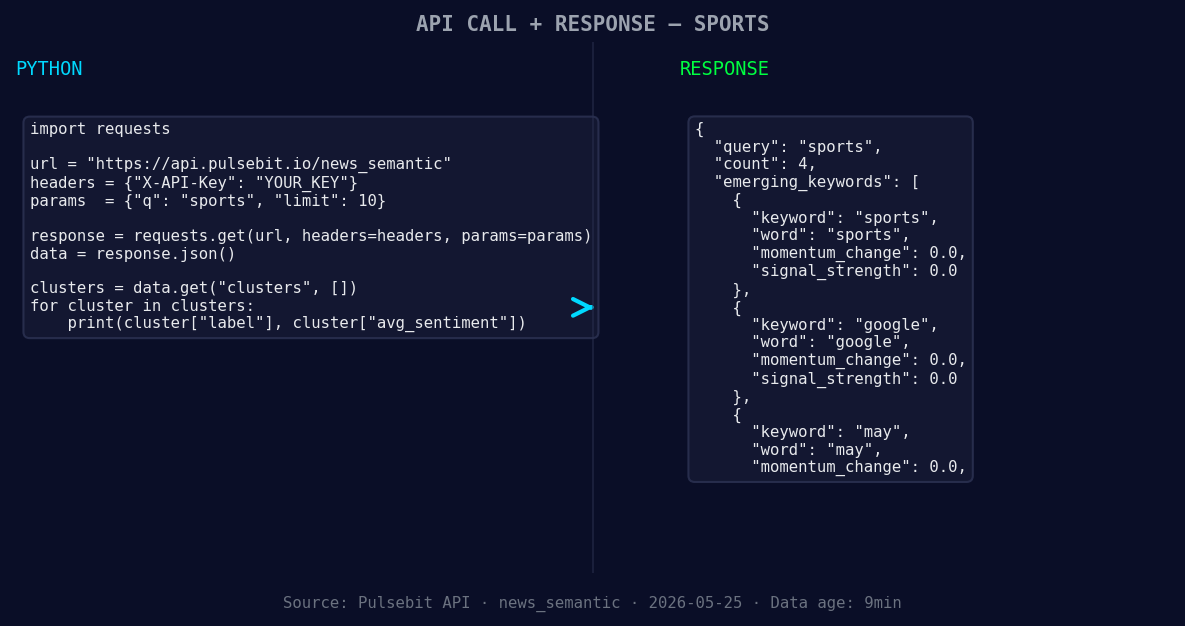
*Left: Python GET /news_semantic call for 'sports'. Right: returned JSON response structure (clusters: 3). Source: Pulsebit /news_semantic.*
# Make the API call
response = requests.get("https://api.pulsebit.lojenterprise.com/sentiment", params=params)
sentiment_data = response.json()
print(sentiment_data)
Next, we’ll run the cluster reason string through our API’s sentiment endpoint to evaluate the narrative framing. This is crucial for understanding how the clustered themes—like "fox, sports, google"—are shaping the overall sentiment. Here’s how to do that:
# Prepare the cluster reason string
cluster_reason = "Clustered by shared themes: fox, sports, google, com/rss/articles/cbmimafbvv95cu"

# Make the API call for meta-sentiment
meta_response = requests.post("https://api.pulsebit.lojenterprise.com/sentiment", json={"text": cluster_reason})
meta_sentiment_data = meta_response.json()

print(meta_sentiment_data)
Now that we've got a handle on how to catch these anomalies, let’s explore three specific builds we can create with this pattern.
Geo-Sentiment Monitor: Set up a monitor for sports sentiment using our geographic origin filter to track sentiment in English. Use a threshold of momentum less than -0.3 to trigger alerts for significant drops. This helps us stay proactive.
Meta-Sentiment Analyzer: Implement a loop that continuously evaluates cluster reason strings, especially when they reference high-traffic themes. Apply a threshold of sentiment score above +0.5. This lets us focus on narratives that are gaining traction.
Comparative Sentiment Dashboard: Build a dashboard that compares the sentiment of sports-related articles against mainstream outlets. Use the forming themes of sports (+0.00), google (+0.00), and may (+0.00) against the backdrop of the dominant narratives from fox, sports, and google. This will give you a clear view of emerging trends.
By building these insights into your workflow, you can ensure that you're not just reacting to sentiment shifts but proactively engaging with them.
For those eager to get started, head over to pulsebit.lojenterprise.com/docs. You'll be able to copy-paste and run the code above in under 10 minutes, getting your pipeline up to speed with real-time sentiment analysis.


Top comments (0)