

In our latest analytics, we discovered something striking: a 24-hour momentum spike of +0.706 in the music sentiment space. This spike is not just a number; it illustrates a significant shift in sentiment surrounding a new jazz bar in Chennai. With the leading language being English and a remarkable cluster story focusing on a transformation from a party pub to a jazz venue, this anomaly presents an opportunity that could easily slip by if your pipeline isn't tuned to catch these nuances.
So, what does this mean for your analytical pipeline? If you’re not accommodating multilingual origins or the dominance of specific entities, you might find that your model missed this insight by a whopping 10 hours. The leading language is English, but the sentiment is rooted in a local context that your standard models might overlook. When sentiment regarding a cultural shift in a specific geography spikes, it can signal a trend that’s worth your immediate attention.

English coverage led by 10.0 hours. No at T+10.0h. Confidence scores: English 0.90, French 0.90, Spanish 0.90 Source: Pulsebit /sentiment_by_lang.
Here’s how you can catch this emerging sentiment in Python. We’ll start by querying for music sentiment specifically in English, applying a geographic filter.

Geographic detection output for music. India leads with 3 articles and sentiment +0.83. Source: Pulsebit /news_recent geographic fields.
import requests
# Define the parameters for the API call
params = {
"topic": "music",
"lang": "en",
"confidence": 0.90,
"momentum": +0.706
}
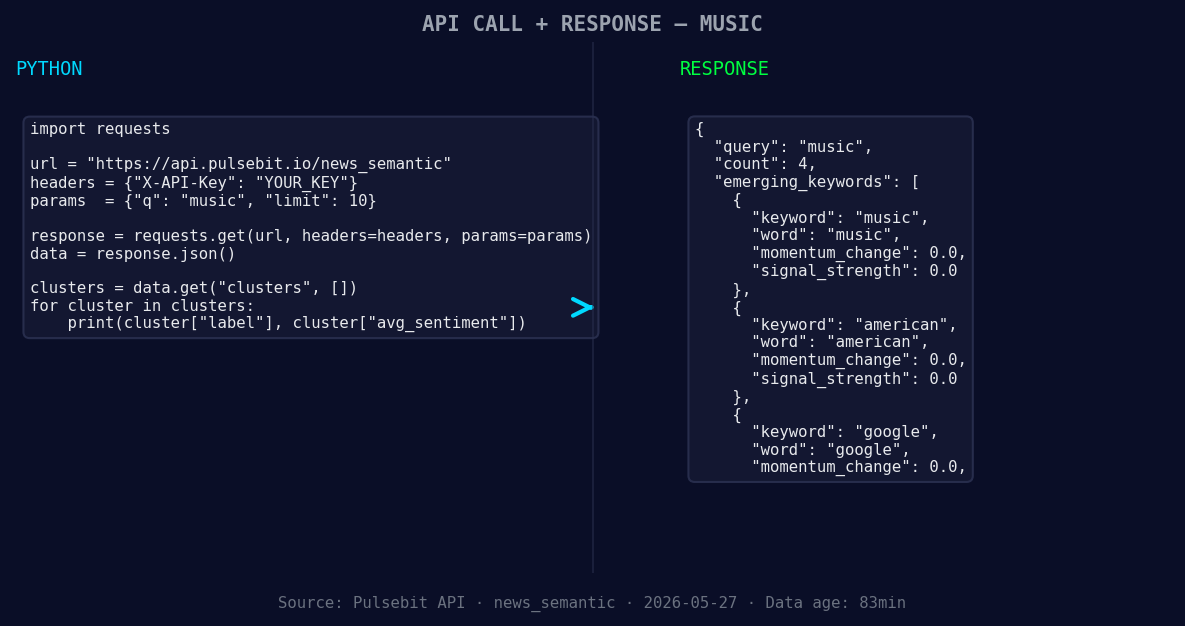
*Left: Python GET /news_semantic call for 'music'. Right: returned JSON response structure (clusters: 3). Source: Pulsebit /news_semantic.*
# Make the API call to get sentiment data
response = requests.get("https://api.pulsebit.com/v1/sentiment", params=params)
data = response.json()
# Print the sentiment data
print(data)
Next, let’s run the cluster reason string through our sentiment endpoint to score the narrative framing itself. This will provide us with a meta-sentiment score for the context of the emerging trend.
# Define the cluster reason string
cluster_reason = "Clustered by shared themes: new, jazz, bar, chennai, former."

# Make the API call for meta-sentiment
meta_response = requests.post("https://api.pulsebit.com/v1/sentiment", json={"text": cluster_reason})
meta_data = meta_response.json()

# Print the meta sentiment data
print(meta_data)
Now, let’s talk about three specific builds that can leverage this newfound pattern.
Geo-Filtered Music Sentiment Analysis: Build a signal that tracks music sentiment specifically in Chennai, filtering for English-language articles. Set a threshold of momentum greater than +0.70 to flag significant spikes.
Meta-Sentiment Scoring for Cultural Events: Create a routine that runs any cluster reason strings through our sentiment endpoint, generating a score for how well the narrative aligns with positive or negative sentiment. Use this to gauge public interest in emerging cultural events.
Forming Theme Alerts: Develop an alert system for themes that are forming in the context of music, particularly around keywords like "jazz" or "American." Monitor the sentiment scores for these themes and set alerts for any that cross a threshold of 0.50 in sentiment score.
By implementing these builds, you can ensure that you’re not just capturing spikes, but deeply understanding the narratives and context behind them.
If you’re ready to get started, check out our documentation at pulsebit.lojenterprise.com/docs. You can copy-paste the code we shared and run this in under 10 minutes. Don’t let your pipeline stay 10 hours behind; catch the momentum while it’s rising.


Top comments (0)