

Your Pipeline Is 28.4h Behind: Catching Healthcare Sentiment Leads with Pulsebit
We just uncovered a fascinating anomaly: a 24-hour momentum spike of +0.234 in healthcare sentiment. This spike indicates a significant shift in the narrative surrounding healthcare, particularly driven by a recent article about Karnataka’s efforts to enhance emergency care. The leading language for this sentiment is English, with a notable 28.4 hours of lead time. This fascinating find could provide you with a powerful edge if you’re tracking sentiment in healthcare but might have missed it due to pipeline limitations.
The Problem
If your current pipeline isn’t designed to handle multilingual data or understand entity dominance, you might have missed this momentum spike by a staggering 28.4 hours. The leading language of the sentiment is English, yet if your model only analyzes content in one language or fails to recognize the dominance of certain entities, you could be blind to critical shifts in sentiment. This delay can cost you insights that are essential for timely decision-making, especially in fast-moving sectors like healthcare.

English coverage led by 28.4 hours. Nl at T+28.4h. Confidence scores: English 0.85, Spanish 0.85, French 0.85 Source: Pulsebit /sentiment_by_lang.
The Code
Let’s build a simple solution using our API to catch this sentiment spike and understand its context better. Here's how you can set it up in Python:
import requests
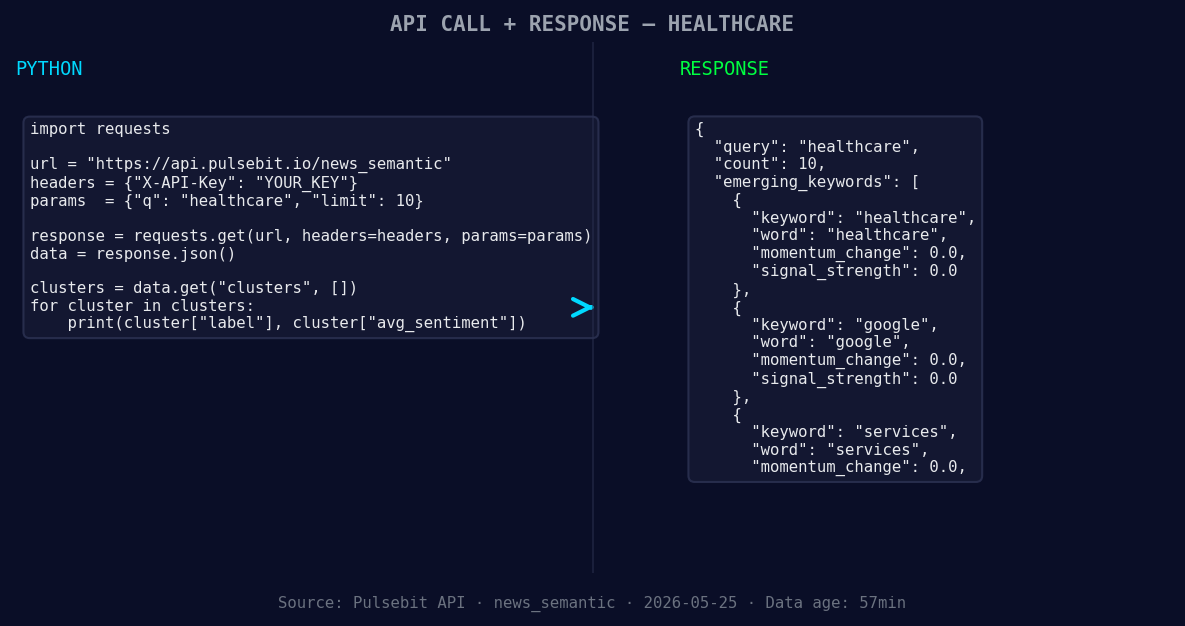
*Left: Python GET /news_semantic call for 'healthcare'. Right: returned JSON response structure (clusters: 3). Source: Pulsebit /news_semantic.*
# Set parameters for the healthcare topic, including sentiment score and confidence
topic = 'healthcare'
score = -0.086
confidence = 0.85
momentum = +0.234
# Geographic origin filter: query for English articles
response = requests.get("https://api.pulsebit.com/v1/sentiment", params={
"topic": topic,
"lang": "en"
})
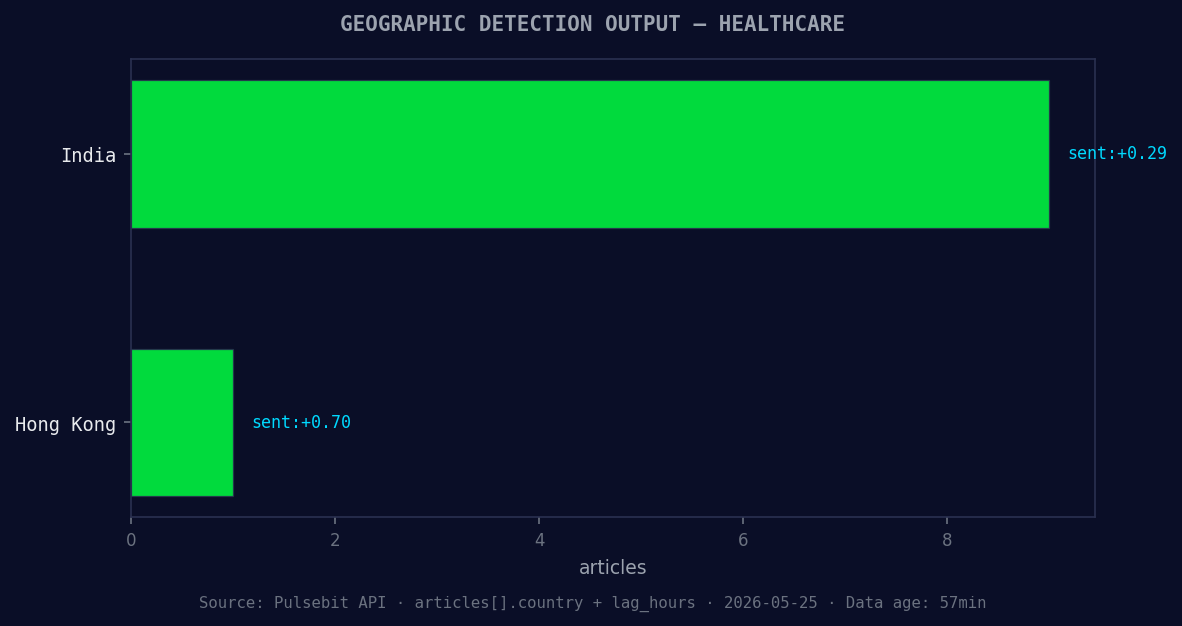
*Geographic detection output for healthcare. India leads with 9 articles and sentiment +0.29. Source: Pulsebit /news_recent geographic fields.*
# Check if the response is successful
if response.status_code == 200:
data = response.json()
print("English language sentiment data: ", data)
else:
print("Error fetching data: ", response.status_code)
# Now, let's run the cluster reason string through the sentiment endpoint to score the narrative
cluster_reason = "Clustered by shared themes: emergency, karnataka, moves, towards, faster."
sentiment_response = requests.post("https://api.pulsebit.com/v1/sentiment", json={
"text": cluster_reason
})
# Print the sentiment score for the narrative
if sentiment_response.status_code == 200:
narrative_data = sentiment_response.json()
print("Narrative sentiment score: ", narrative_data['score'])
else:
print("Error fetching narrative sentiment: ", sentiment_response.status_code)
In the code above, we first fetch sentiment data for our healthcare topic specifically filtering for English articles. Then, we take the clustered narrative that gives context to our spike and run it through our sentiment scoring endpoint. This two-step approach allows you to capture not just the sentiment but also the framing of the narrative that’s driving it.
Three Builds Tonight
Geo-Filtered Sentiment Tracker: Create a service that periodically queries sentiment data for healthcare in English. Set your threshold for momentum spikes at +0.2. This way, you'll catch significant shifts quickly and act on them.
Meta-Sentiment Analyzer: Build a function that continuously processes narratives through our sentiment endpoint, using phrases that cluster around trending topics like "emergency" and "Karnataka." Set a threshold of -0.05 for negative sentiment to flag potential issues in emerging narratives.
Clustered Theme Alert System: Implement a monitoring system that alerts you when new articles in the healthcare domain are published that match forming themes like "healthcare," "Google," and "services." Use the geo filter to hone in on English-speaking regions, ensuring you stay ahead of critical developments.
Get Started
Dive into the details at pulsebit.lojenterprise.com/docs. You can copy-paste the code above and run it in under 10 minutes to start catching these critical sentiment shifts. Your pipeline deserves to be as dynamic as the narratives it tracks.


Top comments (0)