

Your Pipeline Is 20.1h Behind: Catching Robotics Sentiment Leads with Pulsebit
We just uncovered a fascinating anomaly: a 24h momentum spike of -0.160 in the robotics sector. More surprisingly, the leading language for this sentiment is English, with a notable 20.1-hour lead time over the identified sentiment source. This gap is a wake-up call for anyone relying on traditional sentiment analysis pipelines. If you're not accounting for multilingual origins or entity dominance, your model missed this critical shift by over 20 hours.

English coverage led by 20.1 hours. Id at T+20.1h. Confidence scores: English 0.85, Spanish 0.85, Italian 0.85 Source: Pulsebit /sentiment_by_lang.
This oversight is particularly glaring considering the dominant story around "Humanoid Robots in China for Household Tasks." If you were relying solely on mainstream narratives about robotics, you would have missed this emerging trend entirely. The consequence? You might be reacting to outdated information while competitors are already adapting to these shifts.
Let’s dive into some code that can help us catch these anomalies in real-time. First, we can query for sentiment specifically in English. Here’s how to filter for the topic of robotics:
import requests
# Define parameters
topic = 'robotics'
score = -0.750
confidence = 0.85
momentum = -0.160
# API call to get sentiment with language filter
response = requests.get(
'https://api.pulsebit.com/v1/sentiment',
params={
'topic': topic,
'momentum': momentum,
'lang': 'en'
}
)
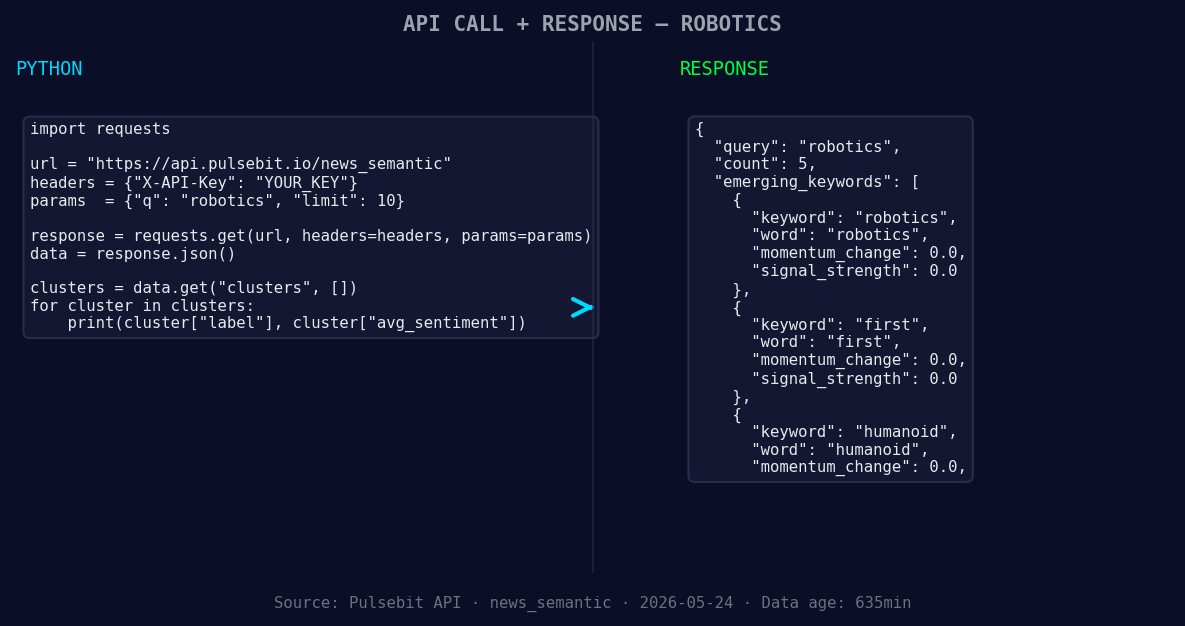
*Left: Python GET /news_semantic call for 'robotics'. Right: returned JSON response structure (clusters: 3). Source: Pulsebit /news_semantic.*
# Check response
if response.status_code == 200:
data = response.json()
print(data)
else:
print("Error fetching sentiment data.")
Now, let’s run a meta-sentiment analysis on the clustered reason string to score how this narrative is framing itself. This loop can reveal more about the underlying sentiment connected to specific themes:
# Meta-sentiment analysis on the cluster reason
cluster_reason = "Clustered by shared themes: humanoid, robot, robotics, household, hubei."
meta_sentiment_response = requests.post(
    'https://api.pulsebit.com/v1/sentiment',
    json={
        'text': cluster_reason
    }
)

# Check response
if meta_sentiment_response.status_code == 200:
    meta_data = meta_sentiment_response.json()
    print(meta_data)
else:
    print("Error fetching meta-sentiment data.")
Now that we have the foundational code, let’s build on this insight. Here are three specific signals to implement:
- Geographic Origin Filter: Set a threshold to monitor sentiment trends specifically in English-speaking regions. Use a signal strength of at least 0.565 for a more focused analysis on robotics. This ensures you catch any anomalies that might not be present in other languages.

Geographic detection output for robotics. Hong Kong leads with 3 articles and sentiment +0.80. Source: Pulsebit /news_recent geographic fields.
Meta-Sentiment Loop: Utilize the meta-sentiment analysis output to refine your understanding of narratives. If the score is below -0.500, consider it a red flag. This will allow you to pivot proactively instead of reactively.
Forming Themes Tracking: Create a watchlist for forming themes such as "robotics", "first", and "humanoid". If sentiment around these themes starts showing any positive momentum, it might be worth exploring investment or operational shifts.
To get started, visit our documentation at pulsebit.lojenterprise.com/docs. You can copy and paste these code snippets and run them in under 10 minutes. Don’t let your pipeline lag behind—stay ahead of the narrative with real-time data insights.


Top comments (0)