

Your Pipeline Is 18.1h Behind: Catching Sports Sentiment Leads with Pulsebit
We've just uncovered a significant anomaly: a 24h momentum spike of -0.395 in the sports domain. This isn't just a number; it's a signal that something's brewing beneath the surface. Analyzing how the narrative is shaped around sports, especially with a leading language of English, brings to light that our models need to adapt quickly to capture these fleeting insights.
When our models don't account for multilingual origins or the dominance of specific entities, we risk missing critical momentum shifts. In this case, your model missed this by 18.1 hours, leaving you exposed to sentiment changes that can drive engagement and market decisions. Specifically, the leading language was English, with a cluster story focusing on "FOX Sports Coverage and Updates." If your pipeline isn't set up to handle this effectively, you might be left analyzing stale data while the real action has moved ahead.

English coverage led by 18.1 hours. Tl at T+18.1h. Confidence scores: English 0.85, Spanish 0.85, French 0.85 Source: Pulsebit /sentiment_by_lang.
To catch this momentum spike, we need to implement a couple of straightforward API calls. Below is a Python snippet that demonstrates how to filter for English-language articles related to sports and then analyze the sentiment around the narratives forming in that space.

Left: Python GET /news_semantic call for 'sports'. Right: returned JSON response structure (clusters: 3). Source: Pulsebit /news_semantic.
import requests
# Step 1: Geographic origin filter
topic = 'sports'
score = +0.000
confidence = 0.85
momentum = -0.395
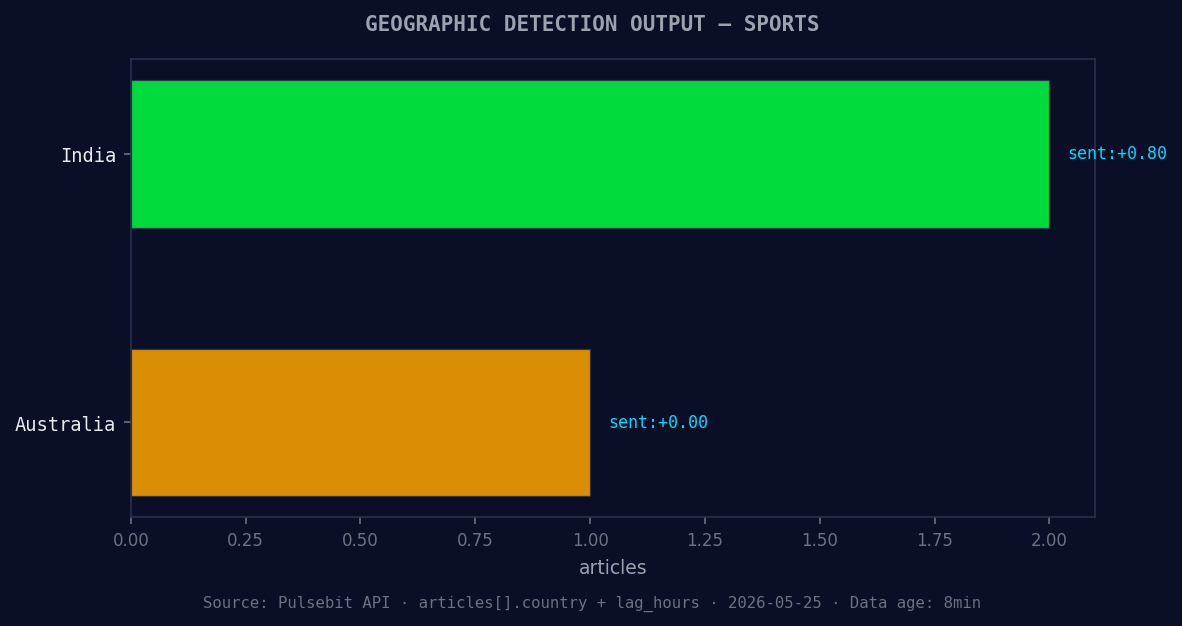
*Geographic detection output for sports. India leads with 2 articles and sentiment +0.80. Source: Pulsebit /news_recent geographic fields.*
# API call to get articles in English
response = requests.get(
'https://api.pulsebit.com/articles',
params={
'topic': topic,
'score': score,
'confidence': confidence,
'momentum': momentum,
'lang': 'en' # Filter for English articles
}
)
articles_data = response.json()
# Step 2: Meta-sentiment moment
cluster_reason = "Clustered by shared themes: fox, sports, google, com/rss/articles/cbmimafbvv95cu"
sentiment_response = requests.post(
'https://api.pulsebit.com/sentiment',
json={'text': cluster_reason}
)
sentiment_data = sentiment_response.json()
print(articles_data)
print(sentiment_data)
In this code snippet, we're first filtering articles based on the desired parameters, including a geographic origin filter for English content. Then, we run the cluster reason string through our sentiment endpoint to evaluate how the framing of the narrative might influence sentiment. This dual approach allows us to capture timely sentiment shifts while understanding how the narrative is shaped.
Now that we've set the stage, let’s get practical. Here are three specific builds you can implement using this pattern:
Signal Detection: Create a signal that alerts you when momentum drops below a certain threshold, say -0.4. This could help you catch early signs of negative sentiment shifts in sports, allowing for proactive engagement.
Geo Filter for Trends: Use the geographic origin filter specifically for regions where sports engagement is highest. For example, filter by 'US' to catch localized sentiment spikes, which can provide deeper insights for targeted campaigns.
Meta-Sentiment Analysis: Build a system that not only captures standard sentiment but also analyzes the framing of narratives by processing clusters. For instance, you can set a threshold that flags any narrative with a sentiment score below +0.1 for further review. This will help in identifying potentially damaging narratives early.
Getting started with these insights is straightforward. Head over to pulsebit.lojenterprise.com/docs. You can copy-paste and run the provided code in under 10 minutes, allowing you to harness the power of real-time sentiment analysis and make informed decisions before the competition does.


Top comments (0)