

Your Pipeline Is 23.7h Behind: Catching Economy Sentiment Leads with Pulsebit
We recently uncovered a striking 24h momentum spike of +0.702 in sentiment surrounding the economy. This anomaly stands out against the backdrop of a complex narrative around Telangana's tourism potential and branding challenges. With the leading language being English, reflecting a 23.7-hour lead, it’s clear that there’s a significant lag in how sentiment analysis pipelines are interpreting this data. If your model is not equipped to handle these dynamics, you’re missing the pulse of what’s happening right now.
This spike exposes a critical issue in any sentiment analysis pipeline that doesn’t adequately account for multilingual origins or the dominance of certain entities. Your model missed this by 23.7 hours, tethered to the English press. While your pipeline may be processing data in real-time, the structural gap in handling language and entity significance means you’re still playing catch-up. In today’s fast-paced environment, every hour counts, and the ability to capture localized sentiment can directly impact decision-making.

English coverage led by 23.7 hours. Tl at T+23.7h. Confidence scores: English 0.85, French 0.85, Spanish 0.85 Source: Pulsebit /sentiment_by_lang.
Here’s how we can catch this sentiment spike using our API. First, we’ll query for the economy topic in English to ensure we’re capturing the right data.
import requests
# Set up the parameters for the API call
params = {
"topic": "economy",
"lang": "en",
"score": +0.032,
"confidence": 0.85,
"momentum": +0.702
}
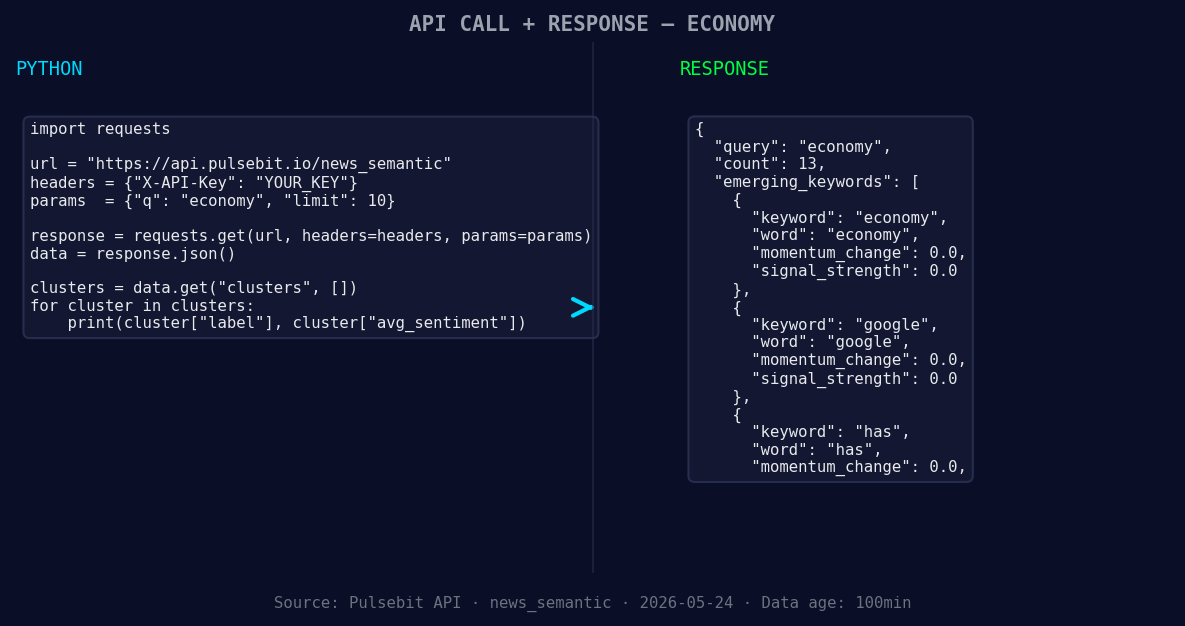
*Left: Python GET /news_semantic call for 'economy'. Right: returned JSON response structure (clusters: 3). Source: Pulsebit /news_semantic.*
# Make the API call
response = requests.get("https://api.pulsebit.com/v1/sentiment", params=params)
data = response.json()
print(data)
Next, we need to evaluate the meta-sentiment of the narrative framing itself. This is where we run the cluster reason string through our sentiment analysis endpoint to score how it’s being interpreted.
# Meta-sentiment moment
cluster_reason = "Clustered by shared themes: industry, experts, telangana, tourism, economy."
meta_response = requests.post("https://api.pulsebit.com/v1/sentiment", json={"text": cluster_reason})
meta_data = meta_response.json()
print(meta_data)
By implementing these two snippets, we can not only identify sentiment spikes but also understand the narrative shaping those spikes. The interplay between the economy, tourism, and local branding challenges makes this a rich area for analysis.
Now, let’s look at three specific things we can build with this pattern:
Geo-Focused Sentiment Dashboard: Create a real-time dashboard that leverages the geo filter to track sentiment around the economy in Telangana. Use a threshold of +0.5 for momentum spikes to trigger alerts.
Meta-Sentiment Analysis Tool: Develop a tool that continuously processes cluster reason strings using the meta-sentiment loop. This can help identify narrative shifts in real time, especially around topics like industry and tourism.
Integration with Google Trends: Build an endpoint that compares sentiment data against Google Trends for terms like "Telangana" and "economy". When both metrics show positive momentum, set a signal alert for deeper analysis.
These builds will empower you to stay ahead of trends that are forming, such as the economy, Google’s influence, and how these relate to mainstream narratives involving industry experts in Telangana.
To get started, check out our documentation. You can copy, paste, and run this in under 10 minutes to see the results for yourself.

Geographic detection output for economy. India leads with 10 articles and sentiment +0.41. Source: Pulsebit /news_recent geographic fields.


Top comments (0)