

Your pipeline just missed a significant anomaly: a 24-hour momentum spike of +0.491 in cloud sentiment. This spike isn't just a number; it's a signal you should have captured sooner. The leading language for this sentiment is English, which has a 23.3-hour lead, suggesting that if your model isn't tuned to handle multilingual data or is lagging on dominant entities, you could be missing out on critical insights. The implications? Your model missed capturing this sentiment shift by a substantial 23.3 hours, leaving you behind in a fast-evolving space.

English coverage led by 23.3 hours. No at T+23.3h. Confidence scores: English 0.85, Spanish 0.85, French 0.85 Source: Pulsebit /sentiment_by_lang.
The structural gap here is clear. If your sentiment analysis pipeline isn't built to handle multilingual origins or doesn’t prioritize dominant entities like "cloud," you're operating with outdated insights. In our case, the leading entity was cloud-related discussions, revealing a significant gap that could affect decision-making. This isn't just about missing a trend; it's about losing your competitive edge when the world is discussing the future of cloud capacities and AI.
To catch up, let’s dive into the code. Below is a Python snippet that uses our API to filter sentiment data based on geographic origin and assess the narrative framing of the clustered articles.

Geographic detection output for cloud. India leads with 2 articles and sentiment +0.85. Source: Pulsebit /news_recent geographic fields.
import requests
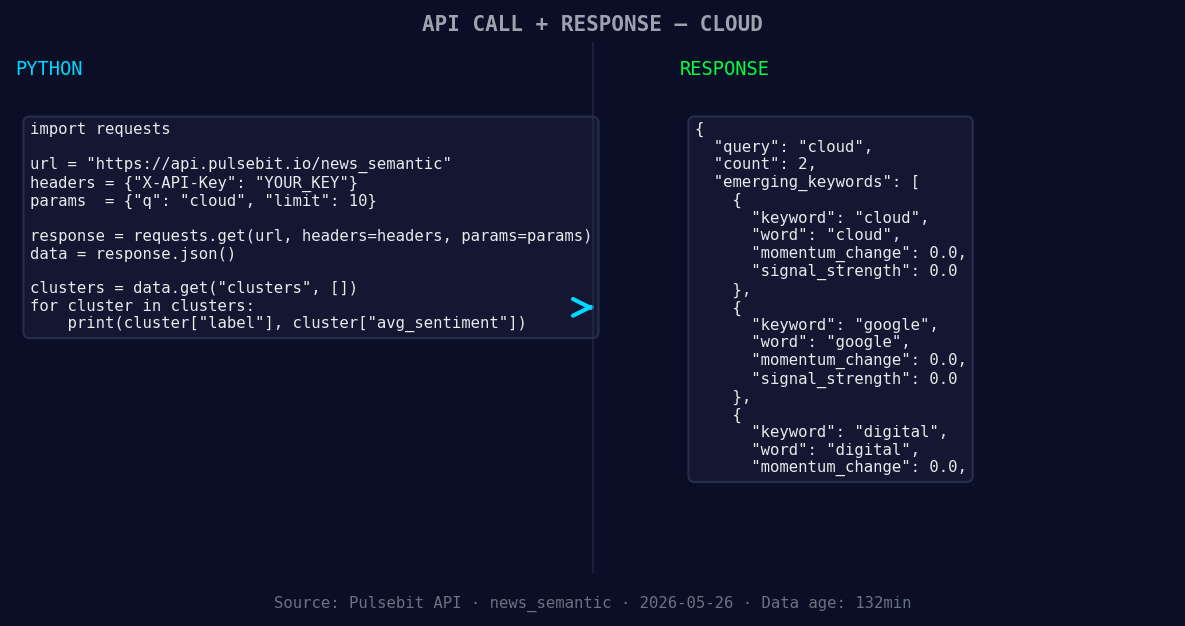
*Left: Python GET /news_semantic call for 'cloud'. Right: returned JSON response structure (clusters: 3). Source: Pulsebit /news_semantic.*
# Step 1: Geographic origin filter for sentiment on 'cloud'
url = "https://api.pulsebit.com/v1/sentiment"
params = {
"topic": "cloud",
"lang": "en",
"score": +0.453,
"confidence": 0.85,
"momentum": +0.491
}
response = requests.get(url, params=params)
data = response.json()
print("Sentiment Data:", data)
# Step 2: Meta-sentiment moment on the cluster reason
cluster_reason = "Clustered by shared themes: 2026, earnings, show, cloud, capacity."
meta_response = requests.post(url, json={"text": cluster_reason})
meta_data = meta_response.json()
print("Meta Sentiment Data:", meta_data)
This code first queries our sentiment API for the cloud topic, filtered by the English language. The importance of the language filter is paramount, especially when dominant narratives emerge in specific languages. Next, we pass the cluster reason string back through our sentiment API to gauge how the narrative itself is framing the sentiment. This two-step approach allows us to capture both the immediate sentiment and the context behind it.
Here are three specific builds you can implement with this newfound insight:
Signal Monitoring: Set up a monitoring system to trigger alerts when a momentum spike exceeds a threshold of +0.4 in the cloud domain. This ensures you catch significant shifts as they happen.
Geo-Filtered Analysis: Create an endpoint that consistently pulls sentiment data filtered by geographic regions, specifically targeting the English-speaking world and checking for spikes like the recent +0.491. This will help you stay ahead of trends that start in specific locations.
Meta-Sentiment Loop: Implement a function that takes the cluster reason and scores it regularly, especially when articles mention emerging topics like "cloud," "Google," or "digital." This would allow you to capture the framing of discussions surrounding mainstream topics such as earnings and capacity.
This is not just an exercise; it’s a necessary evolution of your data pipeline. As you integrate these builds, you'll find yourself better equipped to capture the rapid shifts in sentiment—especially in critical areas like cloud computing.
Ready to get started? Head over to pulsebit.lojenterprise.com/docs. You can copy-paste the above code and run it in under 10 minutes to start catching those vital insights before they become outdated.


Top comments (0)