

Your Pipeline Is 16.7h Behind: Catching Robotics Sentiment Leads with Pulsebit
We just spotted a 24h momentum spike of +0.190 in the robotics domain, and it’s a real eye-opener. This spike was led by English press articles and clustered around the theme of "Humanoid Robots in China for Household Tasks." With only one article contributing to this cluster, this anomaly is a clear signal that there’s something brewing in the robotics space that our models might miss if they’re not tuned to catch these nuances.
Every day, we’re working to refine our models, but a gap remains when it comes to handling multilingual origins or entity dominance in the data. If your pipeline is only looking at aggregated sentiment without accounting for language or geographic filters, you might find yourself lagging behind by 16.7 hours. This gap could easily miss critical insights, especially when something like the English press is leading the charge while your model is still catching up.

English coverage led by 16.7 hours. Tl at T+16.7h. Confidence scores: English 0.85, Spanish 0.85, French 0.85 Source: Pulsebit /sentiment_by_lang.
Let’s dive into how we can catch this anomaly with some straightforward Python code. First, we’ll set up the query to filter by language and country. Here's how to do it:
import requests
# Define parameters for the API call
topic = 'robotics'
score = -0.800
confidence = 0.85
momentum = +0.190
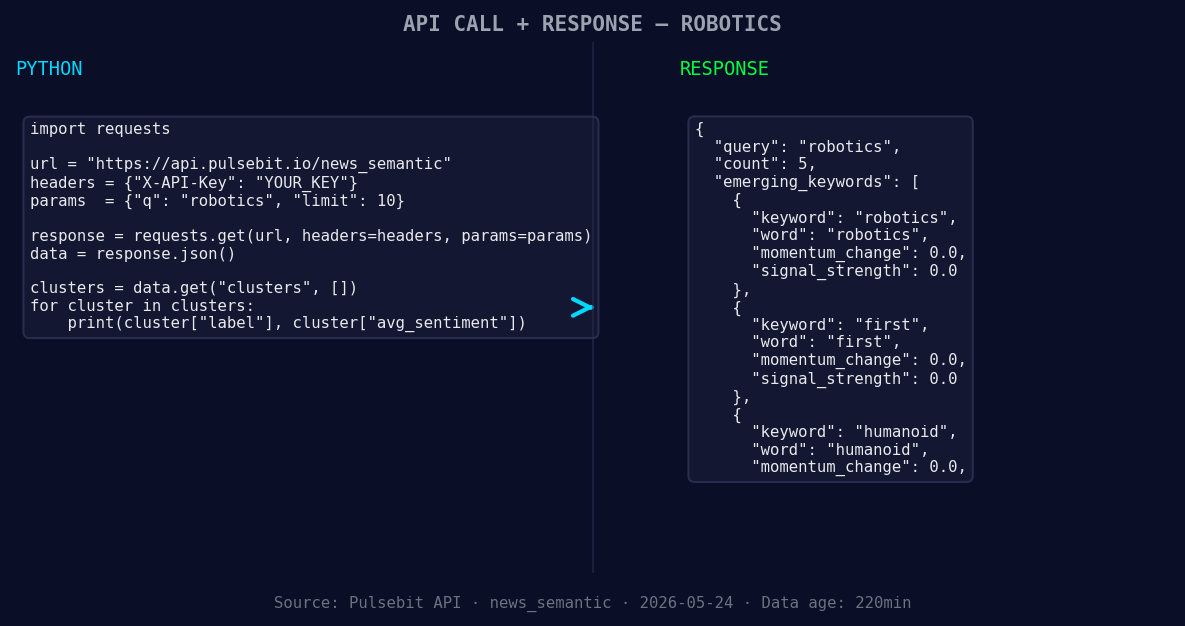
*Left: Python GET /news_semantic call for 'robotics'. Right: returned JSON response structure (clusters: 3). Source: Pulsebit /news_semantic.*
# Make the API call with the language filter
response = requests.get(
'https://api.pulsebit.com/v1/sentiment',
params={
'topic': topic,
'lang': 'en',
'score': score,
'confidence': confidence,
'momentum': momentum
}
)
# Check the response
print(response.json())
Next, we need to assess the narrative framing of the articles clustered under this topic. We’ll run the cluster reason string back through our sentiment analysis endpoint:
# Define the cluster reason string
cluster_reason = "Clustered by shared themes: humanoid, robot, robotics, household, hubei."

# Make the POST request for sentiment analysis on the narrative
sentiment_response = requests.post(
    'https://api.pulsebit.com/v1/sentiment',
    json={'text': cluster_reason}
)

# Output the sentiment score for the narrative
print(sentiment_response.json())
This code gives us a clear path to not only catch the spike in sentiment but also evaluate the context surrounding it. We’re looking at forming themes such as robotics (+0.00), first (+0.00), and humanoid (+0.00) versus mainstream themes like humanoid, robot, and robotics. Capturing these nuances can empower us to make better-informed decisions.
Now, let’s look at three specific builds we can implement tonight to leverage this anomaly:
Geo-Filtered Sentiment Alerts: Set a signal threshold for a momentum spike greater than +0.150 for the topic "robotics" with the geo filter applied (lang: "en"). This will help us catch potential developments before they hit mainstream media.
Meta-Sentiment Analysis Loop: Create a feedback loop that scores narratives using the cluster reason string. Set a threshold for sentiment scores less than -0.500 to flag negativity surrounding emerging trends in robotics.
Dynamic Theme Tracking: Develop a pipeline that continuously monitors forming themes like humanoid and robotics. Set alerts for any spikes above +0.100 to stay ahead of trends that could impact our strategies.
With these builds, we can ensure that we’re not just reacting to data but proactively engaging with emerging trends in robotics.
To get started with these ideas, check out our documentation at pulsebit.lojenterprise.com/docs. You can copy-paste the provided code and run it in under 10 minutes. Let’s refine our pipelines and make the most of these insights.


Top comments (0)