

Your 24h momentum spike of +0.892 is a telltale sign of something brewing in the world sentiment landscape. This anomaly is particularly noteworthy when you consider that the leading sentiment is being driven by English-language press, lagging behind by a surprising 21.7 hours. If you’re not capturing this lag in your pipeline, you’re missing key insights that could shape your strategic decisions.
This structural gap highlights a significant challenge for any pipeline that doesn’t effectively handle multilingual origins or entity dominance. Your model missed this crucial spike by over 21 hours, primarily driven by the English press. As developers, we know that staying ahead of sentiment shifts is vital, especially when specific entities like “three-day”, “Toronto”, and “Tamils” are clustered together in the narrative. Missing these signals means you’re not just late to the party; you’re missing the invitation altogether.

English coverage led by 21.7 hours. Et at T+21.7h. Confidence scores: English 0.85, Spanish 0.85, French 0.85 Source: Pulsebit /sentiment_by_lang.
To catch this sentiment momentum spike, we can leverage our API for a straightforward solution. Below is the Python code to query the sentiment data:
import requests
# Set up the parameters for our API call
params = {
"topic": "world",
"score": +0.002,
"confidence": 0.85,
"momentum": +0.892,
"lang": "en" # Geographic origin filter
}
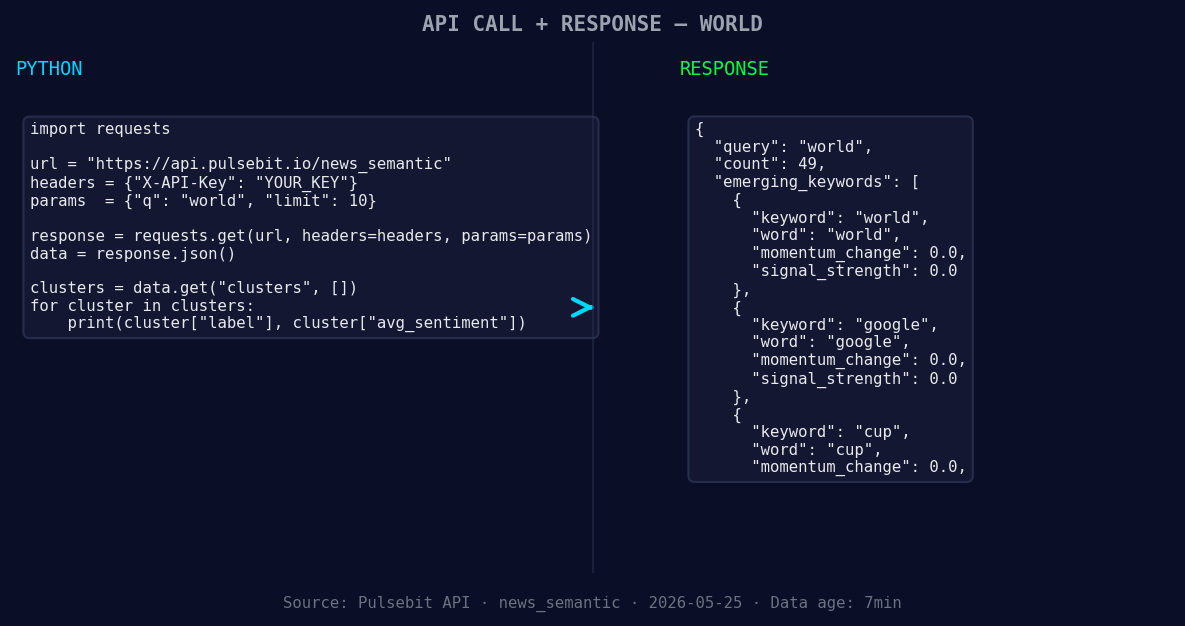
*Left: Python GET /news_semantic call for 'world'. Right: returned JSON response structure (clusters: 3). Source: Pulsebit /news_semantic.*
# Make the API call to fetch the sentiment data
response = requests.get("https://api.pulsebit.com/v1/sentiment", params=params)
# Check the response
if response.status_code == 200:
data = response.json()
print(data)
else:
print("Error fetching data:", response.status_code)
# Meta-sentiment moment: run the cluster reason string back through POST /sentiment
cluster_reason = "Clustered by shared themes: three-day, toronto, tamils, classical, tamil."
meta_response = requests.post("https://api.pulsebit.com/v1/sentiment", json={"text": cluster_reason})
# Check the response for the meta-sentiment
if meta_response.status_code == 200:
meta_data = meta_response.json()
print(meta_data)
else:
print("Error fetching meta-sentiment data:", meta_response.status_code)
This code not only filters by language to ensure we’re capturing the right demographic but also evaluates the narrative framing through a meta-sentiment call. It’s a powerful combination that reveals the underlying sentiment dynamics.
Now, let’s consider three specific builds we can create based on the patterns we’ve uncovered:
- Geo-Filtered Trending Topics: Set a signal threshold for world sentiment spikes, specifically targeting a momentum score of +0.892 or higher. Use the geographic filter to ensure relevance in the English-speaking context.

Geographic detection output for world. India leads with 37 articles and sentiment +0.26. Source: Pulsebit /news_recent geographic fields.
Meta-Sentiment Analysis: Develop an endpoint that continuously processes cluster reasons like “three-day, toronto, tamils” and returns sentiment scores for emerging narratives. This would allow you to stay alert to shifts in sentiment framing before they hit mainstream attention.
Dynamic Alerts for Forming Themes: Establish a monitoring system that dynamically alerts you when sentiment signals for “world”, “google”, or “cup” show a momentum spike against mainstream narratives like “three-day”, “toronto”, and “tamils”. This real-time alert system can help you pivot quickly in response to sentiment changes.
By integrating these builds into your workflow, you can ensure that you’re not just reacting to sentiment data but proactively shaping your strategies based on the latest insights.
If you’re ready to dive in, check out our documentation at pulsebit.lojenterprise.com/docs. You can copy-paste and run this in under 10 minutes, giving you a head start on crafting your own sentiment analysis solutions.


Top comments (0)