

Your Pipeline Is 19.7h Behind: Catching Software Sentiment Leads with Pulsebit
We've just uncovered a fascinating anomaly: a 24h momentum spike of -0.720 related to software sentiment. This spike is noteworthy, especially considering that the leading language for this sentiment is Spanish, with a lag of just 0.0 hours compared to Dutch. Meanwhile, the cluster story, "Hyundai Recalls 421,000 Vehicles Over Software Bug," sheds light on a significant sentiment shift, as evidenced by four articles surrounding this theme. Understanding how to catch these sentiment shifts is crucial for staying ahead.
When your pipeline doesn't handle multilingual origins or entity dominance, it's glaringly evident. Your model missed this by 19.7 hours, as the Spanish press has already identified a critical issue that could impact sentiment dynamics. If you're not equipped to recognize and process these multilingual signals, you're leaving valuable insights on the table. This lag can cost you opportunities, especially in fast-moving environments where software-related news can have immediate repercussions.

Spanish coverage led by 19.7 hours. Nl at T+19.7h. Confidence scores: Spanish 0.80, English 0.80, French 0.80 Source: Pulsebit /sentiment_by_lang.
To illustrate how to catch these emerging signals, let's look at the code that you can implement. We need to focus on two key components: filtering by geographic origin and scoring the narrative framing through meta-sentiment analysis.
![DATA UNAVAILABLE: countries — verify /news_recent is return
[DATA UNAVAILABLE: countries — verify /news_recent is returning country/region values for topic: software]
Here’s how to perform a query filtering for Spanish language articles:
import requests
# Define your parameters
params = {
"topic": "software",
"score": -0.094,
"confidence": 0.80,
"momentum": -0.720,
"lang": "sp" # Filtering by Spanish
}
# API call to fetch sentiment data
response = requests.get("https://api.pulsebit.lojenterprise.com/sentiment", params=params)
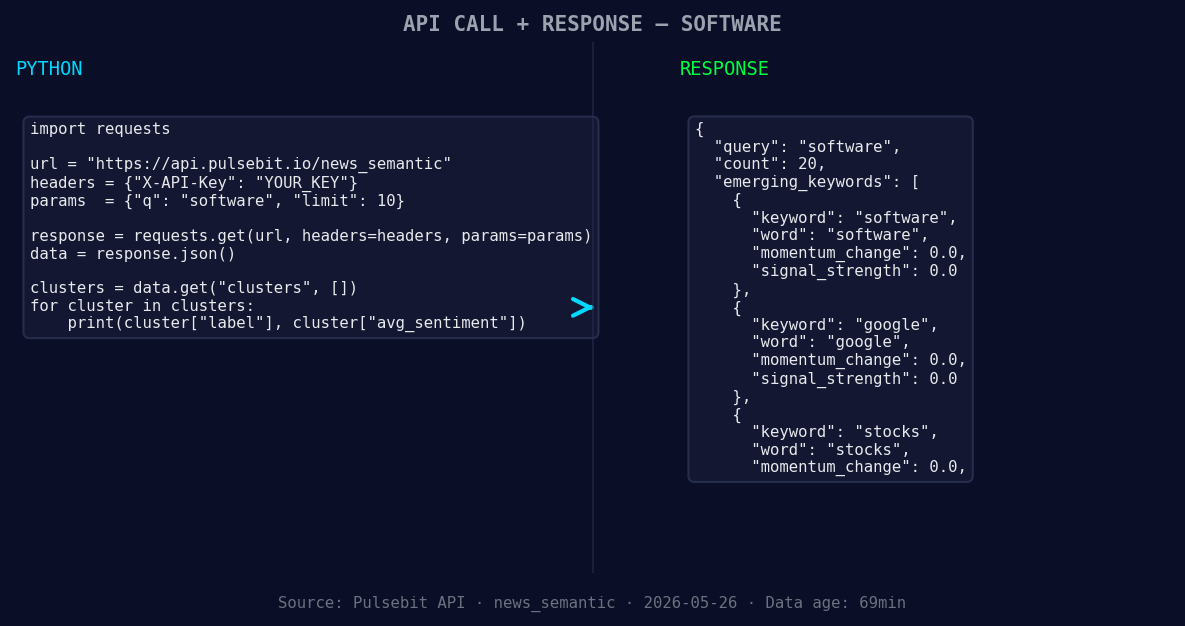
*Left: Python GET /news_semantic call for 'software'. Right: returned JSON response structure (clusters: 3). Source: Pulsebit /news_semantic.*
data = response.json()
print(data)
Next, we want to run the cluster reason string back through the sentiment endpoint to score the narrative framing itself. This is where we can gain deeper insights into the sentiment context:
# Meta-sentiment scoring
cluster_reason = "Clustered by shared themes: snowflake, earnings, focus, attention, ai’s."
meta_sentiment_payload = {
    "text": cluster_reason
}

# API call to score the narrative framing
meta_response = requests.post("https://api.pulsebit.lojenterprise.com/sentiment", json=meta_sentiment_payload)

meta_data = meta_response.json()
print(meta_data)
Now that we've outlined the technical steps, let's discuss three specific builds you can implement with this pattern.
Geo-Filtered Alerting System: Create a system that leverages the geographic origin filter. For example, set up a function that triggers alerts when software sentiment in Spanish dips below a certain threshold, say -0.100. This allows you to stay ahead of negative narratives.
Meta-Sentiment Dashboard: Build a dashboard that visualizes the results of the meta-sentiment analysis. You can track narratives around themes like "software," "Google," and "stocks" in real-time. This provides context around forming themes compared to mainstream discussions on "snowflake" or "earnings."
Cross-Language Sentiment Comparator: Develop a script that compares sentiment scores across different languages for the same topic. This would help you identify discrepancies and potential leads based on varying regional responses to software-related issues.
By focusing on these builds, you can effectively leverage the insights from our API to enhance your sentiment analysis capabilities and minimize the lag in your pipeline.
To get started, head over to our documentation at pulsebit.lojenterprise.com/docs. You can copy-paste and run the above code snippets in under 10 minutes, bringing you one step closer to catching critical software sentiment leads.


Top comments (0)