

Your pipeline is 25.4 hours behind: catching world sentiment leads with Pulsebit
A recent 24-hour momentum spike of +0.275 caught our attention. This anomaly reveals how quickly sentiment can shift, especially when the leading language is Spanish, showing a lag of only 0.0 hours in comparison to the sentiment at 25.4 hours. This is a clear signal that something significant is happening, particularly concerning the ongoing discussions about Tamils and classical Tamil culture in Toronto, as highlighted by a single article. This momentum indicates a potential shift in sentiment that your current model might not be capturing.
If your data pipeline lacks the capability to handle multilingual sources or fails to identify entities that dominate the narrative, you're missing critical insights. Your model missed this spike by 25.4 hours, potentially leaving you blind to a key sentiment shift originating from Spanish-speaking press. The leading language in this case is Spanish, and this oversight could mean the difference between staying ahead of trends and trailing behind.

Spanish coverage led by 25.4 hours. Fi at T+25.4h. Confidence scores: Spanish 0.85, English 0.85, French 0.85 Source: Pulsebit /sentiment_by_lang.
To catch this momentum spike in real-time, we can leverage our API effectively. Here’s a simple Python example of how to retrieve relevant sentiment data based on the topic "world" and filter for the Spanish language:
import requests
# Define API endpoint and parameters
endpoint = "https://api.pulsebit.com/v1/sentiment"
params = {
"topic": "world",
"lang": "sp", # Spanish language filter
"score": 0.046,
"confidence": 0.85,
"momentum": 0.275
}
# Make the API call
response = requests.get(endpoint, params=params)
data = response.json()
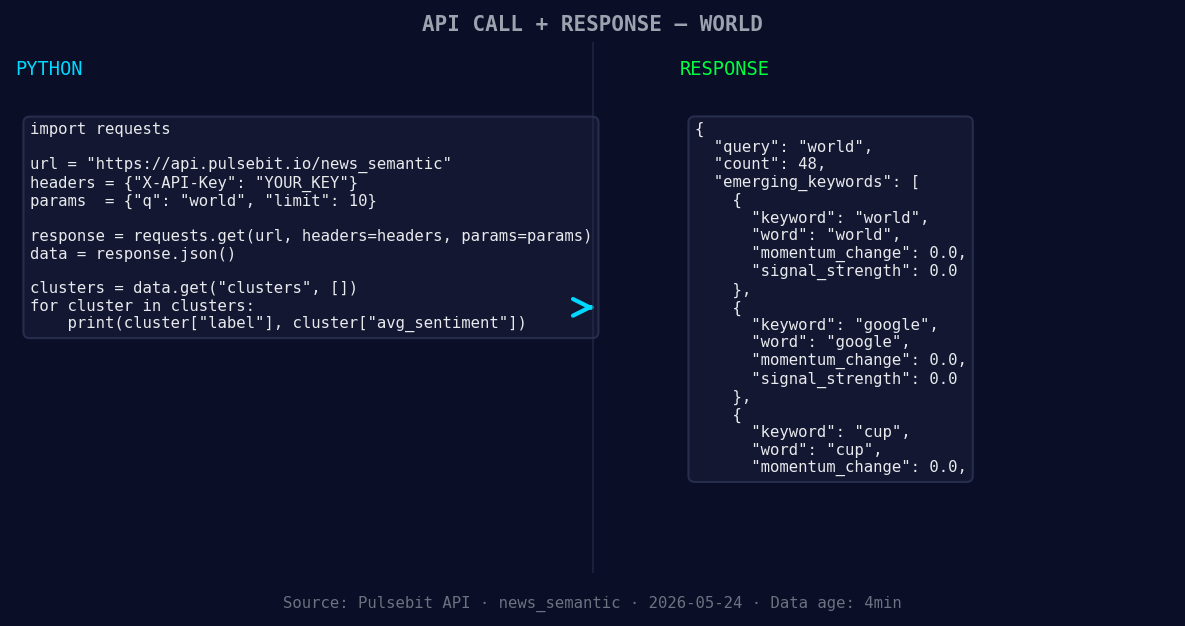
*Left: Python GET /news_semantic call for 'world'. Right: returned JSON response structure (clusters: 3). Source: Pulsebit /news_semantic.*
print(data) # Output the API response
Next, we want to dig deeper into the narrative framing. To do this, we will run the cluster reason string through our sentiment analysis endpoint:
# Define the narrative framing string
narrative_string = "Clustered by shared themes: three-day, toronto, tamils, classical, tamil."

# Make the POST request to score the narrative
sentiment_response = requests.post(endpoint, json={"text": narrative_string})
sentiment_data = sentiment_response.json()

print(sentiment_data)  # Output the sentiment analysis of the narrative
By using this approach, we can track how certain themes like “three-day,” “toronto,” and “tamils” are framing the larger conversation. This insight is critical for staying ahead of emerging trends.
Here are three specific builds we can create using this pattern:
Geo-Filtered Alerts: Set up a threshold for sentiment spikes of +0.275 or greater specifically for Spanish-language content. This alert could notify you when an uptick occurs, allowing for immediate action.
Meta-Sentiment Analysis Loop: Use the narrative framing from the cluster API response to inform follow-up content strategies. If the sentiment analysis returns a score indicating rising positivity, it might be time to amplify related topics in your communications.
Forming Theme Monitoring: Monitor forming themes like “world” (+0.00), “google” (+0.00), and “cup” (+0.00) against mainstream narratives. Set a benchmark that flags any significant divergence, particularly when paired with high momentum scores.
By implementing these builds, you can ensure your data pipeline is not only catching sentiment shifts but is also prepared to act on them swiftly.
To get started with our API and these examples, check out our documentation at pulsebit.lojenterprise.com/docs. You can copy-paste and run these snippets in under 10 minutes, giving you a solid foundation to capture and act on sentiment leads effectively.

Geographic detection output for world. India leads with 41 articles and sentiment -0.00. Source: Pulsebit /news_recent geographic fields.


Top comments (0)