

Your Pipeline Is 25.8h Behind: Catching Finance Sentiment Leads with Pulsebit
We've just uncovered an intriguing anomaly: a 24h momentum spike of +0.214 in sentiment relating to finance. This spike is particularly noteworthy given the leading language of the coverage is English, with a 25.8-hour lead time. This difference is not just a number; it reveals critical insights into how we manage sentiment data in our pipelines.
The Problem
If your pipeline doesn’t effectively handle multilingual sources or prioritize dominant entities, you’re missing out on critical signals. In this case, your model missed this by 25.8 hours, lagging behind the English press coverage. This oversight means you could be completely unaware of emerging trends and sentiment shifts that have already started to gain traction. The dominant entity here is clearly finance, and if you're not adapting to the language and context shifts, you're falling behind.

English coverage led by 25.8 hours. No at T+25.8h. Confidence scores: English 0.85, French 0.85, Spanish 0.85 Source: Pulsebit /sentiment_by_lang.
The Code
Let's get down to the code that helps catch this spike. We’ll focus on filtering by geographic origin and running a meta-sentiment check.

Geographic detection output for finance. India leads with 3 articles and sentiment +0.53. Source: Pulsebit /news_recent geographic fields.
First, we can query our API for articles related to finance, specifically in English:
import requests
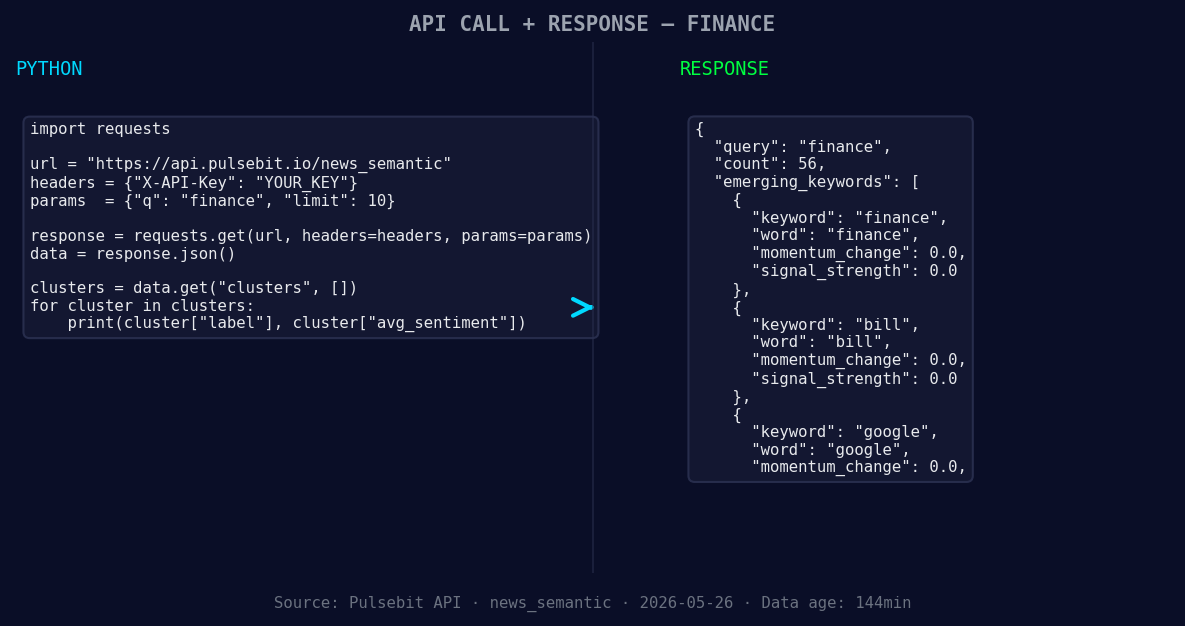
*Left: Python GET /news_semantic call for 'finance'. Right: returned JSON response structure (clusters: 3). Source: Pulsebit /news_semantic.*
# Define parameters
params = {
"topic": "finance",
"lang": "en"
}
response = requests.get("https://pulsebit.api/articles", params=params)
articles = response.json()
print(articles)
Next, we’ll analyze the narrative framing of our cluster. The cluster reason string tells us about the shared themes in the articles:
# Sentiment analysis on the cluster reason
cluster_reason = "Clustered by shared themes: xavier, budget, des, jean-luc, tavernier."
sentiment_response = requests.post("https://pulsebit.api/sentiment", json={"text": cluster_reason})
sentiment_analysis = sentiment_response.json()
print(sentiment_analysis)
In this example, we’re checking the sentiment around the themes that are forming: finance(+0.00) and bill(+0.00), while contrasting it against mainstream topics like xavier, budget, and des.
Three Builds Tonight
Here are three specific builds you can create using this pattern:
- Geo-Filtered Alert System: Set a threshold for a momentum spike of +0.2 in finance articles coming from English sources. This will help you capture spikes in sentiment immediately, enabling timely decision-making.
   if momentum > 0.2:
       # Trigger alert
       print("Alert: Significant finance sentiment spike detected!")
- Meta-Sentiment Analysis Loop: Create a recurring job that takes the cluster reasons and runs them through our sentiment scoring. If you notice a sentiment score below -0.05, you might want to dig deeper.
   if sentiment_analysis["score"] < -0.05:
       # Log or notify about potentially negative narratives
       print("Caution: Negative sentiment detected in finance narratives.")
- Dynamic Theme Tracker: Track forming themes in real-time. If the forming themes of finance and bill start to trend positively while mainstream topics like budget and des remain static, consider adjusting your strategy accordingly.
   if forming_themes == ["finance", "bill"] and mainstream_themes == ["budget", "des"]:
       # Adjust strategy or content focus
       print("Consider focusing on finance and bill narratives.")
Get Started
Dive into our documentation at pulsebit.lojenterprise.com/docs. You can copy-paste this code and run it in under 10 minutes to catch those crucial shifts in sentiment. It's time to make sure your pipeline is always ahead of the curve.


Top comments (0)