

Your pipeline just missed a significant 24h momentum spike of +0.491. This spike in sentiment around the topic of "cloud" reveals a sudden surge in interest, primarily led by English-language articles. The leading article in this cluster, from The Futurum Group, titled "Nebius Q1 FY 2026 Earnings Show AI Cloud Capacity Scaling," suggests that there’s a growing narrative about cloud capacity and earnings that you need to be aware of. If your model isn’t picking up on these shifts in real-time, you’re lagging behind by about 19.7 hours.
This structural gap is critical. Without handling multilingual origins or entity dominance, your model is blind to emerging trends and narratives that can shift rapidly. In this case, the English press is steering the conversation, and if your analytics are stuck in a different linguistic or thematic space, you missed this spike. You have to consider how sentiment is evolving in real-time across multiple languages and topics.

English coverage led by 19.7 hours. No at T+19.7h. Confidence scores: English 0.85, French 0.85, Spanish 0.85 Source: Pulsebit /sentiment_by_lang.
Here’s how we can catch this spike using our API. First, let’s set up a query to filter articles by language and extract relevant sentiment data. You would start with the following Python code:
import requests
# Define the parameters for the API call
url = "https://api.pulsebit.com/v1/articles"
params = {
"topic": "cloud",
"lang": "en", # Filtering for English articles
"momentum": "+0.491"
}
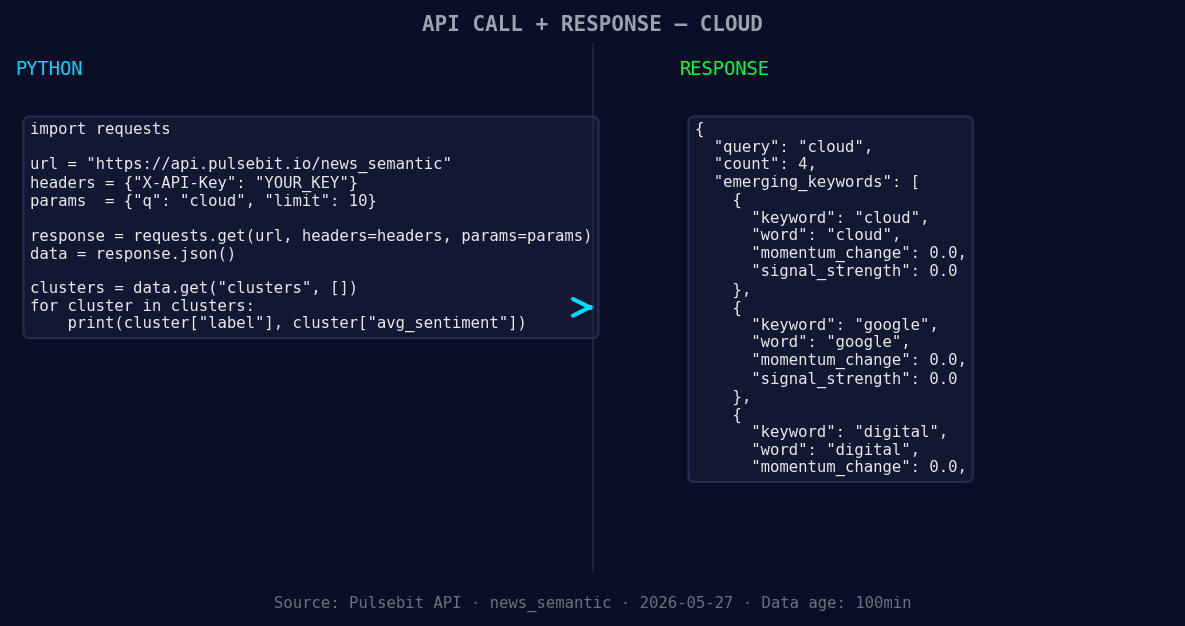
*Left: Python GET /news_semantic call for 'cloud'. Right: returned JSON response structure (clusters: 3). Source: Pulsebit /news_semantic.*
# Make the API call to get the articles
response = requests.get(url, params=params)
articles = response.json()
# Print out the articles processed
print(f"Articles processed: {articles['articles_processed']}")
Next, we want to analyze the sentiment around the narrative itself. The cluster reason string—"Clustered by shared themes: 2026, earnings, show, cloud, capacity."—can be run through our sentiment endpoint to gauge the framing of the narrative:
# Define the meta-sentiment analysis input
meta_sentiment_input = {
    "text": "Clustered by shared themes: 2026, earnings, show, cloud, capacity."
}

# Make the API call for sentiment analysis
sentiment_response = requests.post("https://api.pulsebit.com/v1/sentiment", json=meta_sentiment_input)
sentiment_score = sentiment_response.json()

# Print out the sentiment score
print(f"Meta-sentiment score: {sentiment_score['sentiment_score']}, Confidence: {sentiment_score['confidence']}")
With these snippets, you can catch the narrative shifts and adjust your trading or analytics strategies accordingly.
Now, what can we build with this newfound spike? Here are three actionable ideas:
- Geo-Filtered Alert System: Set a threshold for momentum spikes like +0.491 in the cloud topic specifically for English articles. Create an alert that notifies you when this threshold is reached. Use the geographic origin filter in your query to ensure you’re tracking sentiment shifts in specific regions.

Geographic detection output for cloud. India leads with 2 articles and sentiment +0.85. Source: Pulsebit /news_recent geographic fields.
Meta-Sentiment Dashboard: Build a dashboard that visualizes meta-sentiment scores over time for key narratives. Utilize the sentiment analysis API to continuously pull in data based on your defined cluster themes, like "earnings" and "cloud." This will help you see how narratives evolve.
Anomaly Detection Model: Develop an anomaly detection model that flags significant shifts in sentiment scores, specifically for topics like "cloud," "google," or "digital." Use the sentiment score of +0.400 as a baseline and set thresholds to catch meaningful deviations from this score.
If you're ready to get started, head over to our documentation at pulsebit.lojenterprise.com/docs. With the provided code, you can copy-paste and run this in under 10 minutes. Don't let your pipeline lag behind; catch those sentiment leads!


Top comments (0)