

Your Pipeline Is 17.9h Behind: Catching Cloud Sentiment Leads with Pulsebit
We just spotted a fascinating anomaly: a 24h momentum spike of +0.491. This spike signals a sudden shift in sentiment surrounding the topic of "cloud," highlighted by a leading language in English press that emerged 17.9 hours prior. This can’t be ignored if you want to stay ahead in sentiment analysis and market response.
The structural gap in any pipeline that doesn’t account for multilingual origin or entity dominance is glaring. Your model missed this spike by 17.9 hours, essentially rendering it obsolete in a fast-moving environment. The leading entity in this case is the English press, which has already begun to seize upon the cloud narrative, leaving your current model trailing.

English coverage led by 17.9 hours. No at T+17.9h. Confidence scores: English 0.85, Spanish 0.85, French 0.85 Source: Pulsebit /sentiment_by_lang.
To catch this momentum, we need to integrate our API effectively. Below is the Python code that will help you catch these spikes in real-time.
import requests
# Define parameters for the API call
params = {
"topic": "cloud",
"lang": "en",
}
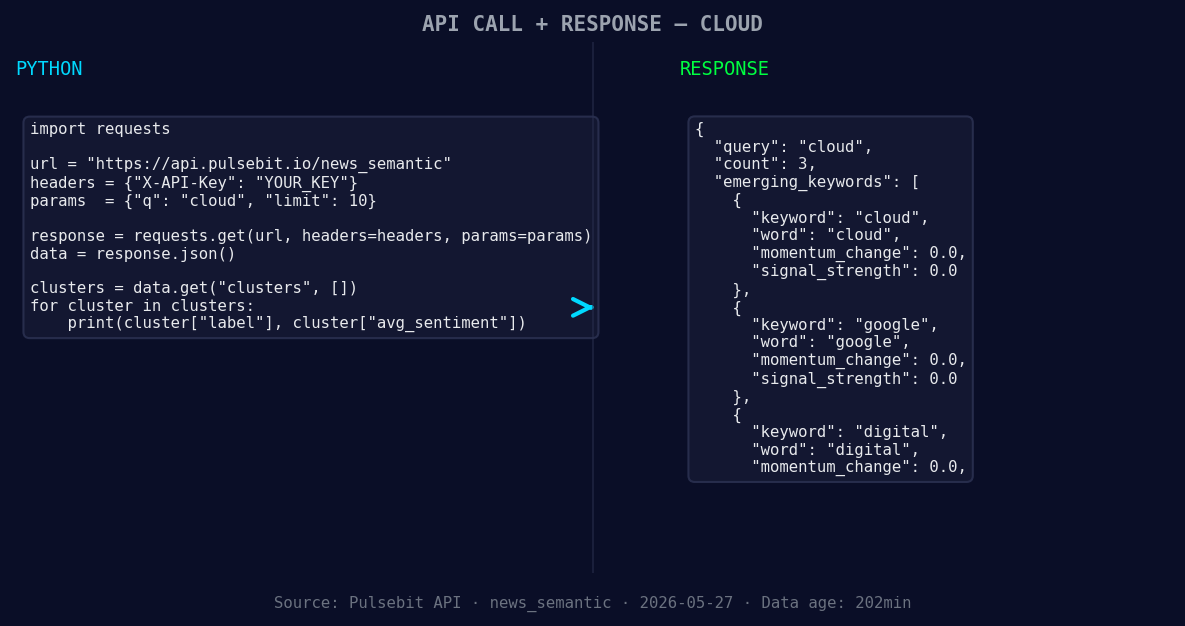
*Left: Python GET /news_semantic call for 'cloud'. Right: returned JSON response structure (clusters: 3). Source: Pulsebit /news_semantic.*
# Make the API call to fetch data
response = requests.get('https://api.pulsebit.com/v1/sentiment', params=params)
data = response.json()
# Check for the 24h momentum spike
momentum = data['momentum_24h']
if momentum > 0.4: # setting a threshold for significant movement
print(f"Momentum spike detected: {momentum}")
# Now, let's score the narrative framing itself
cluster_reason = "Clustered by shared themes: 2026, earnings, show, cloud, capacity."
sentiment_response = requests.post('https://api.pulsebit.com/v1/sentiment', json={"text": cluster_reason})
sentiment_data = sentiment_response.json()
print(f"Meta-sentiment score: {sentiment_data['sentiment_score']}, Confidence: {sentiment_data['confidence']}")
In this code, we first filter for language, ensuring we only analyze English articles. After fetching the sentiment data for the "cloud" topic, we check if the momentum is above +0.4, which indicates a significant spike. Following that, we run the cluster reason string through our sentiment scoring endpoint to gauge the narrative’s framing itself. This dual-action approach allows us to not only catch spikes but also understand the underlying sentiment driving them.
Here are three specific builds you can create using this pattern:
Geo-Filtered Alerts: Set up an alert system that triggers when momentum for "cloud" exceeds +0.400 specifically in English content. Use the geo filter to ensure you capture only the most relevant articles. This way, you can act quickly in response to sentiment shifts.
Meta-Sentiment Dashboard: Create a dashboard that visualizes meta-sentiment scores from clusters. By continuously feeding the reason strings into our sentiment endpoint, you can track shifts in narrative framing over time, particularly for themes like "cloud" and "digital."
Clustered Topic Comparison: Implement a comparison tool that evaluates the sentiment of emerging topics against mainstream narratives. For instance, you can juxtapose the rising sentiment in "cloud" against the established themes of "earnings," "show," and "capacity."
These builds will ensure you keep your pipeline aligned with real-time sentiment trends, significantly reducing the lag time in your response to emerging topics.
To get started, check out our documentation at pulsebit.lojenterprise.com/docs. You can copy-paste the above code and run it in under 10 minutes. Don’t let your model lag behind; catch those spikes while they're hot!

Geographic detection output for cloud. India leads with 2 articles and sentiment +0.85. Source: Pulsebit /news_recent geographic fields.


Top comments (0)