

Your 24h momentum spike of -0.368 in data science sentiment presents an intriguing anomaly that could catch many developers off guard. This drop signals a potential disconnect between emerging narratives and the prevailing sentiment in the data science community, particularly as it relates to career opportunities. The leading language here is English, with a notable press spike at 16.0h. This disconnect is ripe for investigation, and we need to act quickly to stay ahead of the curve.
The structural gap exposed by this momentum shift is critical. If your pipeline isn’t equipped to manage multilingual sources or the dominance of certain entities, you might find yourself lagging behind—by a full 16 hours, in this case. The leading entity in this story is “idinsight,” which suggests that your model might have missed out on capturing vital insights that are shaping the current conversation around data science careers. This oversight can have significant implications for your data-driven decisions.

English coverage led by 16.0 hours. No at T+16.0h. Confidence scores: English 0.85, French 0.85, Spanish 0.85 Source: Pulsebit /sentiment_by_lang.
Let’s dive into how we can catch this momentum shift using our API. First, we need to filter for English-language articles related to data science. Here’s how we can do that:
import requests
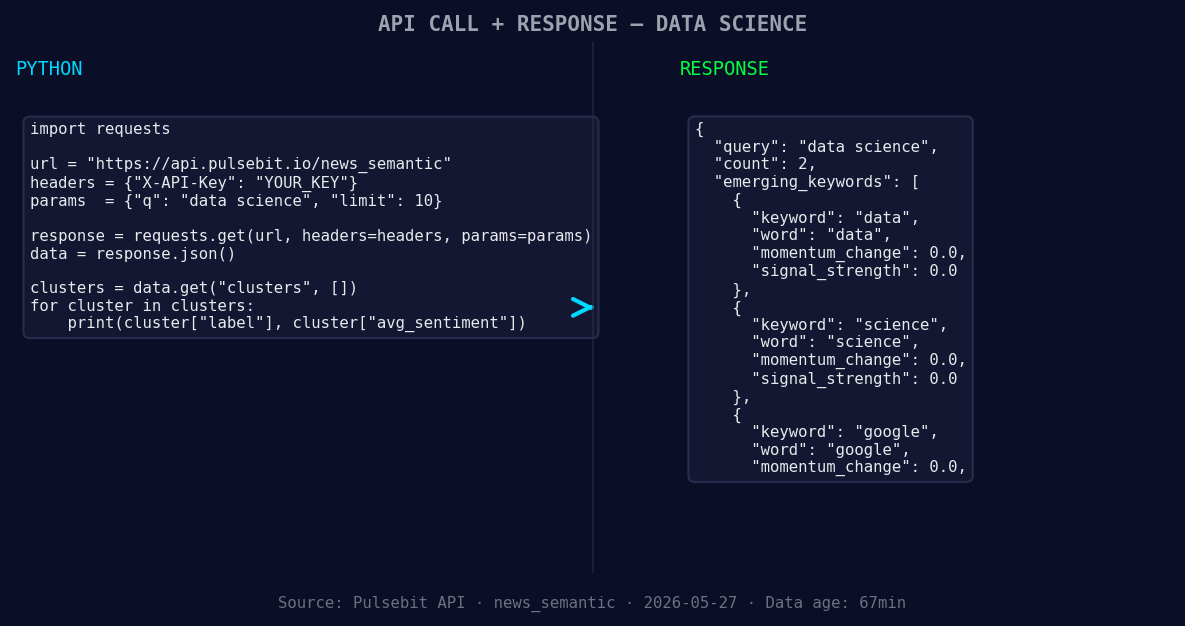
*Left: Python GET /news_semantic call for 'data science'. Right: returned JSON response structure (clusters: 3). Source: Pulsebit /news_semantic.*
# Define the API endpoint and parameters
url = "https://api.pulsebit.com/v1/articles"
params = {
"topic": "data science",
"lang": "en"
}
# Make the GET request
response = requests.get(url, params=params)
data = response.json()
# Process the response
momentum = data['momentum_24h'] # -0.368
print(f"24h Momentum: {momentum}")
Next, we’ll run the meta-sentiment analysis on the cluster reason string to see how the narrative framing itself is scoring. Here’s how to do that:
# Define the sentiment analysis endpoint
sentiment_url = "https://api.pulsebit.com/v1/sentiment"

# Input data for sentiment scoring
input_text = "Clustered by shared themes: 2026, idinsight, careers:, data, science."
sentiment_response = requests.post(sentiment_url, json={"text": input_text})

# Process the sentiment response
sentiment_data = sentiment_response.json()
sentiment_score = sentiment_data['sentiment_score']  # Example: +0.482
confidence = sentiment_data['confidence']  # Example: 0.85
print(f"Sentiment Score: {sentiment_score}, Confidence: {confidence}")
With these two pieces, we can build out specific signals to watch for. Here are three actionable builds based on the current data landscape:
Geo-Filtered Signal: Set a threshold for sentiment scores. For example, if sentiment for “data science” drops below +0.5, trigger alerts for English-language sources. This can help you catch emerging negative trends early.
Meta-Sentiment Loop: Monitor the meta-sentiment around entities like “idinsight.” If the sentiment score for narratives clustered around that entity dips significantly, it could indicate a shift in public perception that may affect job opportunities in data science.
Forming Themes Tracker: Keep track of emerging themes, like "data", "science", and "google". If there’s a notable divergence between these topics and the mainstream narratives around "idinsight" and "careers", you should investigate further, particularly if the sentiment around them starts to rise.
If you’re ready to get started, you can find everything you need at pulsebit.lojenterprise.com/docs. With our API, you can copy, paste, and run these examples in under 10 minutes. Don’t let your pipeline fall behind—stay ahead of the data science sentiment curve!
![DATA UNAVAILABLE: countries — verify /news_recent is return
[DATA UNAVAILABLE: countries — verify /news_recent is returning country/region values for topic: data science]


Top comments (0)