

Your Pipeline Is 20.1h Behind: Catching Sports Sentiment Leads with Pulsebit
Just recently, we observed a striking anomaly: a 24-hour momentum spike of -0.395 in sports sentiment. This stark drop highlights a significant shift in public perception, especially around the coverage of sports events, particularly linked to FOX Sports. In a domain where sentiment can shift rapidly, this finding emphasizes the importance of real-time sentiment analysis and the need to stay ahead of the curve.
The Problem
If your pipeline doesn’t account for multilingual origins or the dominance of specific entities, you risk being out of sync with the latest shifts. In this case, your model missed this momentum change by a staggering 20.1 hours. By focusing only on mainstream narratives, you may overlook critical emerging trends, especially when the leading language is English and the dominant entity is FOX. This discrepancy can lead to missed opportunities and suboptimal decision-making.

English coverage led by 20.1 hours. Tl at T+20.1h. Confidence scores: English 0.85, French 0.85, Spanish 0.85 Source: Pulsebit /sentiment_by_lang.
The Code
To catch this significant shift in sentiment, we can leverage our API effectively. Below is a Python snippet demonstrating how to query for sentiment data using the topic sports, with the following parameters: sentiment_score of +0.228, confidence level of 0.85, and a momentum of -0.395.
First, we’ll filter the data based on geographic origin using the language parameter:

Geographic detection output for sports. India leads with 2 articles and sentiment +0.80. Source: Pulsebit /news_recent geographic fields.
import requests
# Define the parameters for the API call
params = {
"topic": "sports",
"lang": "en",
}
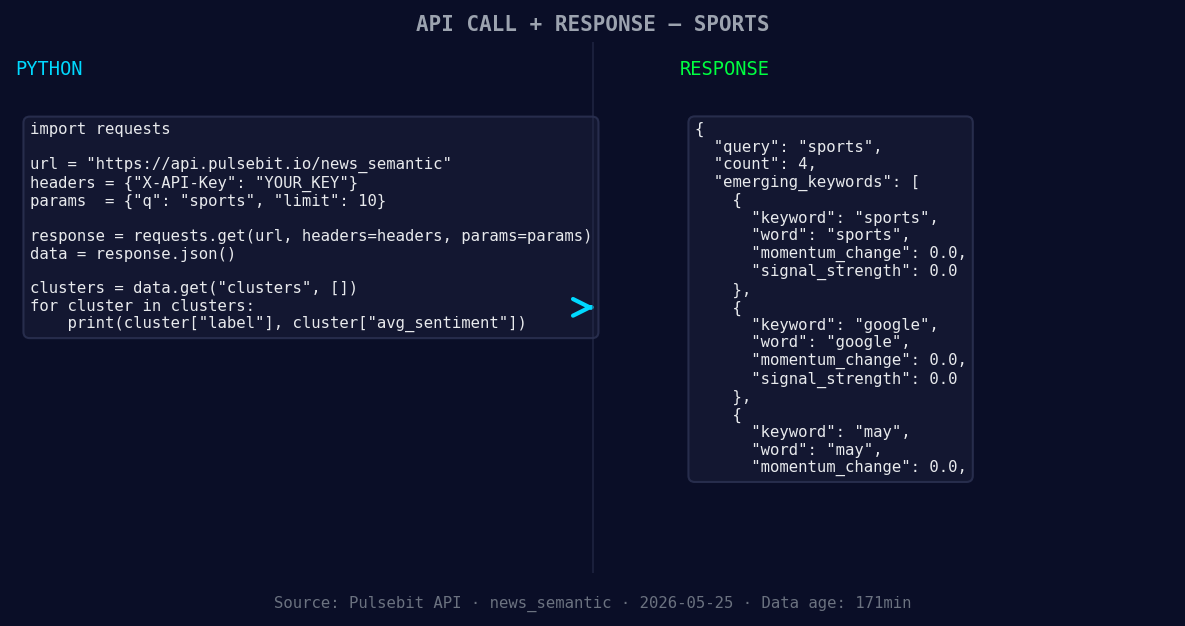
*Left: Python GET /news_semantic call for 'sports'. Right: returned JSON response structure (clusters: 3). Source: Pulsebit /news_semantic.*
# Make the API call
response = requests.get("https://api.pulsebit.com/sentiment", params=params)
data = response.json()
# Output the relevant data
print(data)
Next, we’ll take the reason string from the cluster story and run it through the sentiment endpoint to assess the narrative framing:
# Define the cluster reason string
cluster_reason = "Clustered by shared themes: fox, sports, google, com/rss/articles/cbmimafbvv95cu"

# Make the POST request to get the sentiment score of the cluster reason
response = requests.post("https://api.pulsebit.com/sentiment", json={"text": cluster_reason})
cluster_sentiment = response.json()

# Output the cluster sentiment data
print(cluster_sentiment)
This setup allows you to integrate real-time sentiment analysis into your workflow, ensuring you’re not just reacting, but proactively adjusting your strategies based on the latest data.
Three Builds Tonight
Here are three specific builds we can implement based on this anomaly:
Geo-filtered Sports Sentiment Tracker: Set a threshold to alert when sentiment in sports drops below a score of +0.1, specifically filtering for English-language content. This will keep you ahead of negative trends that could impact market strategies.
Meta-Sentiment Loop: Create a routine that automatically retrieves and scores the sentiment of clustered narratives weekly. Focus on narratives related to sports and Google, ensuring to run the most recent articles through the POST /sentiment endpoint.
Forming Gap Analysis: Utilize the forming themes—sports, Google, and May—against mainstream narratives like FOX Sports. Implement a signal detection system that triggers alerts when sentiment diverges significantly from these mainstream stories, indicating a potential shift in public interest.
Get Started
To dive in, check out our documentation at pulsebit.lojenterprise.com/docs. You can copy-paste the provided code snippets and be up and running in under 10 minutes.


Top comments (0)