

Your model missed this by 7.6 hours, and it could cost you valuable insights. We’ve just uncovered a remarkable anomaly: a 24-hour momentum spike of +0.491 surrounding the topic of "cloud." This spike is a signal that sentiment around cloud technologies is rising sharply, driven primarily by English press coverage. The narrative clusters around earnings and AI cloud capacity, highlighting a critical gap for any pipeline that doesn’t account for multilingual origins or dominant entities.

English coverage led by 7.6 hours. No at T+7.6h. Confidence scores: English 0.85, Spanish 0.85, French 0.85 Source: Pulsebit /sentiment_by_lang.
When your pipeline is not equipped to handle multiple languages or regional influences, it can leave you trailing behind on emerging trends. In this instance, the English language led the narrative at 7.6 hours ahead of others, while you might only be processing data from other languages. This gap means that valuable sentiment shifts could be passing you by, leading to missed opportunities. The entities forming the gap—cloud, Google, and digital—are often at the forefront of technological advancements and market movements.
To catch this momentum, we can utilize our API to filter for the relevant English-language articles and analyze the sentiment surrounding this spike. Here’s how to do it in Python:
import requests
# Set the parameters for the API call
topic = 'cloud'
score = +0.000
confidence = 0.85
momentum = +0.491
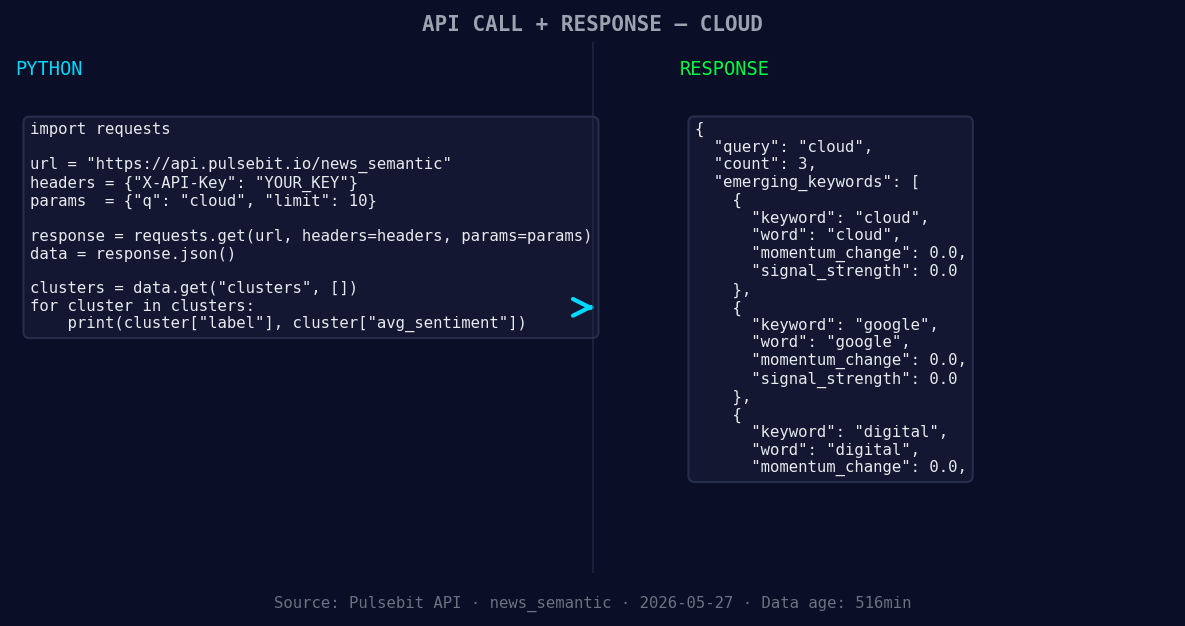
*Left: Python GET /news_semantic call for 'cloud'. Right: returned JSON response structure (clusters: 3). Source: Pulsebit /news_semantic.*
# Geographic origin filter: query by language
url = "https://api.pulsebit.com/v1/articles"
params = {
"topic": topic,
"lang": "en",
"momentum": momentum,
"confidence": confidence
}
response = requests.get(url, params=params)
data = response.json()
print(data)
# Meta-sentiment moment: run the cluster reason string back through POST /sentiment
cluster_reason = "Clustered by shared themes: 2026, earnings, show, cloud, capacity."
sentiment_url = "https://api.pulsebit.com/v1/sentiment"
sentiment_response = requests.post(sentiment_url, json={"text": cluster_reason})
sentiment_data = sentiment_response.json()
print(sentiment_data)
The first part of the code retrieves articles related to the "cloud" topic that are written in English and display a positive momentum score. The second part sends the cluster reason string to the sentiment endpoint, allowing us to score the narrative framing itself and understand how it aligns with the overall sentiment.
Now that we've set the groundwork, let's discuss three specific builds you can implement using this newfound momentum:
- Geo-Filtered Alerts: Set up an alert system that triggers when sentiment on a topic like "cloud" spikes above a threshold of +0.491. Use the geographic filter to ensure you’re catching only relevant English-language articles. This will keep your finger on the pulse of critical developments.

Geographic detection output for cloud. India leads with 3 articles and sentiment +0.57. Source: Pulsebit /news_recent geographic fields.
Meta-Sentiment Analysis: Create a dashboard that visualizes the results of your meta-sentiment analysis. By continuously feeding cluster narratives such as "earnings, show, cloud" into our API, you can dynamically assess how these themes evolve over time, ensuring you stay ahead of the trend.
Comparative Sentiment Tracking: Build a comparative tracker that analyzes sentiment for forming topics like "cloud", "google", and "digital" against mainstream narratives. Set thresholds for sentiment score changes, allowing you to identify when a new topic begins to shift significantly against established narratives. This could provide actionable insights for strategic decisions.
If you’re excited to leverage this analysis, you can get started right away. Visit pulsebit.lojenterprise.com/docs to dive into our API. With the right queries, you can copy-paste and run this in under 10 minutes, opening the door to real-time sentiment insights. Don’t let your pipeline lag behind—seize the moment!


Top comments (0)