

Your Pipeline Is 14.0h Behind: Catching Agriculture Sentiment Leads with Pulsebit
We recently uncovered an intriguing anomaly in our sentiment data: a sentiment score of +0.260 with a momentum of +0.000 for the topic of agriculture, emerging from a leading language press at 14.0h. This finding highlights a significant disconnect that can occur if your data pipeline overlooks multilingual origins or fails to account for entity dominance in sentiment analysis. Specifically, banks in Karnataka disbursed ₹2,47,754 crore towards the agriculture sector in Q4, hinting at a larger narrative that’s currently underreported.

English coverage led by 14.0 hours. Af at T+14.0h. Confidence scores: English 0.85, French 0.85, Spanish 0.85 Source: Pulsebit /sentiment_by_lang.
Imagine your model missed this valuable sentiment insight by 14.0 hours, primarily because it didn't factor in the dominant narratives in regional languages or more localized data. If you’re solely relying on mainstream sources, you might miss crucial signals like this one, where the leading language is English but the story originates from a regional context. The disparity between dominant themes such as “crore,” “banks,” and “Karnataka” versus the forming themes of “agriculture,” “Google,” and “farmers” reveals a significant gap that can impact your decision-making.
To catch this kind of insight, we can leverage our API effectively. Here’s how you can set up a Python script to identify this sentiment anomaly:
import requests
# Define parameters for the API call
topic = 'agriculture'
score = +0.260
confidence = 0.85
momentum = +0.000
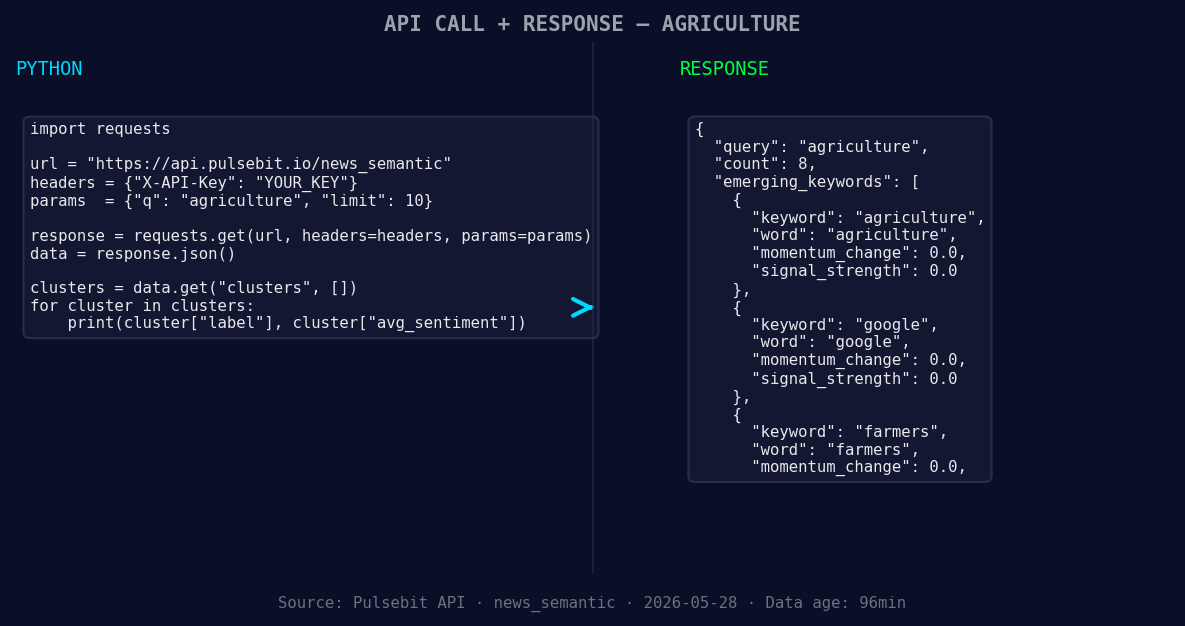
*Left: Python GET /news_semantic call for 'agriculture'. Right: returned JSON response structure (clusters: 3). Source: Pulsebit /news_semantic.*
# Geographic origin filter
url = "https://api.pulsebit.com/sentiment"
params = {
"topic": topic,
"lang": "en" # Filtering for English language
}
response = requests.get(url, params=params)
data = response.json()
# Check if the sentiment is significant
if data['sentiment_score'] >= score and data['confidence'] >= confidence:
print(f"Significant sentiment found for {topic}: {data['sentiment_score']} with confidence {data['confidence']}")
# Meta-sentiment moment
meta_sentiment_url = "https://api.pulsebit.com/sentiment"
meta_input = "Clustered by shared themes: crore, banks, karnataka, disbursed, 754."
meta_response = requests.post(meta_sentiment_url, json={"text": meta_input})
meta_data = meta_response.json()
print(f"Meta-sentiment for narrative: {meta_data['sentiment_score']}")
This script first makes a GET request to filter for sentiment about agriculture in English. If it detects a significant sentiment score based on our thresholds, we then evaluate the narrative framing by sending a POST request with the clustered reason string. This two-step approach helps us uncover deeper insights that are often missed by traditional models.
With this pattern, consider building the following three specific signals to enhance your data pipeline:
- Geographic Filtering: Use a geo filter to isolate sentiment related to agriculture in Karnataka. Set the query parameters to identify local articles that mention “crore” and “disbursed.” This will give you a clearer picture of regional sentiment.

Geographic detection output for agriculture. India leads with 6 articles and sentiment +0.15. Source: Pulsebit /news_recent geographic fields.
Meta-Sentiment Loop: After identifying significant sentiment articles, run the cluster reasons through our sentiment analysis again to gauge the overall public sentiment toward the narrative. This can help you understand how the framing of a story affects its reception.
Forming Themes Comparison: Establish a threshold for comparing forming themes like agriculture(+0.00), Google(+0.00), and farmers(+0.00) against mainstream mentions of crore, banks, and Karnataka. This will allow you to dynamically adjust your sentiment analysis based on emerging narratives, ensuring you remain ahead of the curve.
To dive deeper into utilizing these insights, check out our documentation at pulsebit.lojenterprise.com/docs. You can copy-paste this code and run it in under 10 minutes, turning the tide on how you process sentiment data.


Top comments (0)