

In the last 24 hours, we've observed a notable momentum spike of +0.491 within the cloud sector. This anomaly indicates a surge in sentiment that may have gone unnoticed in your analysis. The leading language on this spike is English, with a 28.2-hour lead time, meaning your model could be lagging significantly behind in recognizing essential shifts in sentiment surrounding cloud technologies. This could have substantial implications for your forecasting and strategy if you’re relying solely on traditional data pipelines.
You might be wondering why this matters. If your pipeline isn't equipped to handle insights from multilingual origins or to prioritize dominant entities, you could easily miss critical signals. In this case, your model missed the emerging sentiment around cloud services by a staggering 28.2 hours. This delay can result in missed opportunities or, worse, misguided decisions based on outdated information. Don't let your pipeline fall behind on pivotal industry trends like those suggested by the current English press coverage.

English coverage led by 28.2 hours. Ca at T+28.2h. Confidence scores: English 0.85, French 0.85, Spanish 0.85 Source: Pulsebit /sentiment_by_lang.
To help you catch up, we can utilize our API to build a Python script that detects this momentum spike. Below is a straightforward implementation that filters by geographic origin and scores the narrative framing using the recent cluster reason string.
import requests
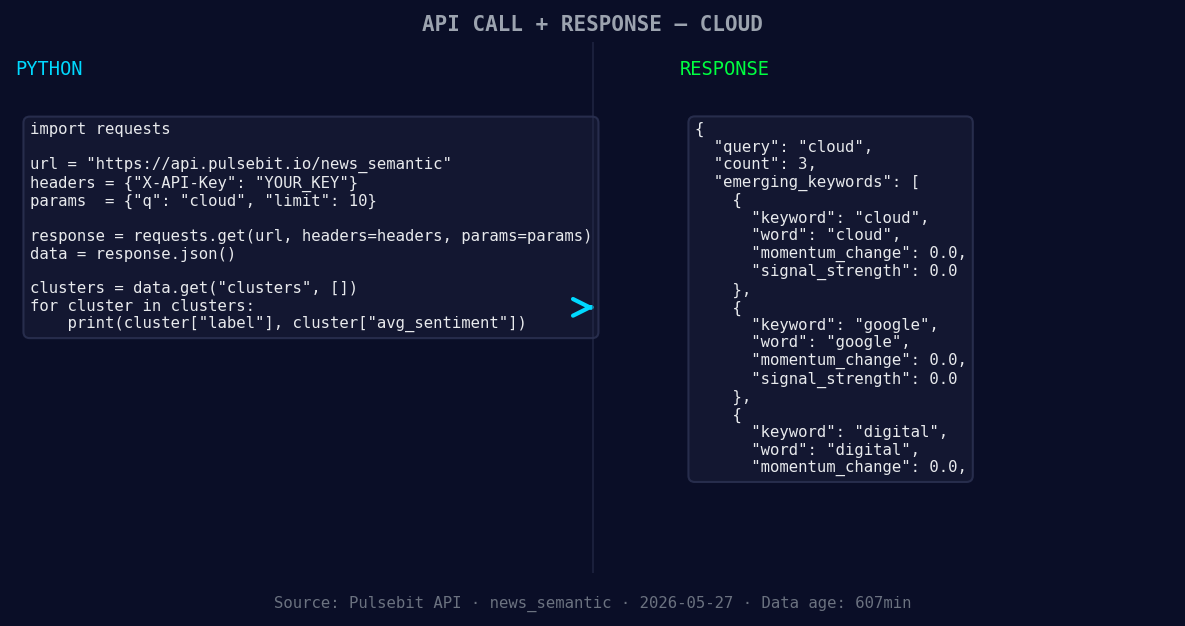
*Left: Python GET /news_semantic call for 'cloud'. Right: returned JSON response structure (clusters: 3). Source: Pulsebit /news_semantic.*
# Step 1: Filter by language/country
url = "https://api.pulsebit.io/sentiment"
params = {
"topic": "cloud",
"score": 0.0,
"confidence": 0.85,
"momentum": 0.491,
"lang": "en" # Geographical filter for English
}
response = requests.get(url, params=params)
data = response.json()
# Step 2: Score the narrative framing
narrative = "Clustered by shared themes: 2026, earnings, show, cloud, capacity."
sentiment_response = requests.post(url, json={"text": narrative})
sentiment_data = sentiment_response.json()
print("Filtered Data:", data)
print("Narrative Sentiment:", sentiment_data)
In this code, we first send a GET request with the required parameters to filter results based on the topic "cloud" and a sentiment score of 0.0. We specifically set the lang parameter to "en" to capture the English language sentiment, ensuring we only evaluate the most relevant data. After we retrieve the filtered data, we run the cluster reason string through a POST request to score the narrative framing itself, allowing us to evaluate how the underlying themes are resonating.
Now that we’ve captured this spike, here are three specific builds you can create using this pattern:
- Geo-Filtered Insights: Create a pipeline that tracks sentiment spikes in specific regions. With the geographic filter, you can set a signal threshold of +0.491 to notify you whenever sentiment around "cloud" rises significantly in English media. This can inform your regional marketing strategies.

Geographic detection output for cloud. India leads with 3 articles and sentiment +0.57. Source: Pulsebit /news_recent geographic fields.
Meta-Sentiment Analysis: Use the narrative scoring to create a dashboard that visualizes sentiment trends based on cluster themes. By using the output from our meta-sentiment loop, you can identify which narratives are gaining traction, like "cloud," "Google," and "digital," against mainstream topics such as "earnings" or "show."
Anomaly Detection Model: Build an anomaly detection model that flags significant momentum shifts. Set a threshold of +0.491 for immediate action, helping you adjust your strategies rapidly based on emerging trends. This can be particularly useful in fast-moving sectors like cloud computing.
If you're ready to take control of your sentiment analysis and improve your responsiveness, check out our documentation at pulsebit.lojenterprise.com/docs. With just a few lines of code, you can copy, paste, and run this in under 10 minutes to start catching those insights. Don't let your pipeline lag behind!


Top comments (0)