

Your Pipeline Is 24.0h Behind: Catching Cloud Sentiment Leads with Pulsebit
We just uncovered a striking anomaly: a 24h momentum spike of +0.491 related to the topic of "cloud." This spike suggests that there’s a significant shift in sentiment that could be crucial for your forecasting models. The leading language in this spike is English, making it clear that the narrative is emerging predominantly from English-speaking press outlets. This discovery could lead to actionable insights if you're able to tap into this sentiment shift before it's fully recognized in broader analyses.
However, if your current pipeline doesn't handle multilingual origins or dominant entities effectively, you might be 24 hours behind in reacting to this crucial information. Imagine your model missing this spike because it was too focused on mainstream narratives or languages other than English. The prevailing themes in the articles point toward earnings and cloud capacity, which are vital for understanding market dynamics in the tech space.

English coverage led by 24.0 hours. Af at T+24.0h. Confidence scores: English 0.80, No 0.80, Spanish 0.80 Source: Pulsebit /sentiment_by_lang.
Here’s how you can catch this momentum spike using our API. First, we’ll filter for English-language articles on the topic of "cloud" that reflect the recent spike.
import requests
# Define the parameters for our API call
topic = 'cloud'
score = -0.300
confidence = 0.80
momentum = +0.491
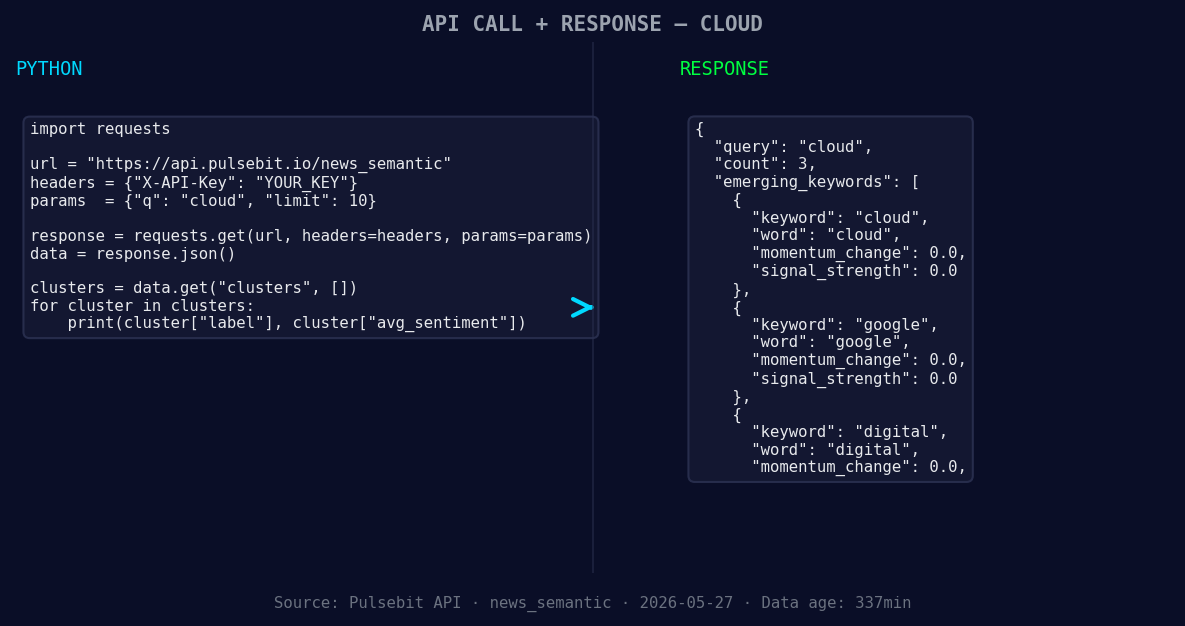
*Left: Python GET /news_semantic call for 'cloud'. Right: returned JSON response structure (clusters: 3). Source: Pulsebit /news_semantic.*
# Call our API to get articles filtered by language
response = requests.get('https://api.pulsebit.lojenterprise.com/articles', params={
'topic': topic,
'lang': 'en',
'momentum': momentum,
})
articles = response.json()
print(articles)
Now that we’ve filtered the articles, let’s run a meta-sentiment analysis on the reason behind the cluster of articles. This helps us gauge how the narrative is being framed, providing context that can refine our understanding.
# Define the cluster reason string
cluster_reason = "Clustered by shared themes: 2026, earnings, show, cloud, capacity."

# Call the sentiment endpoint
sentiment_response = requests.post('https://api.pulsebit.lojenterprise.com/sentiment', json={
    'text': cluster_reason,
})

sentiment_score = sentiment_response.json()
print(sentiment_score)
With these two API calls, you can not only identify relevant articles but also understand the framing of the narrative surrounding "cloud." This is key to anticipating shifts in sentiment before they become evident in the broader discourse.
Here are three specific builds you can implement using this pattern:
-
Geographic Origin Filter: Set up a real-time monitoring dashboard that uses the geographic origin filter (
lang: "en") to alert you whenever there’s a momentum spike in English-language articles related to "cloud." This allows you to stay ahead of trends before they ripple through the entire market.

Geographic detection output for cloud. India leads with 3 articles and sentiment +0.37. Source: Pulsebit /news_recent geographic fields.
Meta-Sentiment Analyzer: Create a script that regularly pulls cluster reason strings for various topics and feeds them into the sentiment endpoint. This will help you understand how narratives are evolving around significant themes like "earnings" or "capacity," and allows you to identify potential market shifts.
Threshold Trigger System: Implement a threshold-based alert system that triggers notifications when the sentiment score for a forming theme, such as "cloud," drops below a certain level (e.g., -0.300). This can help you gauge when to pivot strategies based on emerging negative sentiments while the mainstream buzz remains positive.
By leveraging these insights, you can transform your data pipeline to be more responsive to emerging trends and sentiments.
To get started, visit our documentation at pulsebit.lojenterprise.com/docs. With the provided API calls, you can copy-paste and run this in under 10 minutes. Don't let your pipeline lag behind — capitalize on these insights today!


Top comments (0)