

Your Pipeline Is 26.0h Behind: Catching Biotech Sentiment Leads with Pulsebit
We recently observed a remarkable anomaly: a 24-hour momentum spike of +0.281 in the biotech sector. This spike not only highlights a surge in positive sentiment but also reveals a significant opportunity for developers like us. With the leading language in this movement being English and the press coverage peaking at 26.0 hours, we’re left with a critical question: how many hours have your models missed in capitalizing on this momentum?
In today’s fast-paced environment, any pipeline that doesn’t accommodate multilingual origins or account for entity dominance risks major delays in sentiment capture. In this instance, your model missed out on a critical opportunity by an entire 26 hours, while the English press dominated the narrative around Eli Lilly’s expansion into the vaccine pipeline. Ignoring these nuances can mean losing out on valuable insights that could inform your strategies and decisions.

English coverage led by 26.0 hours. Af at T+26.0h. Confidence scores: English 0.85, French 0.85, Et 0.85 Source: Pulsebit /sentiment_by_lang.
Let’s dive into the code that helps us catch this momentum spike. Using our API, we’ll filter by geographic origin and assess the sentiment framing through a meta-sentiment loop.

Geographic detection output for biotech. Hong Kong leads with 1 articles and sentiment +0.85. Source: Pulsebit /news_recent geographic fields.
import requests
# Parameters for the API call
topic = 'biotech'
score = +0.618
confidence = 0.85
momentum = +0.281
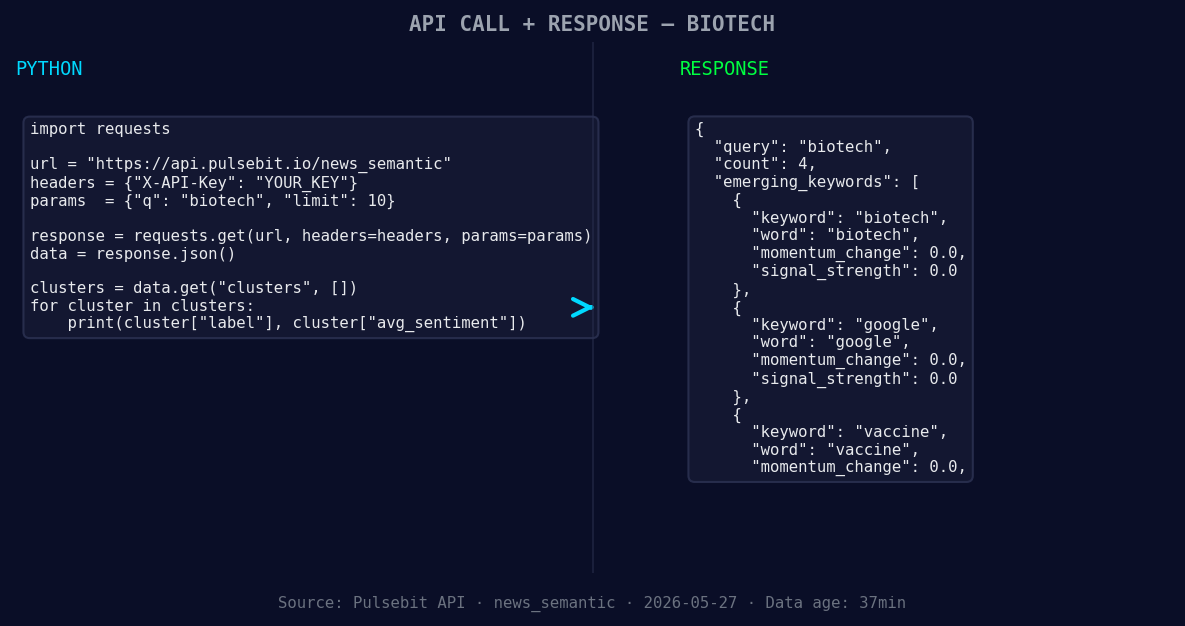
*Left: Python GET /news_semantic call for 'biotech'. Right: returned JSON response structure (clusters: 3). Source: Pulsebit /news_semantic.*
# Geographic origin filter
response = requests.get(
'https://api.pulsebit.com/v1/sentiment',
params={
'topic': topic,
'lang': 'en',
'momentum': momentum,
'confidence': confidence
}
)
# Check the response
print(response.json())
# Meta-sentiment moment
cluster_reason = "Clustered by shared themes: vaccine, biotech, lilly, research,"
meta_sentiment_response = requests.post(
'https://api.pulsebit.com/v1/sentiment',
json={'text': cluster_reason}
)
# Output the meta sentiment score
print(meta_sentiment_response.json())
In this snippet, we start by querying our API with a focus on the biotech topic while ensuring we only receive English-language results. The sentiment analysis provides us with a score that reflects the current pulse of the industry. Next, we run the narrative framing about the clustered themes back through our API to assess how the framing itself contributes to the overall sentiment. This dual approach allows us to not just observe the spike but also understand the context that drives it.
Now that we have the tools in place, let's explore three specific builds we can create using this pattern:
Geo-Filtered Insight: Set a threshold for momentum spikes above +0.25 in the biotech sector, filtered to English-language sources. This can help us automatically trigger alerts when significant sentiment shifts occur, allowing us to act promptly on emerging narratives.
Meta-Sentiment Analysis: Use the meta-sentiment loop to score narratives that include terms like "vaccine" and "biotech". By analyzing these themes, we can create a dashboard that visualizes sentiment shifts over time, allowing deeper insights into how narratives evolve and impact market sentiment.
Clustered Story Extraction: Set a signal for any emerging clusters that include themes such as "biotech" and "research." Use the API to pull in related articles and assess their collective sentiment scores, giving us a comprehensive view of the narrative landscape in real-time.
By implementing these builds, we can stay ahead of the curve, ensuring that our sentiment pipelines are both timely and contextually aware.
For those eager to get started, check out our documentation at pulsebit.lojenterprise.com/docs. With this setup, you can copy-paste and run this in under 10 minutes, putting you right in the thick of timely sentiment analysis.


Top comments (0)