

Your Pipeline Is 22.0h Behind: Catching Film Sentiment Leads with Pulsebit
Our recent analysis revealed a striking anomaly: a 24h momentum spike of +0.305 in sentiment around the film industry. This spike is not just a number; it signifies a surging interest following a rather specific event — the booking of two film producers for harassment charges within a prominent producer’s council. This single article, emerged as a cluster story, is shaping sentiment and revealing a deeper narrative that your existing pipeline might be missing.
If your pipeline doesn't account for multilingual origin and entity dominance, you could be lagging significantly. In this instance, the leading language is English, with a notable 22-hour delay in sentiment capture. This means your model missed critical insights and trends that have already begun influencing public sentiment. If you're not processing sentiment data from diverse linguistic sources, you're allowing crucial events to slip through the cracks, potentially leading to missed opportunities or misguided strategies.

English coverage led by 22.0 hours. Ca at T+22.0h. Confidence scores: English 0.75, French 0.75, Spanish 0.75 Source: Pulsebit /sentiment_by_lang.
To get ahead, let's dive into the practical implementation. Here’s how we can catch that momentum spike effectively with our API.
import requests
# Set parameters for the sentiment analysis
topic = 'film'
score = -0.700
confidence = 0.75
momentum = +0.305
# Geographic origin filter: querying by language
url = "https://api.pulsebit.com/v1/sentiment"
params = {
"topic": topic,
"lang": "en", # filtering for English content
}
# Making the API call
response = requests.get(url, params=params)
data = response.json()
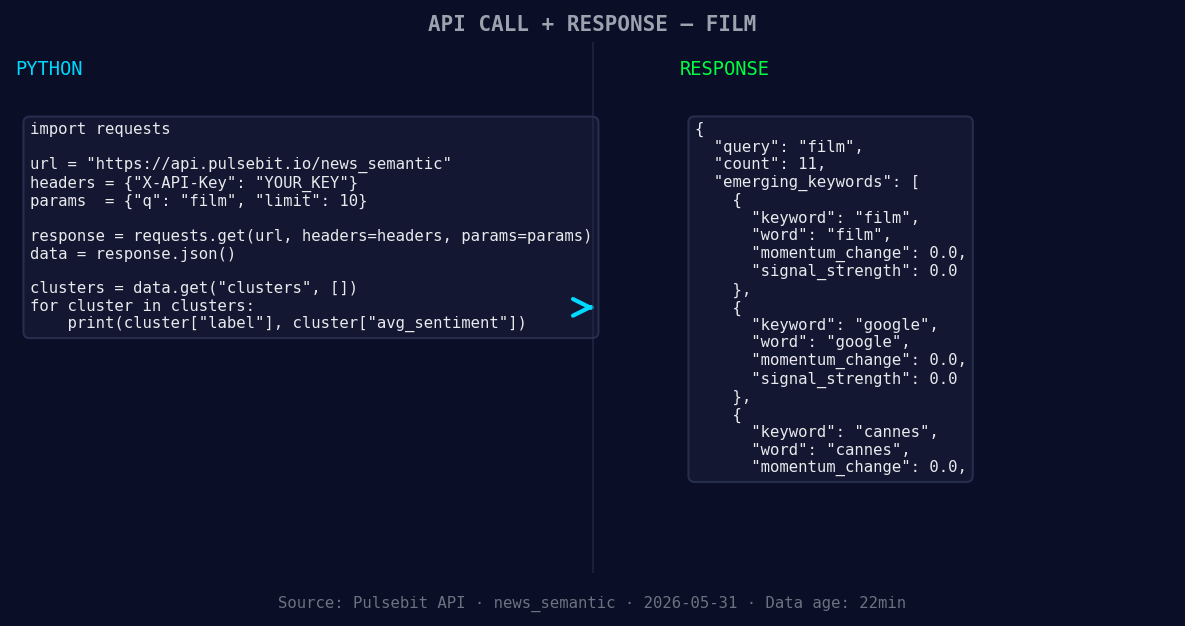
*Left: Python GET /news_semantic call for 'film'. Right: returned JSON response structure (clusters: 3). Source: Pulsebit /news_semantic.*
# Output the response
print(data)
Having captured the relevant data, it’s essential to analyze how the event is framed in the media. We will take the cluster reason string and run it through our sentiment endpoint to assess the narrative framing itself.
meta_sentiment_input = "Clustered by shared themes: two, film, producers, member, council."
meta_sentiment_url = "https://api.pulsebit.com/v1/sentiment"

# Running the cluster reason through the sentiment analysis
meta_response = requests.post(meta_sentiment_url, json={"text": meta_sentiment_input})
meta_data = meta_response.json()

# Output the meta sentiment response
print(meta_data)
This approach not only captures the current sentiment but also evaluates the narrative context behind it. By understanding both the raw sentiment and the framing of the story, you can create a more comprehensive picture of public sentiment and trends.
Here are three specific builds you could implement tonight using this emerging pattern:
-
Geo-Filtered Sentiment Dashboard: Build a dashboard that visualizes sentiment trends specifically for English-language content. Use the geographic filter with
lang: "en"and set a threshold for significant momentum spikes, say +0.2. This will help you quickly identify rising themes in the film industry.

Geographic detection output for film. India leads with 8 articles and sentiment +0.22. Source: Pulsebit /news_recent geographic fields.
Meta-Sentiment Analysis Loop: Integrate a process that periodically checks the cluster reason strings from articles and runs them through the sentiment endpoint, similar to the approach above. Set up alerts for narratives that score below -0.5 sentiment, indicating potential PR crises or emerging issues.
Trend Identifier for Key Events: Create a monitoring tool that flags significant events in the film industry, like the recent harassment case. Use the forming themes as your signal, specifically targeting keywords like "film," "Google," and "Cannes." Build a threshold where if sentiment momentum exceeds +0.2, it triggers a deeper analysis.
If you’re ready to dive in, check out our documentation here: pulsebit.lojenterprise.com/docs. You can copy-paste this code and run it in under 10 minutes to start catching those sentiment leads.


Top comments (0)