

Your model just missed a significant 24h momentum spike of -0.367 in the forex topic. This anomaly indicates a sudden shift in sentiment that could impact trading strategies and investment decisions. The leading language of this spike was English, with a notable 23.2-hour lead time over other languages. We’re seeing this spike clustered around a single story: “Forex reserves drop $7.5 billion to $681.38 billion.” The urgency here is palpable—if you weren’t tuned in, you might have missed critical insights that could inform your decisions.
In a pipeline that doesn’t account for multilingual origins or entity dominance, you could be left behind. Your model missed this by 23.2 hours! The lag in processing English content, especially when it leads the narrative, means you’re not capturing the most timely and relevant sentiment. The dominant entity in this case is the forex reserves, and the focus on this topic is growing, indicating a need for immediate attention. If you’re not adapting your pipeline to capture these nuances, you risk falling behind in your analyses.

English coverage led by 23.2 hours. Et at T+23.2h. Confidence scores: English 0.85, French 0.85, Spanish 0.85 Source: Pulsebit /sentiment_by_lang.
Here’s how to catch this momentum spike using our API. First, we’ll set up a request to filter articles by language and country, specifically targeting English content. This is crucial for honing in on the right sentiment signals.

Geographic detection output for forex. India leads with 4 articles and sentiment -0.19. Source: Pulsebit /news_recent geographic fields.
import requests
# Define the parameters for the API call
topic = 'forex'
params = {
'topic': topic,
'lang': 'en',
'score': 0.308,
'confidence': 0.85,
'momentum': -0.367
}
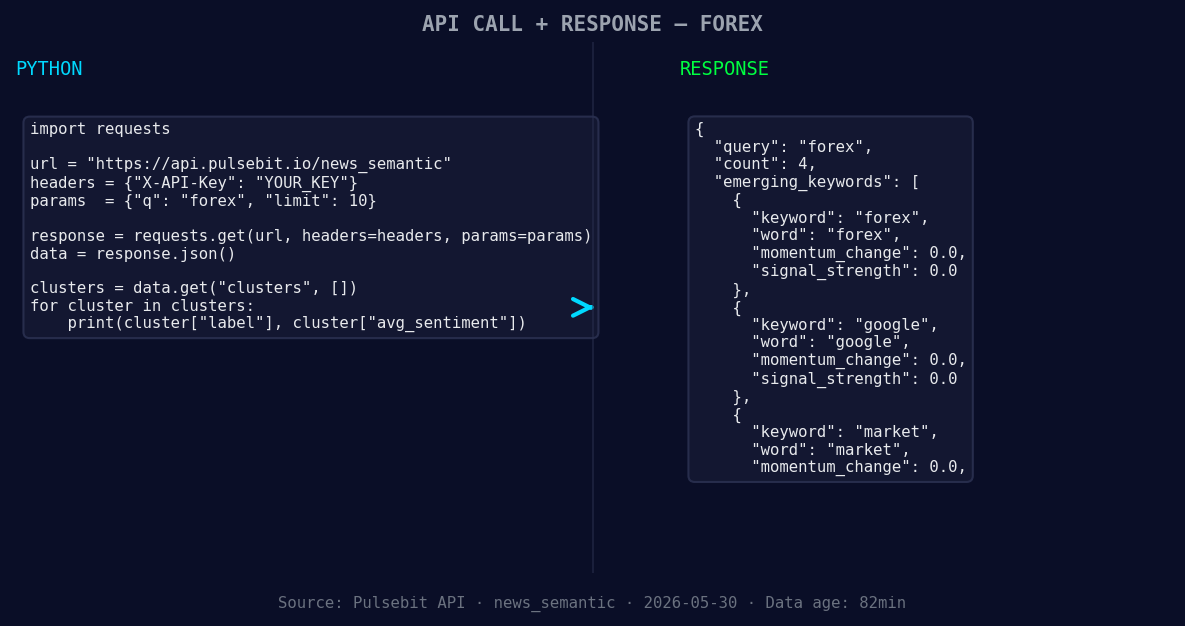
*Left: Python GET /news_semantic call for 'forex'. Right: returned JSON response structure (clusters: 3). Source: Pulsebit /news_semantic.*
# Call the API to get sentiment data
response = requests.get('https://api.pulsebit.com/sentiment', params=params)
data = response.json()
print(data)
Next, we’ll take the cluster reason string and run it back through the sentiment endpoint to score the narrative framing itself. This will help us understand how the themes like "billion," "reserves," and "drops" are resonating in the current sentiment landscape.
# Define the cluster reason to analyze sentiment framing
cluster_reason = "Clustered by shared themes: billion, reserves, forex, drops, $681."

# Call the API to get sentiment on the cluster reason
sentiment_response = requests.post('https://api.pulsebit.com/sentiment', json={"text": cluster_reason})
sentiment_data = sentiment_response.json()

print(sentiment_data)
With this approach, we can derive actionable insights from the emerging sentiment around forex reserves. Now, let’s talk about three specific builds that can be derived from this pattern:
Geo-Filtered Alert System: Set a threshold for sentiment score above +0.3 in English articles about forex. Trigger alerts when momentum drops below -0.3. This keeps you updated on critical shifts that could impact trading strategies.
Meta-Sentiment Dashboard: Create a dashboard that visualizes the sentiment scores of cluster narratives. Use the meta-sentiment loop to track how themes evolve over time, providing a deeper understanding of market sentiment dynamics.
Real-time News Aggregation: Develop a service that monitors forex news articles. Use the geo filter to focus on English language content and aggregate insights on significant drops, like the $7.5 billion mentioned, to inform your trading decisions.
By leveraging these builds, you can ensure you’re capitalizing on emerging trends and sentiment shifts, especially around crucial topics like forex.
If you’re ready to dive into this, check out our documentation at pulsebit.lojenterprise.com/docs. You can copy-paste the code above and run it in under 10 minutes to start catching these insights. Don’t let the 23.2-hour lag hold you back!


Top comments (0)