

Your Pipeline Is 17.9h Behind: Catching Law Sentiment Leads with Pulsebit
We recently uncovered a fascinating anomaly: a 24h momentum spike of +0.380 in the sentiment surrounding legal topics. This spike caught our attention, especially given its strong correlation with a new California law that bans law enforcement from interfering in state elections. What's interesting here is the leading language of the coverage—English—has a 17.9-hour lead time over the actual sentiment movement. This suggests a significant gap in traditional sentiment pipelines that fail to recognize such nuances in multilingual or regional influences.

English coverage led by 17.9 hours. Ca at T+17.9h. Confidence scores: English 0.85, Spanish 0.85, French 0.85 Source: Pulsebit /sentiment_by_lang.
If your model isn't equipped to handle these dynamics, you might be missing valuable sentiment changes that could impact your strategic decisions. With the leading language sitting at 17.9 hours ahead, your setup potentially overlooked critical signals that could have informed your actions much sooner. This gap isn’t just theoretical; it’s a tangible blind spot that could cost you time and insight in a fast-paced landscape.
Let's dive into the code to catch this sentiment spike accurately. We can leverage our API to query relevant data and analyze the narrative framing. First, we filter by geographic origin, specifically targeting English-language articles to focus on the relevant context. Here's how you can do it:

Geographic detection output for law. India leads with 8 articles and sentiment -0.08. Source: Pulsebit /news_recent geographic fields.
import requests
# Define parameters for the API call
params = {
"topic": "law",
"lang": "en",
"score": 0.017,
"confidence": 0.85,
"momentum": 0.380
}
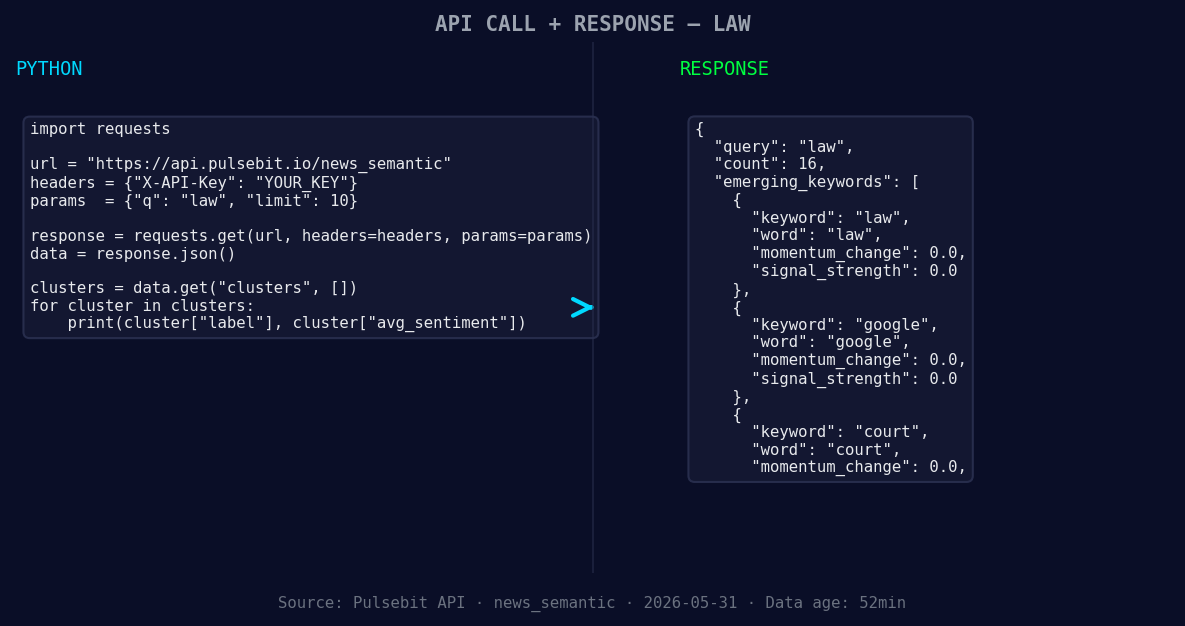
*Left: Python GET /news_semantic call for 'law'. Right: returned JSON response structure (clusters: 3). Source: Pulsebit /news_semantic.*
# Make the API call to retrieve sentiment data
response = requests.get("https://api.pulsebit.com/v1/sentiment", params=params)
sentiment_data = response.json()
print(sentiment_data) # Display the retrieved sentiment data
Next, we can score the narrative framing itself by running the cluster reason string through our sentiment analysis endpoint. This step is crucial as it allows us to understand the meta-sentiment driving the coverage of the law-related topics. Here’s how to do that:
# Define the cluster reason string
cluster_reason = "Clustered by shared themes: law, california, bans, enforcement, interfering."

# Make the API call to score the narrative framing
framing_response = requests.post("https://api.pulsebit.com/v1/sentiment", json={"text": cluster_reason})
framing_sentiment = framing_response.json()

print(framing_sentiment)  # Display the sentiment score of the narrative framing
With this code, we can effectively track the emerging sentiment surrounding pivotal legal changes and their implications.
Now, let’s consider three specific builds you can implement based on this pattern:
Geo-Filtered Alert System: Build an alert that triggers when sentiment spikes above a threshold (e.g., +0.350) specifically for topics like "law" in English articles. This ensures you're notified about emerging legal sentiments before they become mainstream.
Meta-Sentiment Analysis Dashboard: Create a dashboard that visualizes the scores from cluster reasons, allowing you to see how narrative framing impacts sentiment. Use the output from the meta-sentiment loop to identify which themes are contributing positively or negatively to public perception.
Comparative Historical Analysis: Develop a function that tracks historical sentiment scores for legal topics and compares them against current spikes. This can help you identify anomalies and understand if the current sentiment is part of a larger trend or isolated occurrence.
By implementing these builds, you can effectively harness the insights from our API to stay ahead of sentiment trends and make informed decisions.
To get started, visit our documentation at pulsebit.lojenterprise.com/docs. You can copy-paste the provided code and run it in under 10 minutes. Don't let your pipeline lag behind—make it work for you!


Top comments (0)