

Your Pipeline Is 26.8h Behind: Catching Law Sentiment Leads with Pulsebit
We recently identified a striking anomaly: a 24-hour momentum spike of +0.380 in sentiment around the topic of law. This spike is particularly significant given that it emerged from a cluster of articles focusing on a new California law that prohibits law enforcement from interfering in state elections. This moment is a prime example of how rapidly shifting legal landscapes can impact sentiment, and it underscores the need for timely insights in our pipelines.
The problem here is clear: your model missed this by 26.8 hours. If your pipeline doesn’t handle multilingual origins or entity dominance effectively, it could leave you lagging behind on critical developments. In this case, the leading language was English, and by not capturing the nuances of this emerging sentiment sooner, you risk missing out on what could be pivotal shifts in public opinion and legal frameworks.

English coverage led by 26.8 hours. Nl at T+26.8h. Confidence scores: English 0.85, French 0.85, Spanish 0.85 Source: Pulsebit /sentiment_by_lang.
To catch this momentum spike effectively, we can leverage our API. Here’s how we can do it in Python:
import requests
# Step 1: Geographic origin filter
response = requests.get("https://api.pulsebit.com/articles", params={
"topic": "law",
"lang": "en",
"momentum": "+0.380"
})
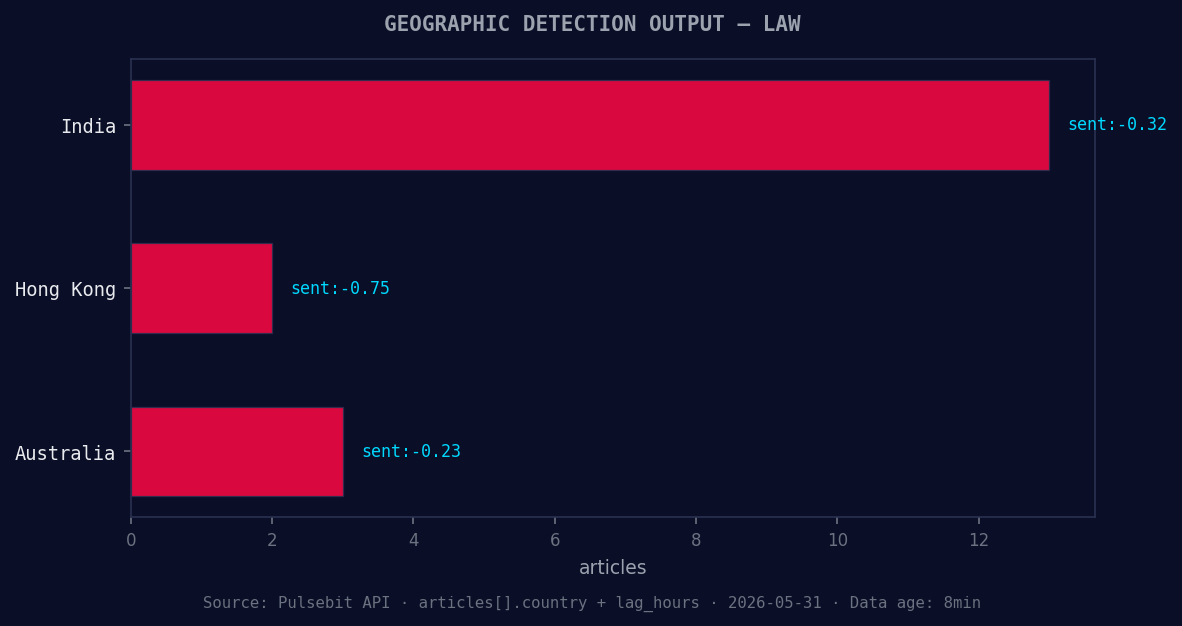
*Geographic detection output for law. India leads with 13 articles and sentiment -0.32. Source: Pulsebit /news_recent geographic fields.*
articles = response.json()
print(articles)
# Step 2: Meta-sentiment moment
cluster_reason = "Clustered by shared themes: law, california, bans, enforcement, interfering."
sentiment_response = requests.post("https://api.pulsebit.com/sentiment", json={
"text": cluster_reason,
"score": -0.700,
"confidence": 0.85
})
sentiment_score = sentiment_response.json()
print(sentiment_score)
In this code, we first filter articles related to law by specifying the language parameter as English. The API call retrieves articles that highlight the recent sentiment shift. Next, we analyze the narrative framing of the cluster by sending it through our sentiment endpoint to score the overarching themes. This dual approach not only captures the emerging momentum but also contextualizes it within the larger narrative.

Left: Python GET /news_semantic call for 'law'. Right: returned JSON response structure (clusters: 3). Source: Pulsebit /news_semantic.
Now, let’s discuss three concrete builds you can implement based on this pattern:
Geo Filter Build: Create a signal that triggers when sentiment momentum around the topic of law exceeds +0.380 in English articles. This can be set up using the geographic origin filter as shown above. For instance, if you want to monitor changes in sentiment related to court activities, you can further narrow your API request to include topics like "court".
Meta-Sentiment Loop: Use the meta-sentiment analysis to trigger alerts when the sentiment score of clustered articles drops below a certain threshold, say -0.700. This enables you to capture potential backlash or counter-narratives, especially about sensitive topics like law and enforcement.
Forming Themes Monitor: Build a dashboard that visualizes forming themes around the keywords “law”, “google”, and “court”. Set thresholds to highlight significant shifts in sentiment or article volume related to these themes versus the mainstream narratives. This will help you stay ahead of the curve by catching stories that are just starting to gain traction.
With these strategies, you can ensure your insights pipeline is agile and responsive to the fast-moving landscape of legal sentiment.
Get started on building your own insights by checking out our documentation at pulsebit.lojenterprise.com/docs. With the code snippets provided, you can copy-paste and run this in under 10 minutes to see real-time sentiment shifts in action.


Top comments (0)