

Your Pipeline Is 26.7h Behind: Catching Markets Sentiment Leads with Pulsebit
We recently discovered a striking anomaly: a 24-hour momentum spike of -0.294. This negative momentum indicates a significant shift in sentiment, particularly relevant as we dive into the landscape of multilingual news sources. The leading language on this topic is French, with a notable 26.7-hour lead time—an important signal indicating that your models might not be capturing sentiment effectively if they aren't built to handle multilingual origins.

French coverage led by 26.7 hours. Italian at T+26.7h. Confidence scores: French 0.70, English 0.70, Spanish 0.70 Source: Pulsebit /sentiment_by_lang.
When your pipeline lacks the capability to process information from diverse linguistic sources, you risk missing critical insights. In this case, your model missed a vital development by 26.7 hours. The French press is leading the narrative, and with the inertia of your pipeline, you're behind in understanding the sentiment around the South African rand and broader market movements.
Let’s look at how to catch this with our API. Below is a Python code snippet that queries sentiment data relevant to the topic "markets" with specific parameters:
import requests
# API call to fetch sentiment data
url = "https://api.pulsebit.com/v1/sentiment"
params = {
"topic": "markets",
"lang": "fr",
"score": -0.142,
"confidence": 0.70,
"momentum": -0.294
}
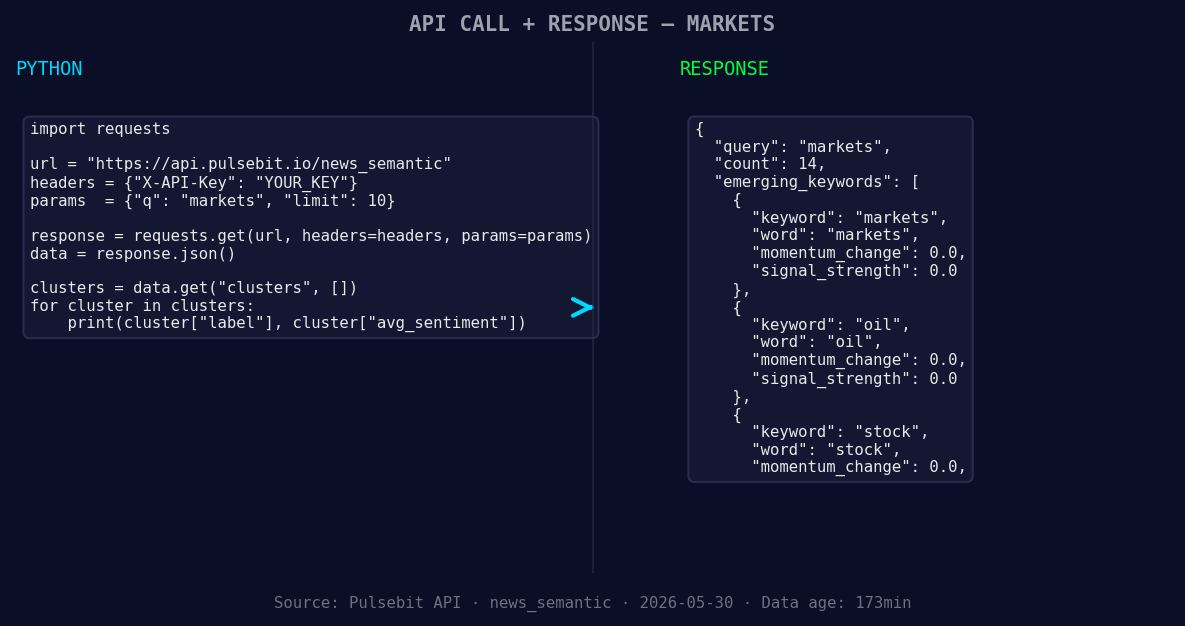
*Left: Python GET /news_semantic call for 'markets'. Right: returned JSON response structure (clusters: 3). Source: Pulsebit /news_semantic.*
response = requests.get(url, params=params)
data = response.json()
print(data)
This code snippet filters sentiment data specifically by French language input, ensuring we capture the relevant narrative that might be leading the sentiment.
Next, we need to dig deeper into the narrative framing itself. Let’s run the cluster reason string back through our sentiment endpoint to score the underlying themes:
# Meta-sentiment moment
meta_url = "https://api.pulsebit.com/v1/sentiment"
meta_input = {
    "text": "Clustered by shared themes: markets, bond, rise, financial, spending."
}

meta_response = requests.post(meta_url, json=meta_input)
meta_data = meta_response.json()
print(meta_data)
This second call helps us understand how the narrative around markets, bonds, and financial themes is being framed, giving us insights into sentiment dynamics that your model would typically overlook.
With the insights gained from this anomaly, there are three specific builds we can implement:
Geo-filtered Sentiment Stream: Build an endpoint that uses the French language filter to track sentiment shifts in markets specifically. Set a threshold to alert when momentum dips below -0.2, allowing you to stay ahead of emerging trends.
Meta-Sentiment Loop: Create a continuous feedback loop where cluster narratives are analyzed for sentiment. Set a trigger to flag any negative sentiment score below -0.15, allowing for proactive adjustments in trading strategies.
Forming Gap Analysis: Build a monitoring tool that compares forming themes, such as markets, oil, and stocks, against mainstream narratives. Use a threshold of 0.00 to identify divergence, signaling potential trading opportunities based on sentiment discrepancies.
By leveraging these insights, you can ensure that your models adapt to the dynamic nature of sentiment data, especially from multilingual sources.
For more details, check out our documentation: pulsebit.lojenterprise.com/docs. You can copy-paste the above code snippets and run them in under 10 minutes to start catching those critical market sentiments.

Geographic detection output for markets. India leads with 7 articles and sentiment -0.25. Source: Pulsebit /news_recent geographic fields.


Top comments (0)