

Your Pipeline Is 19.7h Behind: Catching Travel Sentiment Leads with Pulsebit
We recently discovered a compelling anomaly in our sentiment data: a sentiment score of -0.233 with a momentum of +0.000, leading us to observe a significant shift in travel sentiment. The leading language for this spike is French, with a notable lag time of 19.7 hours. This data reveals an intriguing insight into the travel industry's rebound, particularly highlighted in a single article from KTVU, clustered by themes such as travel, Maui, and rebound.
If your pipeline isn't designed to handle multilingual data or account for entity dominance, you're likely missing out on critical insights like this one. Imagine your model missing this travel sentiment shift by 19.7 hours simply because it couldn't parse the French discussions around travel. This structural gap isn't just an oversight; it can lead to missed opportunities for timely decision-making or strategic planning.

French coverage led by 19.7 hours. Ca at T+19.7h. Confidence scores: French 0.85, English 0.85, Spanish 0.85 Source: Pulsebit /sentiment_by_lang.
To illustrate how we can catch such anomalies, let's walk through the code that highlights this specific sentiment shift. We can query our API to filter for content originating from French sources. Here's how we do that:
import requests
# Define parameters for API call
params = {
"topic": "travel",
"lang": "fr",
"score": -0.233,
"confidence": 0.85,
"momentum": +0.000
}
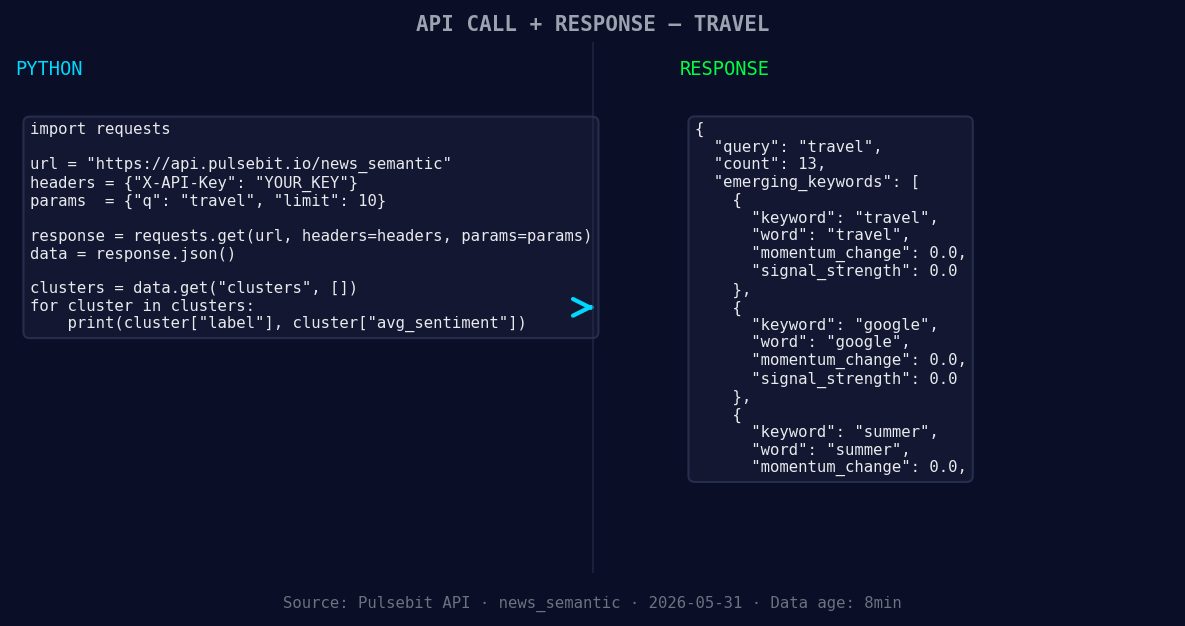
*Left: Python GET /news_semantic call for 'travel'. Right: returned JSON response structure (clusters: 3). Source: Pulsebit /news_semantic.*
# Make the API call
response = requests.get("https://api.pulsebit.com/sentiment", params=params)
data = response.json()
print(data)
Next, we want to assess the narrative framing of the clusters we've identified. We can run the cluster reason string through our sentiment scoring endpoint to understand the implications of the narrative itself. Here’s how we can do that:
# Define the cluster reason string
cluster_reason = "Clustered by shared themes: travel, maui, rebound, ktvu,"

# Make the sentiment scoring API call
meta_sentiment_response = requests.post("https://api.pulsebit.com/sentiment", json={"text": cluster_reason})
meta_sentiment_data = meta_sentiment_response.json()
print(meta_sentiment_data)
Now that we have a working code snippet to capture this sentiment, we can build three specific signals that leverage this pattern.
- Geographic Origin Filter: Create a signal that alerts you whenever sentiment shifts for the topic "travel" in French-speaking regions. Use a threshold of a sentiment score lower than -0.2 to trigger an alert.

Geographic detection output for travel. India leads with 7 articles and sentiment -0.17. Source: Pulsebit /news_recent geographic fields.
Meta-Sentiment Loop: Run a daily job that captures the narrative framing of articles clustered under "travel" and scores them. If the cluster reason string's score drops below 0.0, flag it for review.
Forming Themes Analysis: Set up a monitoring tool that captures emerging themes like "summer" and "google" in conjunction with a sentiment score of 0.0. This can provide insights into consumer interest before it peaks, allowing for proactive content strategy.
With these approaches, you can ensure that your pipeline is not just reactive but also proactive in capturing emerging trends.
To get started with our API, check out our documentation at pulsebit.lojenterprise.com/docs. You can easily copy-paste and run this code in under 10 minutes, setting you on the path to catching sentiment leads like this one.


Top comments (0)