

Your Pipeline Is 23.0h Behind: Catching World Sentiment Leads with Pulsebit
We just identified a striking anomaly in our data: a 24h momentum spike of +0.545. This spike is not just a number; it indicates a significant shift in sentiment surrounding the topic of “world.” The leading language for this shift is English, with a notable 23.0-hour lead time compared to the Netherlands. The article cluster titled "'Nexbax AI Index' to redefine AI adoption in India" highlights a critical narrative that could reshape our understanding of AI dynamics in the region.
Yet, if your pipeline doesn’t account for multilingual origins or entity dominance, you might have missed this opportunity by a whopping 23 hours. This delay means you could be out of sync with emerging trends, particularly in influential markets such as India, where the sentiment surrounding "Nexbax" and "AI adoption" is rapidly evolving.

English coverage led by 23.0 hours. Nl at T+23.0h. Confidence scores: English 0.85, Spanish 0.85, French 0.85 Source: Pulsebit /sentiment_by_lang.
To help you catch up, let’s dive into how to programmatically detect these kinds of shifts. Below is a Python snippet that leverages our API to identify this spike effectively.
import requests
# Parameters for the API call
topic = 'world'
score = +0.037
confidence = 0.85
momentum = +0.545
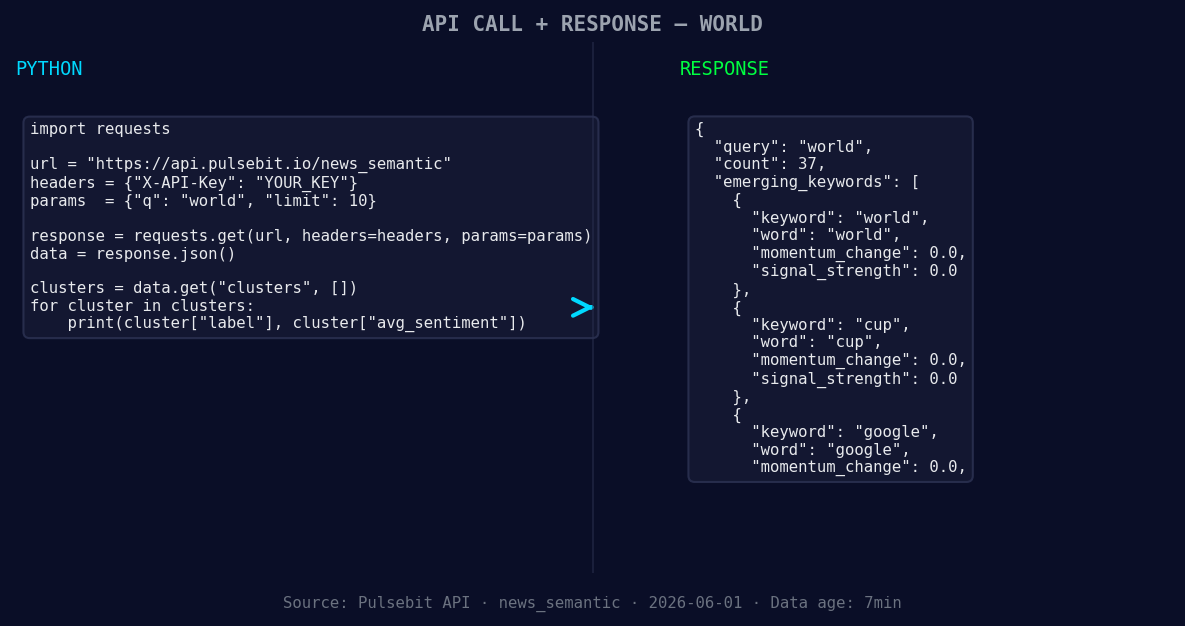
*Left: Python GET /news_semantic call for 'world'. Right: returned JSON response structure (clusters: 3). Source: Pulsebit /news_semantic.*
# Query to filter by language
url = 'https://api.pulsebit.com/sentiment'
params = {
"topic": topic,
"score": score,
"confidence": confidence,
"momentum": momentum,
"lang": "en" # Filtering for English
}
response = requests.get(url, params=params)
data = response.json()
# Now, let's score the narrative framing
cluster_reason = "Clustered by shared themes: india, ‘nexbax, index’, redefine, adoption."
sentiment_response = requests.post(url, json={"text": cluster_reason})
sentiment_data = sentiment_response.json()
print(data)
print(sentiment_data)
In this code, we first filter the sentiment data by language, ensuring we're only looking at English press coverage. Then, we run the cluster reason string through a POST request to score the narrative framing itself. This is a crucial step, as it allows us to assess the impact of the themes surrounding "Nexbax" and "AI adoption" from a meta-sentiment perspective.
Now that we’ve captured the spike and the narrative framing, let's explore three builds we could implement based on this pattern:
Geo-Filtered Alerts: Set up a signal that triggers alerts based on a momentum threshold of +0.5 for English articles originating from India. This would keep you ahead of the curve on regional developments while avoiding the noise from other languages.
Meta-Sentiment Analysis Dashboard: Create a dashboard that visualizes the sentiment scores of clustered narratives. For instance, when monitoring the topic of "world," consider visualizing the scores of related articles like "Nexbax" and "AI adoption" to see how they correlate with your main sentiment metrics.
Cross-Entity Sentiment Comparison: Develop an endpoint that compares sentiment scores of entities like "Google" and "Nexbax" against a baseline of mainstream sentiment. You could set a threshold to trigger alerts when the momentum of a less dominant entity (like Nexbax) exceeds a specific value, say +0.4, compared to mainstream topics.
By leveraging these insights and patterns, you can significantly enhance your pipeline's responsiveness to emerging trends.
Ready to get started? Check out our documentation at pulsebit.lojenterprise.com/docs. You can copy-paste and run these snippets in under 10 minutes, putting you on the front lines of sentiment analysis.

Geographic detection output for world. India leads with 16 articles and sentiment +0.09. Source: Pulsebit /news_recent geographic fields.


Top comments (0)