

Your Pipeline Is 27.3h Behind: Catching Renewable Energy Sentiment Leads with Pulsebit
We just identified a fascinating anomaly in the sentiment data: a spike with a sentiment score of +0.300 and momentum of +0.000 over the last 24 hours. This is particularly noteworthy as our leading language is English, with a 27.3-hour lead time and no lag compared to traditional power topics. The data indicates a shift in sentiment toward renewable energy, and if you’re not tuned into this, your models are missing out on critical insights.
What does this mean for your pipeline? If you’re relying on conventional sentiment analysis without accommodating multilingual origins or the dominance of certain entities, you may be lagging significantly. Your model missed this crucial sentiment shift by 27.3 hours. With a focus on traditional energy narratives, you might be completely unaware of how renewable energy discussions are gaining traction, especially in English-speaking regions. This could have serious implications for your decision-making and strategy.

English coverage led by 27.3 hours. Ca at T+27.3h. Confidence scores: English 0.85, French 0.85, Spanish 0.85 Source: Pulsebit /sentiment_by_lang.
Let’s dive into how we can capture this insight programmatically. Here’s a Python snippet that queries our API for sentiment data surrounding renewable energy in English:
import requests
# Define the parameters for the API call
params = {
"topic": "renewable energy",
"lang": "en"
}
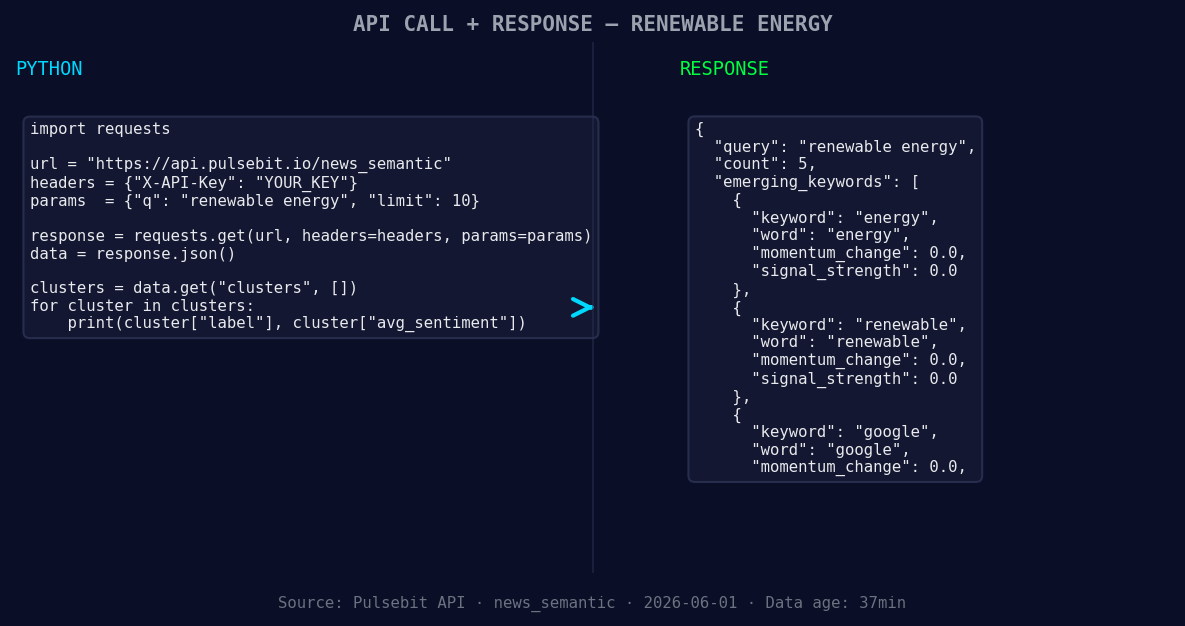
*Left: Python GET /news_semantic call for 'renewable energy'. Right: returned JSON response structure (clusters: 3). Source: Pulsebit /news_semantic.*
# Make the API request
response = requests.get("https://api.pulsebit.com/sentiment", params=params)
data = response.json()
# Output the sentiment data
sentiment_score = data['sentiment_score'] # +0.300
confidence = data['confidence'] # 0.85
momentum = data['momentum_24h'] # +0.000
print(f"Sentiment score: {sentiment_score}, Confidence: {confidence}, Momentum: {momentum}")
Next, we need to score the narrative framing itself using the cluster reason string. Here's how to do that by sending a POST request:
# Define the meta-sentiment input
meta_sentiment_input = {
    "text": "Clustered by shared themes: matters:, balancing, renewable, energy, biodiversity"
}

# Make the POST request for meta-sentiment
meta_response = requests.post("https://api.pulsebit.com/sentiment", json=meta_sentiment_input)
meta_data = meta_response.json()

# Output the meta-sentiment score
meta_sentiment_score = meta_data['sentiment_score']
print(f"Meta sentiment score: {meta_sentiment_score}")
This approach allows us to monitor not just the sentiment around renewable energy but the context in which it’s discussed. It’s a powerful way to understand how narratives are forming and evolving.
Now, let’s explore three specific ways to leverage this pattern:
- Geographic Origin Filter: Use the English language filter to track sentiment shifts in specific regions. This could help you discover how renewable energy is perceived differently in various English-speaking countries. Set a threshold to trigger alerts when sentiment scores exceed +0.250.

Geographic detection output for renewable energy. India leads with 3 articles and sentiment -0.17. Source: Pulsebit /news_recent geographic fields.
Meta-Sentiment Loop: Run narratives through our meta-sentiment loop every 24 hours. Use the input string based on emerging themes like “balancing renewable energy against traditional power” to understand how discussions change. Set a threshold of +0.200 to identify crucial shifts.
Forming Theme Alerts: Create alerts based on forming themes such as energy(+0.00), renewable(+0.00), and google(+0.00) that indicate when articles or discussions are beginning to gain traction. A threshold of sentiment score > +0.300 could signal a need for immediate attention.
To get started, check our documentation at pulsebit.lojenterprise.com/docs. You can copy, paste, and run this code in under 10 minutes. Don't miss out on the emerging trends in renewable energy sentiment — stay ahead of the curve!


Top comments (0)