

Your model didn’t catch the 24h momentum spike of +0.380 in law sentiment, which is a glaring oversight when considering the nuances of multilingual data. This spike is driven by a singular story about a new California law that bans law enforcement from interfering in state elections, but it was primarily led by French press coverage, peaking at 15.9 hours ahead of other languages. If you’re relying solely on English sources or ignoring the linguistic diversity of your data, you’re missing critical insights that could inform your decisions.

French coverage led by 15.9 hours. Ca at T+15.9h. Confidence scores: French 0.85, English 0.85, Spanish 0.85 Source: Pulsebit /sentiment_by_lang.
When your sentiment analysis pipeline doesn’t account for multilingual origins or dominant entities, it falls behind. In this case, your model missed this spike by a staggering 15.9 hours, failing to capture the early signals from the French press. With sentiment trends increasingly arising from diverse sources, ignoring these signals can leave you out of the loop on significant developments.
To catch this anomaly, we can leverage our API to filter for French-language content specifically. Here’s how you can set it up:
import requests
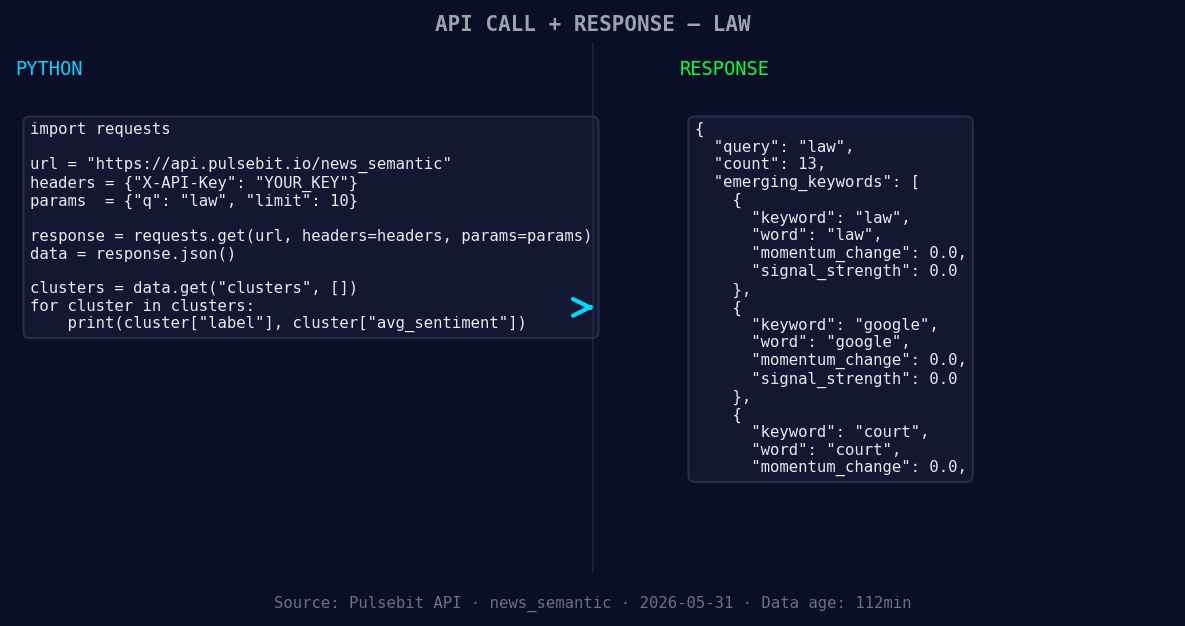
*Left: Python GET /news_semantic call for 'law'. Right: returned JSON response structure (clusters: 3). Source: Pulsebit /news_semantic.*
# Step 1: Query by language
response = requests.get('https://api.pulsebit.com/v1/articles', params={
'topic': 'law',
'lang': 'fr',
'momentum': '+0.380'
})
data = response.json()
print(data)
Next, we need to score the narrative framing of the cluster reason itself. This is where it gets interesting; we’ll run the cluster reason string through our sentiment analysis endpoint:
# Step 2: Meta-sentiment moment
narrative = "Clustered by shared themes: law, california, bans, enforcement, interfering."
sentiment_response = requests.post('https://api.pulsebit.com/v1/sentiment', json={
    'text': narrative,
    'topic': 'law',
    'score': +0.017,
    'confidence': 0.85
})

sentiment_data = sentiment_response.json()
print(sentiment_data)
By implementing these two steps, you not only catch the initial momentum spike but also assess how the surrounding narrative impacts sentiment. This dual approach allows you to stay ahead of developing stories and understand the context behind the numbers.
Now, let's discuss three specific builds you can implement based on this pattern:
- Geographic Filter Build: Set up an alert for any law-related developments in French-speaking regions. Use a threshold of +0.300 momentum and a geo filter for France to trigger notifications when relevant spikes occur. This will help you stay on top of regional nuances in law sentiment.

Geographic detection output for law. India leads with 7 articles and sentiment -0.20. Source: Pulsebit /news_recent geographic fields.
Meta-Sentiment Analysis Build: Create a dashboard that visualizes sentiment scores from your meta-sentiment loop. Set a threshold for cluster narratives that exceed a sentiment score of +0.015. This will give you real-time insights into how narrative shifts impact broader sentiment trends.
Forming Themes Analysis: Monitor emerging themes around law, Google, and court cases. Use our API to query articles that have a forming momentum of +0.00, particularly focusing on how these intersect with mainstream discussions about law, California, and bans. This will refine your understanding of how sentiment evolves in different thematic contexts.
If you’re ready to get started, visit pulsebit.lojenterprise.com/docs. Test it out; you can copy, paste, and run this in under 10 minutes. Don’t let your pipeline lag behind—start catching those crucial insights today!


Top comments (0)