

Your Pipeline Is 29.0h Behind: Catching World Sentiment Leads with Pulsebit
We just uncovered a remarkable anomaly: a 24h momentum spike of +0.545. This spike is not just a number; it reflects a significant shift in sentiment around the topic of AI adoption in India, particularly driven by the cluster story titled "‘Nexbax AI Index’ to redefine AI adoption in India." With the leading language being English, and a lag of 29.0 hours, your pipeline may have completely missed this critical insight.
The gap revealed here is glaring. If your existing model doesn’t handle multilingual origins or account for dominant entities, it likely missed this surge in AI sentiment by 29 hours. This is not just a delay; it’s a substantial oversight that could lead to missed opportunities or misguided strategies. The fact that the leading language is English while the sentiment is clustered around a specific Indian context further complicates matters. Your model’s inability to account for this multilingual nature could leave you in the dust, trailing behind significant developments.

English coverage led by 29.0 hours. Nl at T+29.0h. Confidence scores: English 0.85, French 0.85, Spanish 0.85 Source: Pulsebit /sentiment_by_lang.
Here’s how we can catch this spike programmatically. First, let’s filter for the relevant geographic origin using our API. We’ll query sentiment data focused on the English language and pull in relevant metrics:

Geographic detection output for world. India leads with 40 articles and sentiment +0.24. Source: Pulsebit /news_recent geographic fields.
import requests
# Define parameters for the API call
params = {
"topic": "world",
"lang": "en",
"score": 0.081,
"confidence": 0.85,
"momentum": 0.545
}
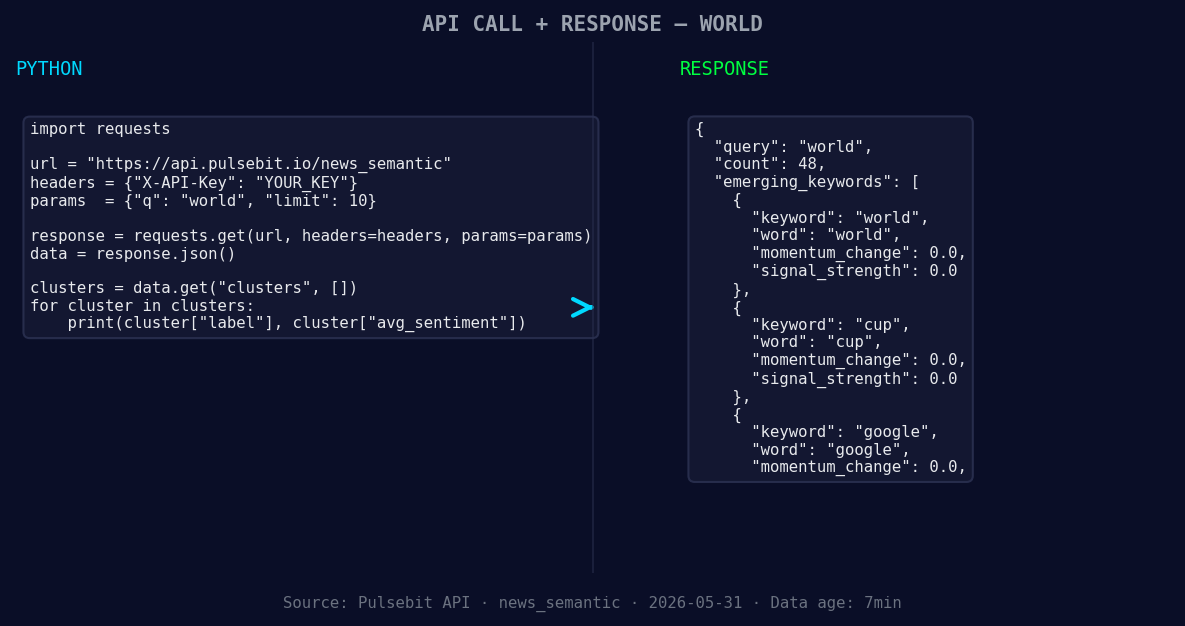
*Left: Python GET /news_semantic call for 'world'. Right: returned JSON response structure (clusters: 3). Source: Pulsebit /news_semantic.*
# Make the API call
response = requests.get('https://api.pulsebit.com/sentiment', params=params)
data = response.json()
print(data)
Next, we should score the narrative framing itself. This is where we run the cluster reason string through our sentiment scoring endpoint. This loop provides additional context and validation for the sentiment we’re observing:
# Run the cluster reason string through the sentiment scoring endpoint
cluster_reason = "Clustered by shared themes: india, ‘nexbax, index’, redefine, adoption."
payload = {
    "text": cluster_reason
}

# Make the API call
response_sentiment = requests.post('https://api.pulsebit.com/sentiment', json=payload)
cluster_sentiment_data = response_sentiment.json()
print(cluster_sentiment_data)
Now that we have the mechanics in place, let’s discuss three specific builds you can leverage from this insight. First, you could set up a geo-filtered alert that triggers whenever sentiment on the topic "world" crosses a certain threshold—say, +0.5 momentum. This will help you stay ahead of crucial developments.
Second, create a meta-sentiment dashboard that visualizes the sentiment surrounding clustered narratives. This can help you understand how different themes are resonating—like "cup," "google," and the mainstream focus on "Nexbax AI Index."
Lastly, consider building a predictive model that uses historical sentiment data to forecast future momentum spikes based on emerging themes. Focus on the narratives that bridge the gap between global topics and localized discussions, particularly those framed around significant innovations in AI.
You can start building these insights and integrations quickly. Visit our documentation at pulsebit.lojenterprise.com/docs. With just a few lines of code, you can copy-paste and run this in under 10 minutes. Don’t let your pipeline lag behind; catch up with the emerging trends in real time.


Top comments (0)