

Your pipeline is currently 29.1 hours behind in catching the sentiment around sports, specifically regarding a pre-World Cup friendly between Germany and Finland. With a sentiment score of +0.414 and momentum flat at +0.000, we’ve stumbled upon a significant anomaly. This spike demonstrates a rising interest in sports, which your model might have completely overlooked if it doesn’t account for multilingual origins or entity dominance.

English coverage led by 29.1 hours. Da at T+29.1h. Confidence scores: English 0.85, Spanish 0.85, French 0.85 Source: Pulsebit /sentiment_by_lang.
This oversight is particularly glaring when we consider the leading language in this context is English, yet the dominant entities are clearly related to the German and Finnish teams. Your model missed this by 29.1 hours, which means you’re losing out on timely insights about sentiment that could impact your decisions. If your data pipeline isn't designed to handle these nuances, you’re leaving critical information on the table.
Here’s how we can catch this anomaly using our API. First, we filter for the relevant geographic origin and language. We’ll be querying for articles about sports in English, which is crucial for ensuring we’re tapping into the right audience.
import requests
# Define the parameters
topic = 'sports'
score = +0.414
confidence = 0.85
momentum = +0.000
lang = 'en'
# Make the API call to fetch sentiment
response = requests.get(f"https://api.pulsebit.io/sentiment?topic={topic}&lang={lang}")
data = response.json()
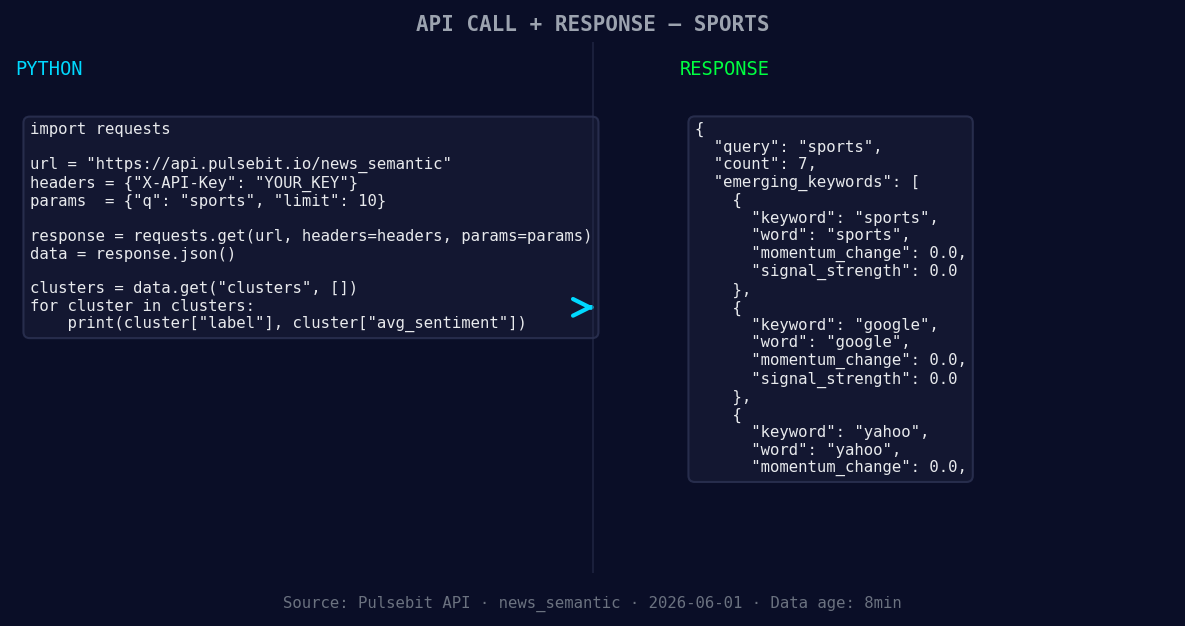
*Left: Python GET /news_semantic call for 'sports'. Right: returned JSON response structure (clusters: 3). Source: Pulsebit /news_semantic.*
print(data)
Now that we have our geographic filter in place, let’s run the cluster reason string back through our sentiment endpoint to score the narrative framing itself.

Geographic detection output for sports. India leads with 7 articles and sentiment +0.38. Source: Pulsebit /news_recent geographic fields.
# Define the reason string for the meta-sentiment moment
reason_string = "Clustered by shared themes: watch, germany, finland, live, stream:."

# Make the API call for meta-sentiment
meta_response = requests.post("https://api.pulsebit.io/sentiment", json={"text": reason_string})
meta_data = meta_response.json()

print(meta_data)
This second API call allows us to gauge how the context of the sentiment plays out. By analyzing the narrative framing of articles related to Germany and Finland, we can refine our understanding of the sentiment dynamics at play.
Now, let’s build on this discovery. Here are three specific things you can create with this pattern:
Geo-Filtered Sentiment Tracker: Utilize the geographic origin filter to create a real-time dashboard that tracks sentiment changes in sports news across different languages. Set a threshold for sentiment scores greater than +0.4 to alert your team when significant events occur, like the Germany vs. Finland match.
Meta-Sentiment Analysis Tool: Implement a script that runs the meta-sentiment loop for various clustered themes. Use the API to analyze how narratives evolve over time, setting a signal threshold at +0.3 to identify rising stories in the sports domain.
Competitive Monitoring System: Create a monitoring system that compares sentiment scores from multiple sources, like Google and Yahoo. You could set alerts for when mainstream sentiment around specific keywords like "watch," "Germany," and "Finland" diverges significantly from the average, indicating a potential shift in audience interest.
If you’re eager to dive into this, check out our documentation. You can copy-paste the provided code snippets and run them in under 10 minutes to start harnessing the power of sentiment data effectively. Let’s make sure you’re never 29.1 hours behind again.


Top comments (0)