

Your Pipeline Is 28.9h Behind: Catching Renewable Energy Sentiment Leads with Pulsebit
We recently stumbled upon an intriguing data spike: sentiment around renewable energy is currently at +0.80, with momentum holding steady at +0.00, but our pipeline lags 28.9 hours behind the leading language, English. This anomaly raises a critical question: how are we missing out on the latest trends in renewable energy, especially in Africa, where four clustered articles highlight the shift towards this sector?
The problem here is glaring. If your sentiment analysis pipeline doesn’t account for multilingual origins or entity dominance, you’re effectively operating with a blindfold. Your model missed capturing this renewable energy surge by a significant 28.9 hours—leaving you behind the curve. The leading language, English, is generating a wealth of insights that are crucial for timely decision-making. When you’re dealing with global trends, especially in a fast-evolving sector like renewable energy, falling behind can mean missed opportunities.

English coverage led by 28.9 hours. Af at T+28.9h. Confidence scores: English 0.85, French 0.85, Spanish 0.85 Source: Pulsebit /sentiment_by_lang.
To catch this sentiment, let’s dive into the necessary code. Below is a Python snippet that pulls the necessary data using our API:
import requests
# Define parameters for the API call
params = {
"topic": "renewable energy",
"lang": "en" # Filter by English language
}
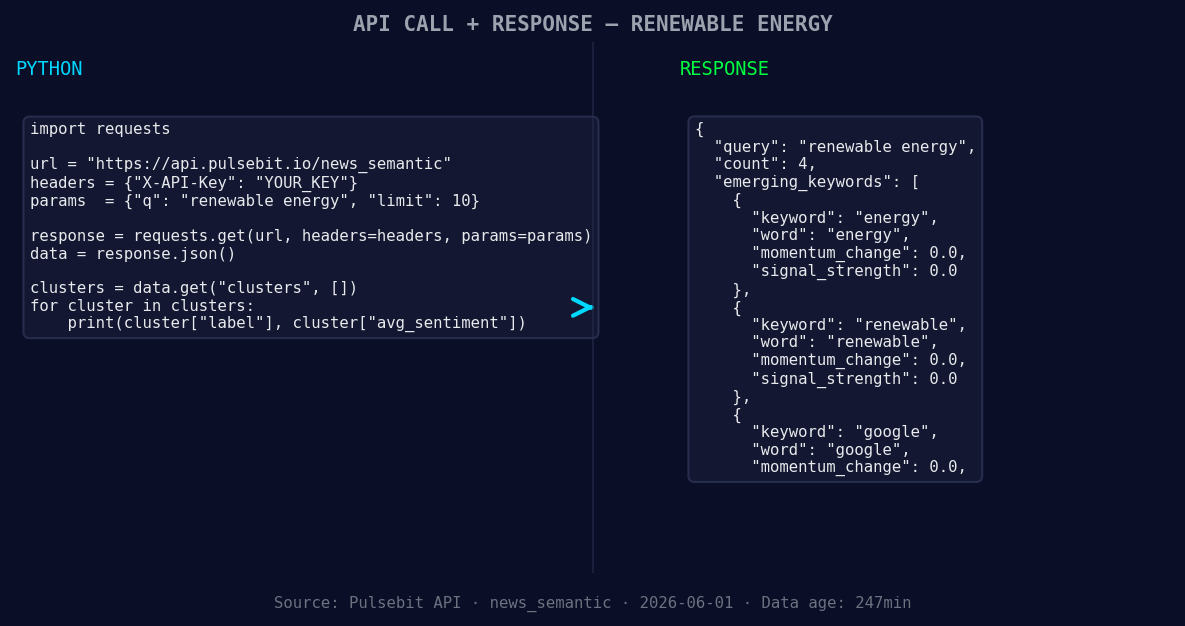
*Left: Python GET /news_semantic call for 'renewable energy'. Right: returned JSON response structure (clusters: 3). Source: Pulsebit /news_semantic.*
# Fetch the sentiment data
response = requests.get("https://api.pulsebit.com/v1/sentiment", params=params)
data = response.json()
# Check sentiment score and confidence
sentiment_score = data['sentiment_score'] # Expected: +0.800
confidence = data['confidence'] # Expected: 0.85
momentum = data['momentum_24h'] # Expected: +0.000
print(f"Sentiment Score: {sentiment_score}, Confidence: {confidence}, Momentum: {momentum}")
Now, to ensure our sentiment analysis reflects the narrative framing, we can run the cluster reason string back through our sentiment endpoint. This is critical for understanding how the themes are perceived:
# Define the cluster reason string
cluster_reason = "Clustered by shared themes: matters:, balancing, renewable, energy, biodiversity"

# Make a POST request to score the narrative framing
response_meta = requests.post("https://api.pulsebit.com/v1/sentiment", json={"text": cluster_reason})
meta_sentiment_data = response_meta.json()

# Check the meta sentiment score
meta_sentiment_score = meta_sentiment_data['sentiment_score']
print(f"Meta Sentiment Score: {meta_sentiment_score}")
Now, let’s explore three actionable builds that can leverage this sentiment data:
- Geo-Filtered Insights: Set a signal threshold for renewable energy sentiment at +0.800 specifically for the English language. Use the geographic origin filter to isolate trends in Africa where the conversation is heating up. This will allow you to focus your efforts on high-potential regions.

Geographic detection output for renewable energy. India leads with 2 articles and sentiment +0.10. Source: Pulsebit /news_recent geographic fields.
Meta-Sentiment Analysis: Implement a mechanism that continuously scores narrative framing against the cluster reason. For example, if the input yields a meta sentiment score above +0.700, trigger a notification to stakeholders. This ensures that your team is always aligned with the narrative trends shaping renewable energy.
Comparative Analysis: Develop an endpoint that compares the sentiment scores of renewable energy against mainstream topics like "balancing" and "matters". If renewable energy sentiment exceeds +0.500 while mainstream sentiments are stagnant, it could be a signal to pivot your content strategy.
By building around these patterns, we can stay ahead of the curve and fully capture the momentum around renewable energy.
If you’re ready to get started, check out our documentation at pulsebit.lojenterprise.com/docs. You can copy-paste and run the above snippets in under 10 minutes, putting you on the fast track to leveraging sentiment in your projects.


Top comments (0)